

🔴 Website 👉 https://u-s-news.com/
Telegram 👉 https://t.me/usnewscom_channel
“Pull yourself up by your bootstraps.” It’s a common phrase in American political discourse, particularly present in conservative rhetoric about self-reliance.
The concept is simple: To pull yourself up by your bootstraps means to succeed or elevate yourself without any outside help.
But when you examine this expression and its current meaning, it doesn’t seem to make much sense.
To pull yourself up by your bootstraps is actually physically impossible. In fact, the original meaning of the phrase was more along the lines of “to try to do something completely absurd.”
Etymologist Barry Popik and linguist and lexicographer Ben Zimmer have cited an American newspaper snippet from Sept. 30, 1834 as the earliest published reference to lifting oneself up by one’s bootstraps. A month earlier, a man named Nimrod Murphree announced in the Nashville Banner that he had “discovered perpetual motion.” The Mobile Advertiser picked up this tidbit and published it with a snarky response ridiculing his claim: “Probably Mr. Murphree has succeeded in handing himself over the Cumberland river, or a barn yard fence, by the straps of his boots.”
“Bootstraps were a typical feature of boots that you could pull on in the act of putting your boots on, but of course bootstraps wouldn’t actually help you pull yourself over anything,” Zimmer told HuffPost. “If you pulled on them, it would be physically impossible to get yourself over a fence. The original imagery was something very ludicrous, as opposed to what we mean by it today of being a self-made man.”
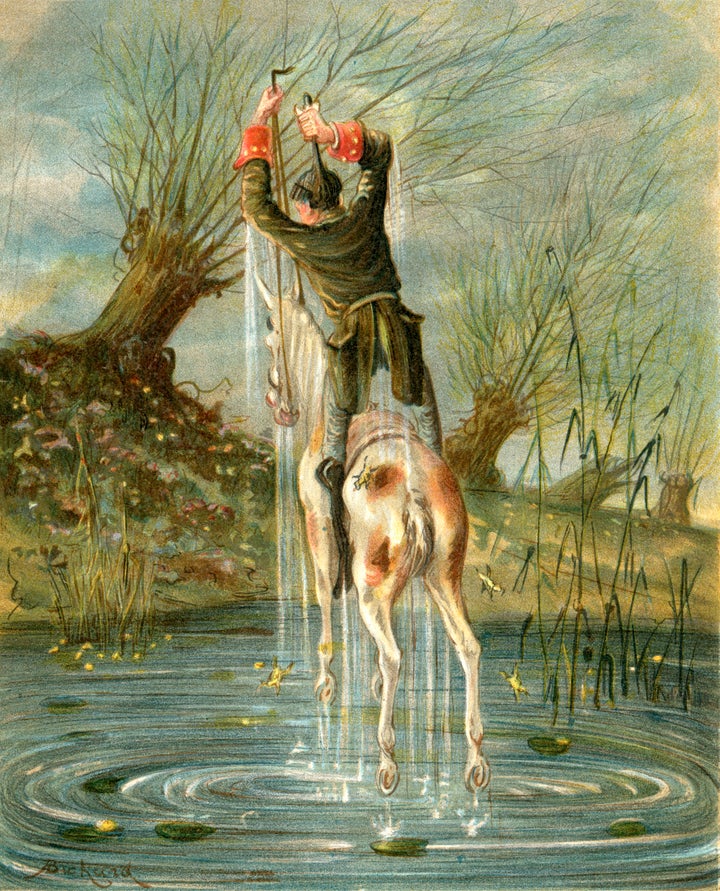
Zimmer, who is currently a columnist for The Wall Street Journal, first looked into the phrase in 2005 for an American Dialect Society newsletter. In his research, he came across claims that the expression dates back to the story of Baron Munchausen, a fictional 18th-century German nobleman who was famous for telling tall tales about his sensational achievements as a soldier and world traveler. In one such tale, he manages to launch himself up out of a swamp by pulling on his own hair.
Supposedly, an American version of the story has Baron Munchausen using his bootstraps to pull himself out, though Zimmer said he hasn’t been able to find any evidence of this.
Regardless of whether such a connection exists between the American expression and German story, the Baron Munchausen example helps to illustrate the original intention of “pull yourself up by your bootstraps.”
UniversalImagesGroup via Getty Images
Beyond the Murphree example, versions of the phrase appeared in many published texts to describe something ridiculous. Popik has documented several of these examples on his blog.
“Though not so palpably absurd, it is still of the same character as the efforts of the man who should essay to lift himself by the straps of his boots,” reads a line from The North American Review from 1867.
“When steam was turned on the pressure in both ends of the cylinder was perfectly balanced through this connection and the piston could not move any more than a man can lift himself by his bootstraps,” notes another example from an issue of Popular Mechanics published in 1908.
So when did “pull yourself up by your bootstraps” change from something ludicrous to something attainable? The shift appears to have occurred around the early 20th century.
The Oxford English Dictionary cites James Joyce’s Ulysses (1922) as its earliest example of the phrase, and it appears to illustrate the contemporary meaning: “There were … others who had forced their way to the top from the lowest rung by the aid of their bootstraps.”
A 1931 volume of Pattern Makers’ Journal notes, “Pull yourself up by the bootstraps; shake off your cloak of indifference and voluntary serfdom.” And in 1927, Britain’s Sunday Times published an editorial ridiculing the headstrong American belief in self-improvement as exemplified by “the American bootstrapper.”
It’s unclear why the understanding of “pull yourself up by the bootstraps” shifted from absurd to accessible.
“It’s hard to explain why the meaning of an expression changes over time. Sometimes things start off as having a kind of ironic or humorous edge to them, but that gets forgotten along the way,” Zimmer explained. “People have been referring to bootstraps in this metaphorical way for so long, the original irony of the expression was lost. Nobody’s thinking of the impossible image of pulling themselves over a fence.”
“Maybe that says something about Americans and how they view themselves,” he added. “That something that seems utterly ludicrous and impossible becomes a regular idiom for improving yourself.”
Today, “pull yourself up by your bootstraps” appears in political speeches, criticism, scientific studies and even pep talks. The related term “bootstrapping” has taken on a number of meanings in contexts ranging from technology to statistics to entrepreneurship to law.
jackaldu via Getty Images

While it’s certainly interesting to look back on the shifting meaning of the phrase, does this apparent contradiction actually matter? Not really, according to Grant Barrett, a lexicographer and co-host of the public radio show, “A Way with Words.” After all, idioms simply mean what they mean.
“The saying does its new job as well as it did its old job,” said Barrett. “There’s something called the ‘etymological fallacy,’ which is when people incorrectly believe that the original or older meaning of a word or expression is the more correct one. It just isn’t the case: Lexical items often change their meanings; they often have more than one meaning. Those meanings often co-exist, and we learn to manage those possible conflicts through context, clarification, and restatement, which are normal parts of human language.”
By this logic, the modern use of “pull yourself up by your bootstraps” is just as valid as the early version. Barrett noted that the English language is full of hyperbolic and figurative expressions that should not be interpreted literally.
“‘She busted her ass meeting the deadline,’ for example. Her ass did not break,” he noted. “‘My boss’s head exploded when he saw our sales numbers.’ His head is intact. ‘Juanita has a bug up her butt about getting the report’s margins to line up.’ There are no insects in her derrière.”
Still, for those who disagree with the bootstraps notion of pure self-reliance as a universally attainable goal, the whole phrase feels somewhat ironic.
Writer John Swansburg touched on the contrast between the early, literal meaning of “pull yourself up by your bootstraps” and its current figurative sense in a piece called “The Self-Made Man,” which examined “America’s most pliable, pernicious, irrepressible myth.”
“The very language we use to describe the self-made ideal has these fault lines embedded within it: To ‘pull yourself up by your bootstraps’ is to succeed by dint of your own efforts. But that’s a modern corruption of the phrase’s original meaning. It used to describe a quixotic attempt to achieve an impossibility, not a feat of self-reliance. You can’t pull yourself up by your bootstraps, anymore than you can by your shoelaces. (Try it.) The phrase’s first known usage comes from a sarcastic 1834 account of a crackpot inventor’s attempt to build a perpetual motion machine.”
“He thought it was perfect that this is all kind of founded on an expression that’s literally impossible,” said Zimmer, who consulted with Swansburg for the piece. “It’s part of this rags-to-riches, Horatio Alger view ― a kind of American idea that you can always better yourself, usually financially but also spiritually when you look at the self-help movement. Other people might find the idea ludicrous in the way that British people reviewing American bootstrappers in the 1920s did.”
Ultimately, Zimmer offered a similar conclusion to Barrett’s, noting that the English language is full of idioms that don’t appear to make literal sense. “Looking for logic in language is a fool’s errand,” he said.
Indeed, it might just be as foolish as … trying to pull yourself up by your bootstraps.
The original version of this story was published on HuffPost at an earlier date.