
🔴 Website 👉 https://u-s-news.com/
Telegram 👉 https://t.me/usnewscom_channel
As children’s vaccination rates drop across the United States, rarely discussed diseases are becoming more common. This includes whooping cough, a highly-contagious illness that is largely preventable through vaccination.
“We’re now seeing tens of thousands of cases in the U.S. each year, including multiple deaths this year,” said Dr. Caitlin Li, an infectious diseases specialist at Ann & Robert H. Lurie Children’s Hospital of Chicago.
Three unvaccinated infants in Kentucky have died of whooping cough this year, with many more children and adults infected throughout the country. The U.S., as a whole, is on a bad trajectory. There were 6,600 cases of whooping cough in January through March of this year. This is four times more than the same time period last year.
“These numbers are higher than what we were seeing before the COVID-19 pandemic — we saw a dip during the COVID-19 pandemic, when there was so much rigorous masking happening, but those numbers have now come back up and are even higher than they were pre-pandemic,” said Li.
The illness is very contagious and can be deadly. Here’s what to know and how to protect your loved ones:
Whooping cough is highly contagious and most severe in infants.
Whooping cough, which is also known as pertussis, is “a bacterial infection that affects the back of the throat, down into the airway and causes really severe inflammation of the airway, and that inflammation results with symptoms such as cough,” said Dr. Ross Newman, a pediatrician based in Oregon and a medical communicator on social media.
The cough often lasts for weeks or months, according to Newman. It spreads through respiratory droplets when someone coughs, sneezes or even talks near you.
At first, the illness looks a lot like a regular cold, “but it is highly contagious during that time,” said Dr. Melanie Wellington, a clinical professor of pediatric infectious diseases at the University of Iowa Health Care.
“Then, about a week or two weeks into the illness, the cough changes, and it gets worse and worse and worse,” Wellington added. “And the whooping cough name comes from the fact that the cough is so bad that people often will have these coughing fits,” ending with a whooping sound to catch their breath, Wellington said.
This tends to be the case in older kids and adults, but it can cause more severe symptoms in immunocompromised folks and especially infants.
“When really young children ― like infants under 1 year of age ― get it, it has a tendency to cause them to go apneic. Apneic means you stop breathing, and that’s obviously supremely dangerous,” Newman said.
The repeated coughing can also cause patients to pull muscles and break ribs, Newman added. “Sometimes, especially small infants, they need to be intubated so we can control their lungs… it can be very scary, especially for our little ones,” he said.
“This huge surge that you’re seeing right now is almost completely related to decreased vaccination rate.”
– Dr. Melanie Wellington
Dropping vaccination rates are the reason behind this year’s surge.
“Because of both political and social media influences, we’re seeing vaccination rates drop across the board for all diseases,” Newman said.
Vaccination rates are down among kindergartners throughout the country. This includes the vaccine for whooping cough, which is known as the diphtheria, tetanus and pertussis (DTaP) vaccine. Overall DTaP vaccination rates dropped from 92.3% to 92.1% from 2024 to 2025, with states such as Idaho reporting a 78.3% vaccination rate.
Diseases that didn’t achieve a necessary level of elimination (such as whooping cough and measles) have been lingering beneath the service and causing outbreaks, Newman said.
“As vaccination rates fall, disease rates rise,” Wellington explained. “And so this huge surge that you’re seeing right now is almost completely related to decreased vaccination rate.”
In addition to lower vaccination rates, the formulation of the vaccine also changed.
“The current pertussis vaccines that we use now have fewer side effects than the ones we used in the ’90s and before, but the immunity from them doesn’t last as long as the older vaccines did,” Li said.
Vaccinated people can, in rare cases, carry whooping cough and have no symptoms or have mild symptoms, Newman explained.
“Critics will say, ‘Well, if you can still get malformed disease and still pass it on, then why vaccinate?’ But the more people you vaccinate … even if one person ends up getting a mild form of the disease or carrying it, if the next person is vaccinated, they’re less likely to be a carrier, and so on and so forth,” Newman said.
This bolsters protection in the community, which then protects the most vulnerable, such as infants and immunocompromised people, he added.
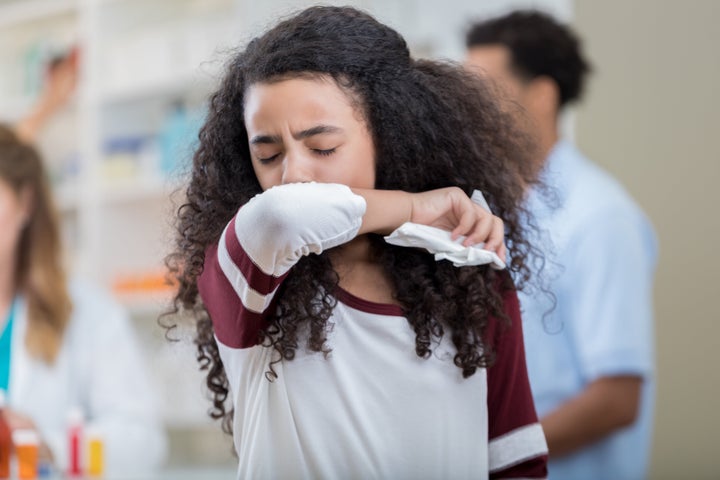
SDI Productions via Getty Images


Vaccination is the best way to protect yourself, your family and your community, and you need to get it multiple times throughout your life to stay protected.
Since immunity wanes from the vaccine, it’s not a one-and-done kind of shot; it requires a booster during multiple points of your life.
“It’s recommended that all adults who are 18 and over get a Tdap [shot] … if you haven’t had one as an adult,” said Wellington. “And then get a booster probably every 10 years.” (DTaP is the vaccination for infants and young children, and Tdap is the vaccination for older children and adults.)
It’s also recommended that pregnant people get a Tdap booster during every pregnancy, said Li. “That Tdap booster is the most important thing you can do to protect babies who are at highest risk of dying from pertussis — because the babies who are at highest risk are too young to be vaccinated themselves.”
If a pregnant person gets vaccinated, they then pass the antibodies on to the baby, according to Li. It’s also recommended that those who are going to be around an infant, say a grandchild, niece or godchild, get a Tdap booster.
Babies get their first shot that protects against pertussis at 2 months old, but they don’t get great protection until their second or third dose, so not until they’re 6 months or 1 year old, said Wellington.
There are additional steps you can take for protection, too.
With whooping cough being so prevalent right now, it’s important for vaccinated people to understand they can still get mild forms of the disease. If you notice a cough or any upper respiratory illness symptoms, stay home, Wellington stressed. That’s true whether you have a cold or something more severe.
“If you absolutely can’t stay home, because we all have times when there’s no options, [or] if you have to go out into public when you’re sick, wear a mask,” Wellington added.
If you have any symptoms of whooping cough (or any illness), also stay away from infants. If you suspect you have whooping cough, or your child does, talk to your doctor or pediatrician immediately. Monitoring may be necessary for infants, and there are also treatments available, Wellington noted.
If you’ve been around someone with whooping cough, you should also let your doctor know. “We also give antibiotics to somebody who’s been exposed to pertussis and doesn’t have it yet,” Wellington explained.
It’s best to avoid whooping cough, if possible, which is best done through vaccination, according to Newman. The more people who are vaccinated means the less spread of the bacteria, which means healthier people and safer communities.