

🔴 Website 👉 https://u-s-news.com/
Telegram 👉 https://t.me/usnewscom_channel
I did not plan to give birth under fluorescent lights. I did not plan to give birth numb from the chest down, or with a blue sheet between me and the lower half of my body, or to hear the words “uterine incision” spoken as casually as small talk about the weather. I had planned to bring my son into the world in water, surrounded by cedar and drumming and the steady hands of the women who had walked with me through pregnancy. I planned to roar him out, to stand on the edge of pain and power — to remember myself as an animal.
Instead, after 50 hours of labor, I found myself asking a surgeon if she would allow me to smudge her before cutting me open.
There is a particular kind of whiplash that comes from holding a ceremony in a house filled with song and steam and then waking up inside a building designed for efficiency. Hospitals are engineered to save lives, not to hold stories. They are full of machines that measure what is measurable. My people come from practices that tend what cannot be measured — breath, relationality, spirit, the unseen threads that tie us to the world. I grew up knowing these ways were not designed into the walls that surround most American births. They have survived in the bodies of those who still carry them.
Still, nothing prepared me for the moment when my midwife said softly, “It’s time.”
By then, my body had already traveled somewhere beyond language. I had labored for so long in the birthing tub — 12 hours of contractions cresting over me like tidal waves — that I had lost track of where my skin ended. At one point, I felt my soul slide out of my body and stretch toward my son. My husband sat behind me whispering to every version of me that existed: the earthly one, the higher one, the terrified one, the ancestor-held one. Our doula sang to me and then sang to the baby, and something cracked open so violently that both my husband and I wept. It felt like a doorway to the old world had opened in our living room.
But doorways close. Cervixes swell. Bodies get tired. Babies don’t descend. Even the most ancestral ways have limits, and mine hit the edge of what my body could endure.
So I showered. I dressed. I gathered the arrowhead I had packed months before, a spiral stone I chose for grounding, and the small bundle of cedar that had floated beside me in the tub like an ally. My husband drove me to the hospital through the dark streets, and the whole time I tried not to feel the enormity of what we were doing: leaving ceremony for science, leaving home for a room built by people who did not imagine someone like me — Hopi, Purépecha, Indigenous, resistant — walking in with smoke and prayer.
At the hospital, the doctor sat with us for half an hour, listening to the full story of my labor with the attention of someone who understood the difference between a chart and a life. She was calm. Precise. Respectful. She asked what mattered to us. She didn’t flinch when I said that ceremony was part of my birth plan. Science and spirit, she seemed to say with her posture, do not need to be in opposition; they can be two hands working toward the same outcome.
For a moment, it almost felt possible.
But then night fell inside the room. My contractions slowed. My temperature rose. The baby’s heart rate dipped after each wave. I could feel the window narrowing. When she came back to us after reviewing the monitors, her tone had shifted. She didn’t force us, but the subtext was clear: It’s time to get your baby out. It’s time to go to surgery.
And that was when something unexpected rose in me — the same old survival instinct that has carried my people through centuries of medical violence and erasure. I felt the weight of every Native woman who labored without consent, every one who was sterilized without permission, every one who was told her ways were backward and her body was a problem to be solved. My body knew that history even before my mouth could form words.
So I told her: “I need to smudge you.”
I didn’t say it to be dramatic. I didn’t say it as a performance of faith. I said it because if someone was going to cut into me while I was paralyzed from the breasts down, I needed to feel the presence of my people in the room. I needed to know that the incision wouldn’t sever me from the ceremony that had held me through the night. I needed to bring my ancestors with me, because I knew the operating room wasn’t built to hold them.
She didn’t hesitate. “I would be honored,” she said.
What had felt like a loss, of my birth plan, of control, of the story I wanted, became an offering. It was a way to say, even here, in this place where science reigns, my people will not be erased.
We couldn’t smudge the entire surgical team — there are limits even the most generous doctor cannot bend — but she allowed me, my husband, and my doula to move slowly through the small pre-op room, lighting the bundle, letting the smoke rise over our heads. I smudged my own trembling hands. I smudged my husband. Then I smudged the woman who would cut into me, watching the smoke thread through the blue of her scrubs, watching her bow her head slightly as if entering sacred ground.
You cannot measure the effect of ceremony the way you can measure blood pressure. But something shifted in the room. The stakes softened. Fear loosened its grip. What had felt like a loss, of my birth plan, of control, of the story I wanted, became an offering. It was a way to say, even here, in this place where science reigns, my people will not be erased.

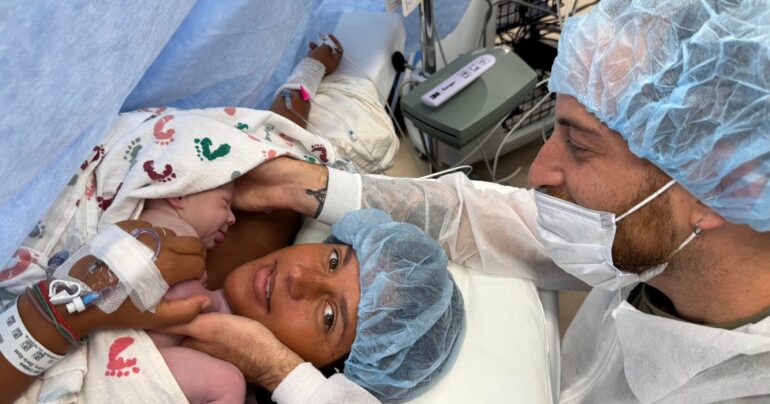
The lights in the OR were so bright I could feel them in my teeth. My whole body shook uncontrollably from the anesthesia. When my husband walked in, I looked at him with the wildness of someone holding two worlds at once: the world of medicine that was about to save me, and the world of memory that had carried me this far.
I held the spiral stone in my left hand. I listened as she narrated each cut. First layer. Second layer. Uterus. The words felt like tectonic plates shifting beneath me. And then, after a pressure so deep it felt like being pulled back into my body from a great distance, I heard it: my son’s cry.
They lowered the sheet so I could see him. His body was gray and wriggling, a newborn animal pulled from the ocean of my belly. My husband held him against my neck while they stitched me up, and I felt an almost disorienting gratitude. We had crossed every threshold: water to tub, tub to floor, floor to shower, shower to car, car to hospital, ceremony to scalpel. And still, my son entered to the sound of the song we chose, “The Waves We Give,” playing through a small speaker in the corner of the most sterile room we had ever been in.
Ceremony had followed us in.
People talk about C-sections with shame, or silence, or the quiet resentment of thwarted plans. I have felt pieces of that. But none of those words can hold the truth of what it meant to smudge my surgeon before she cut me open. None of them capture what it means for an Indigenous woman to walk into the most clinical space of her life and insist that her ancestors be present. None of them speak to the sovereignty inside that choice.
This wasn’t a failure of my body. It was a continuation of the ceremony that had already been guiding us. It was a moment where science and spirit didn’t compete — they converged. My surgeon saved my life and my baby’s life. The smoke saved my spirit. Both were necessary.
My son is here because of that convergence. Because I trusted the water and the cedar and the midwives. Because I trusted the doctor and the incision and the fluorescent lights. Because I held both worlds and refused to surrender either.
I didn’t plan to give birth in an operating room. But when I look back at the moment I lifted the smoldering bundle toward the woman who would bring my son safely into the world, I understand something I didn’t know then:
Ceremony doesn’t require the right setting. It only requires that we carry it with us. And I did.