
🔴 Website 👉 https://u-s-news.com/
Telegram 👉 https://t.me/usnewscom_channel
“Isn’t it amazing how old trauma like this can still present itself all these years later?” Jade said as she tapped hair-thin needles into pressure points along my shoulder blades.
What does she mean, old trauma? I didn’t ask about that.
At 38, a neurologist told me I have degenerative disc disease in my cervical spine that is so bad it looked like I spent years wrangling a jackhammer on a construction site. As a suburban mom and college professor, what could I have possibly done in life to contribute to this condition? Carry a growing baby in the björn and a toddler on my hip as I ran in and out of Target? Lug my entire office in a tote bag from class to class across campus? It has never been clear. So it made sense that the acupuncturist assumed all of my neck pain radiated from the bulging discs.
What I brought up with Jade, though, was my tumor site.
“When I was in college,” I told her, “I had a malignant tumor removed from the base of my skull.”
“I had no idea,” Jade said with surprise. “Did you have physical therapy?”
“No, I didn’t. It was so long ago, and I was so young,” I explained. “The surgeon removed a chunk of my scalp and it wasn’t until 10 years later that I realized he had actually removed part of my occipital bone, too.”
She stood close behind me, giving me time and space to put two and two together.
“Is it possible that I have simultaneous issues causing my pain and discomfort?” I asked. “Could my decades-old surgery have anything to do with the chronic throbs I always feel on both sides of my neck?”
Jade sat me at the edge of the table and turned my head right, then down, then left as she ran the tip of her pointer finger along each side of my hanging head.
“May I see the scar?”
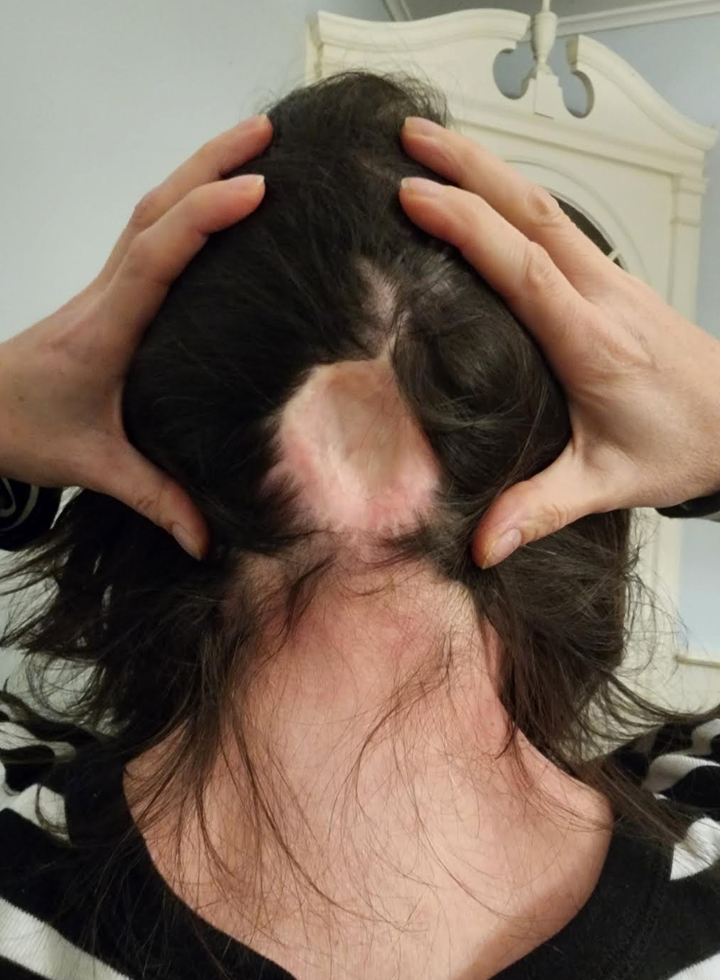
Blood rushed into my cheeks. I fumbled for an answer to her unexpected question. Hearing no audible objection from me, Jade tenderly parted my hair. Her thumbs pushed inside the lime-sized hole in my head, precisely tracing the suboccipital muscles to see where they had reattached themselves after my surgery.
Courtesy of Jennifer Young
Who was the last person to ask to see my flawed scalp? I shifted on the table. It was probably my surgical oncologist. Who even knows that skin graft is there? My family, of course, but who else? My hairdresser? She is probably the only one.
Engrossed by the sea foam color sunlit on the wavy glass of the window, I sat transfixed. The soft spa sounds of lapping waves and sea birds chirping circulated in the room as I half listened to Jade speak about the physical trauma to my head and neck and the surgical scar that has now been part of my body for more than half my life.
“It isn’t until we uncover old trauma like this and begin to treat it that we can truly heal,” she said.
While Jade was clearly referring to my physical body, her words synonymously triggered thoughts about something else too — the scars she can’t see on the inside. It has finally dawned on me that, even after continuously interacting with the world and understanding how it has shaped me, I never truly realized that surviving cancer as a young adult could still have an enormous impact on my life decades later.
Is it possible for people to not realize how much previous traumas affect them? According to the National Council for Mental Wellbeing, 70% of adults in the U.S. have experienced some type of traumatic event at least once in their lives. That’s 235.1 million people. Trauma, then, is more universal than we probably realize. And while some people do not remember traumatic or painful experiences from the past at all, many others work to understand the potential effects on their lives. But do these attempts to understand what they’ve been through automatically translate into true healing?
In spite of these efforts, emotions and thoughts we ignore or push down can still manifest physically, sometimes as tension, fatigue, or even illness. In other words, “your body expresses what your mind suppresses,” says Lauren Roxburgh, international body alignment expert and wellness educator dubbed The Body Whisperer. And while repressed memories may not be readily accessible, they can sometimes resurface later in life, often triggered by specific cues or situations.
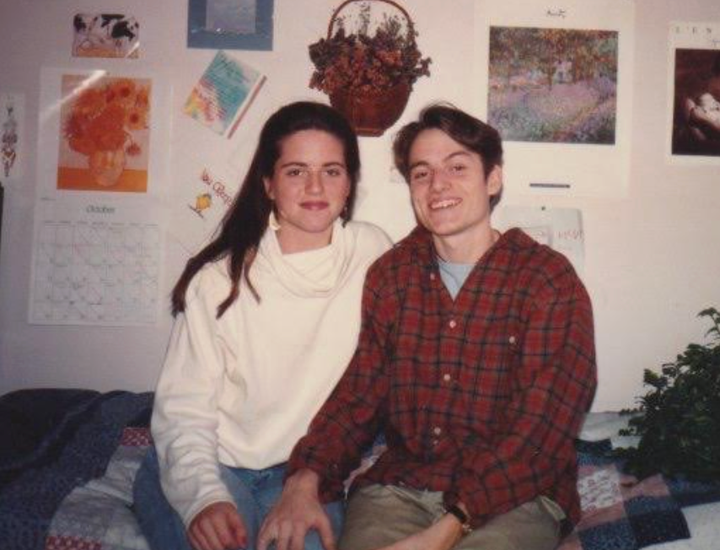
Sitting in my acupuncturist’s office, I was suddenly aware that I had been holding that broken girl deep inside of me for too long. I felt ready to reconnect with her, to write her back into my story. As the mother of four children around the same age as when I was diagnosed with cancer, I see pieces of her in them. Each of them are navigating all the challenges that come with new adulthood — finding your own identity, learning to navigate new and old relationships, and developing emotional and financial independence. All of that was happening for me back then, too. How did I manage a cancer diagnosis on top of everything else? How could the 19-year-old me have juggled those balls and not have expected one to drop?

Courtesy of Jennifer Young
A rush of memories released as Jade carefully pushed the slender points of filiform into the narrows of my neck. I thought back to my 19-year-old self and realized she and I still have a lot in common. She had to borrow wisps of hair from behind her ears to bobby pin over the bald spot on the back of her head every time she twisted up her hair. I still do that. She had to carefully cover the pockmarks on her shoulders from the vaccine shots with just-long-enough capped sleeves. I do that, too. She always yanked at her swimsuit to cover the square skin graft scar on her left butt cheek. Guess what? It still shows.
But how did it never occur to me until this moment that the emotional trauma I endured as a young adult was even bigger and brighter than every blemish on my body? And while I am grateful to now have nurturing practitioners to help ease my physical pain, I realized that every time I worked to cover up these imperfections so that no one can see them, I stashed those old painful feelings beneath metal hairpins and bathing suit bottoms at the same time.


Desperate to put as much space as possible between my trauma and the rest of my life, I thought I had to erase that chapter entirely. How would it feel if instead I paid closer attention to the cues my body has been giving me and worked to acknowledge that heartbreak from long ago?
Although today many people are better at recognizing the emotional and psychological impacts of trauma like cancer has, I believe there are many others like me who never gave themselves that grace. Psychiatrist and author Bessel Van Der Kolk, M.D., underscores this notion in his bestselling book “The Body Keeps the Score”: “… trauma almost invariably involves not being seen, not being mirrored, and not being taken into account.” Is releasing these trapped emotions the key to restoring balance and well-being?
Now, it seems like a no-brainer that missing bone from the back of my head was one likely cause of upper body pain for all of these years. But having my very own ah-ha moment in the least expected time and place is not lost on me, and what Jade has been saying gets through: A textbook understanding of trauma is not enough. True healing will only come if I accept every scar and allow each version of myself to be seen.
My physical wounds healed long ago, of course, but I now understand that scars — both physical and emotional — are stories our bodies carry, even when we’d prefer them to stay untold. Old traumas heal, it seems, not when we hide our scars, but when we finally let them speak.
Since that moment at my acupuncturist’s office, I’ve started unpacking this chapter more intentionally — reflecting on it, writing about it, and having honest conversations I used to avoid. It’s helped. I even worked up the courage to submit a survivor profile to a melanoma community on Instagram — including a photo that showed the scar on the back of my head.
I almost hit delete a dozen times! But I didn’t, and the multitude of likes and messages I received connected me to others whose lives had been touched by cancer — and, unexpectedly, it felt like that 19-year-old version of me was connected to them too.
Healing isn’t about going back; it’s about bringing every part of myself forward. And for the first time in a long time, that feels possible.


Courtesy of Jennifer Young
Jennifer Young, a long-term melanoma survivor, is currently working on a coming-of-age memoir about love, illness, and the decades-long journey to reclaim who she was. She’s written for Coping Magazine, Business Insider, and Elephants and Tea, among others. A writing professor, she teaches students how to find their voice on the page and serves as faculty adviser for the Oncology Society. She lives in New York with her husband, their four children, and a 100-pound Golden Retriever who thinks he still fits in their laps. Visit
jenniferyoung.net or follow her on Instagram @jennifer_young_writer for more.
Do you have a compelling personal story you’d like to see published on HuffPost? Find out what we’re looking for here and send us a pitch at pitch@huffpost.com.