

🔴 Website 👉 https://u-s-news.com/
Telegram 👉 https://t.me/usnewscom_channel
I stood before the screen gripping my lumbar, as the black-and-white X-rays stared back at me. I was 45 and I’d never gotten an X-ray — hardly been to a hospital except to be born and once for an extreme case of poison ivy.
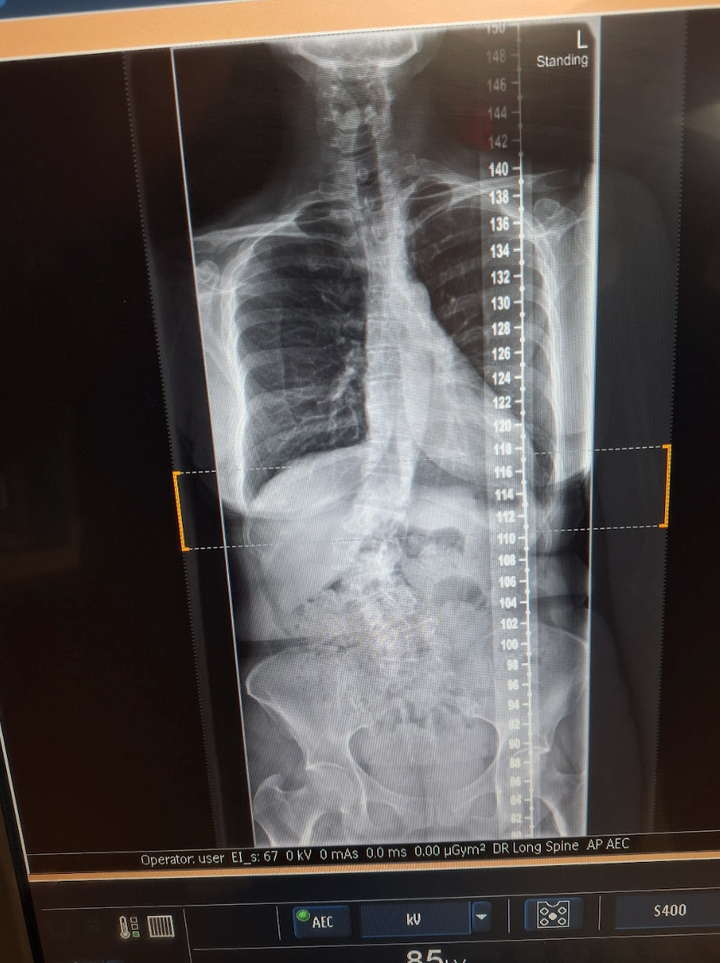
“That’s not me,” I protested, straightening my strained spine. I didn’t have anatomical terms for what I refused to see — the lower backbone bowed to the right in the shape of a capital C; the middle spine jogged to the left off-plumb; the shoulders and hips were cockeyed. “You got the X-rays mixed up.”
“Sorry, it is,” the doctor traced the curve with his finger. “Bordering on severe scoliosis.”
“But I just ran a 10-mile road race…” I winced, as fireworks exploded in my back, hips and legs. “Placed fourth in my age group, fastest time…”
“You telling me you never knew?” He frowned. “The condition manifests in childhood.”
Tears glossed my eyes, my fit middle-aged body crumpling in on itself, as a tiny seed of anger sprouted from a dark crevice. Where were my parents?
In a flash, I was back to 1976 and my family’s pristine split-level house — white painted brick, black shutters, lemon-yellow door. Around that time, when kids got checked in gym class for scoliosis with a simple forward bend test, our upwardly mobile nuclear family was melting down.
“You need to quit running,” said the doctor as he pressed his finger pads into my inflamed hump.
“What?” My throat constricted.
Courtesy of Anne Marina Pellicciotto
During the fall of seventh grade, as I entered junior high, my father had lost another Pentagon contract and my mother’s dizzy spells kept her holed up in the blue bedroom. As the determined eldest child, I set my alarm for the crack of dawn and tiptoed out before my father awoke.
When I joined the huddle of misfits on the blacktop — puffs of breath in the shivery morning air — I felt a small sense of victory. I’d escaped Dad’s inevitable wrath — the vindictive unpredictability of what I would much later discover was manic depression. Undiagnosed, he self-medicated with gin.
Heart pounding, lungs panting, by the time we completed our first loop, thoughts of home had receded and, for a miraculous moment, it was just my body moving in rhythm with the pack.
“Stop running, and see me back in a month.” The doctor handed me a prescription and walked out.
Within weeks, I was back on the running trail, pushing through the pain. That doctor didn’t know what he was talking about.
I’m 57 and running down a dirt road in Vermont — out for the daily endorphin fix. The scent of cow manure wafting in the breeze, arms and legs swinging in pendular rhythm, I was suddenly stopped in my tracks. My body was engulfed in flames of pain and I couldn’t take another step. I doubled over, sweat pouring off my head and my heart racing with panic.
That time, I landed in the emergency room. The attending nurse took my vitals. “Pain level?” she asked, glancing up from her iPad.
I shut my eyes, body screaming. The pain — stabbing, burning, shooting through my back, into my hips and down my prickly numbed-out legs — was exponentially worse than anything I’d ever felt. And it was everywhere.
“Seven… eight? Nine.” My voice sounded guttural.
My secret deformity was back — it had not disappeared. Perhaps it had worsened. And why not, after a decade defying doctor’s orders?
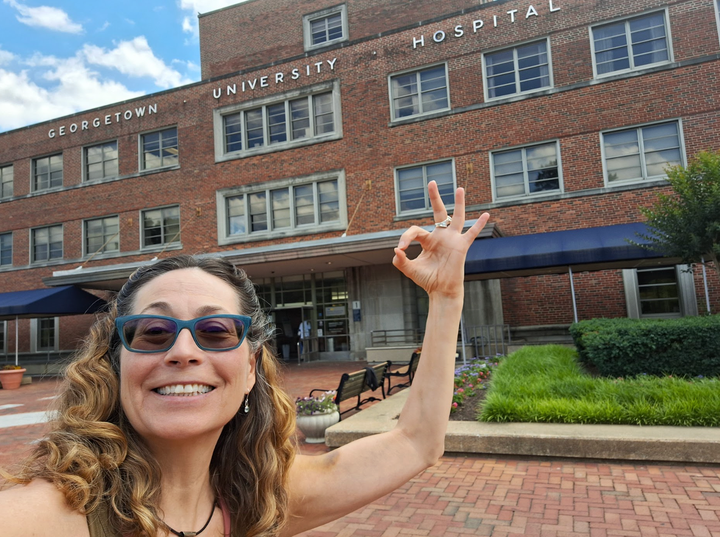
“See, here?” The spine surgeon pointed to the new set of X-rays. “Serious lumbar curve of 45 degrees, apex here at L4, then a 20-degree rotation at T2 and T3. That’s where you get your disk compression and nerve impingement causing neuropathy in the legs.”
“Neuropathy,” I murmured in a cortisol-infused daze. It was like seeing the snaking horror inside me for the very first time.
“I’m sorry to have to tell you: You’re a candidate for surgery. The sooner the better — to prevent the spine from sinking further with gravity and time and impinging on vital organs.”
“I won’t lie. It’s a big surgery. Six-to-12-month recovery. It’s easier when you’re younger. Late 50s? Lots of good years left.”
Gripping the exam table, I caught sight of a spinal model adorned with bolts and rods; the gleaming steel sent a shiver straight up my contorted spine.
“Will it stop the pain?” I bit my lips together, trapping sobs in my chest. “I’ve never… I don’t know who…”
Who would take care of me? Parentless, partnerless, childless, petless — over the years, I’d successfully escaped any and all confines. Now this surgeon wanted to immobilize me from the inside — in a steel cage.
He extended his hand to help me off the exam table. I didn’t want to let go. I wanted a savior so badly to make me all better — a magician to make this nightmare disappear.
Courtesy of Anne Marina Pellicciotto
The steroids the doctor prescribed were just a mask. When they wore off, weeks later, my broken body was back.
I couldn’t walk five steps without squatting to catch my breath; couldn’t carry a thing — backpack, bag of groceries, tiny purse, a feather. I could barely stand at the vanity for long enough to brush my teeth.
Through life’s roller-coaster ups and downs, my body had been one reliable constant. Cycling centuries, winning triathlons, running day in and out to keep my unruly chemicals in some kind of haphazard balance. Now I couldn’t even sit! Not a single seat in my house was tolerable. Sitting at my desk to get my work done? Impossible.
Confined to my bed to avoid the pain, I felt myself sink. Storm clouds of suicidal ideation hung over me. Desperate thoughts — well, it’s been a good life and maybe my time is up — that induced a hot-flash of terror which, thankfully, thrust me out of bed onto my yoga mat. Stretched out in child’s pose, I exhaled a sigh as tears gushed.
As a kid, and the top runner on my team, Coach said I made it look easy; but he’d been wrong. I didn’t love running — it hurt. Still, I went back day after day, year after year, because my body knew something I did not: the physical pain beat the emotional pain any day.
Little could I know the two were inextricably entwined. My body-mind was screaming at me to wake up and do something.
I couldn’t run from it any longer. The all-consuming pain impelled me to take a life-changing step. Two weeks later, for the first in my life, at 57 going on 58, I lay on a physical therapist’s table.
“Start here at the sacrum,” said Dr. Jen, kneading her fingers into the rigid triangle of bone at the base of my spine.
My eyes welled, less from outright pain and more from relief — the tenderness of being touched in that flawed, fragile place I didn’t want to acknowledge. All the MDs I’d seen never touched — just analyzed, diagnosed, prognosed, prescribed.
“And here’s your overworked convexity.”
As she pressed her palm against my hump, a well of sadness rose inside my cavity. Tears slid down my cheeks and out the massage table’s face hole.
“Can’t you see it protruding? Not sure why … how they never … caught this.”
My diaphragm contracted. Breath held in my chest. I was back, again, on the parental neglect riff.
Dr. Jen exhaled audibly. “So many ways parents go wrong.”
She paused, spreading her hands across my throbbing scapula. I’d awoken that morning with new pain — a knife stabbing the meat between my shoulder-blades — body rebelling against me.
“But the way I see it, they did you a favor. If they’d elected surgery — pretty crude back in the ’70s — you’d be up for re-surgery about now … if that first surgery even took in the first place. Other scenario: the dreaded brace. Success rate less than 3%, because no kid can withstand being encased 23 hours a day.”
I nodded, certain I could not have, as snapshot images appeared behind my eyelids: Dad teaching me to throw a perfect spiral, navigate a two-wheeler, and swing a wicked backhand.
Courtesy of Anne Marina Pellicciotto
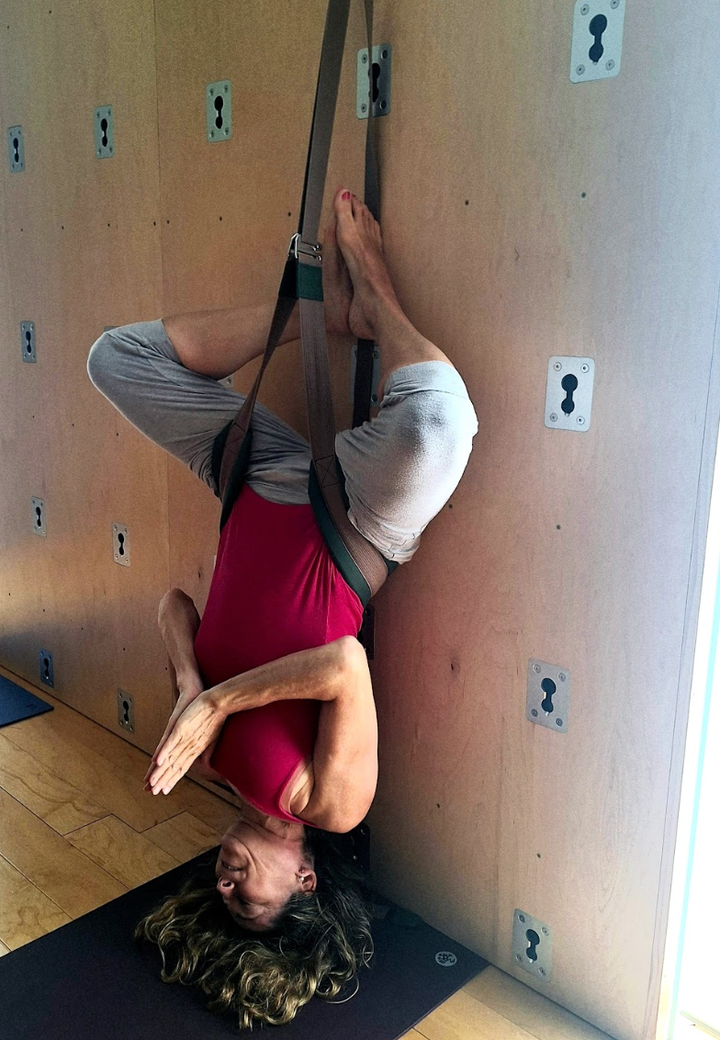
“Either way, you’d have lost those early athletic years — runner, gymnast, tennis player. Who knows about all the cool things you’ve done as an adult — triathlons, bicycle tours. And didn’t you say you were a dancer?”

“Salsa, swing, zydeco…” Quiet tears streamed.
“Amazing.” Her hands gripped my shoulders. “You’re fit. You’ve got fortitude, Anne. You can do this.”
“Do what?” Eyes closed, I listened for the answer I already knew in my wise old bones.
The truth resonated in my chest.
My father had done some good, loving things — he’d seen my athletic potential and encouraged me. But he disappeared into an illness he refused to see, and he never came back.
“I can’t let what happened to him happen to me. I’ll do anything.” I pushed up off the table, heart thumping, and wiped the snot from my face.
Dr. Jen smiled. “Then let’s begin.”
Glancing out the window at the maple in fiery fall majesty, I felt the vise grip on my lumbar ever so slightly loosen as I stretched out on the floor to learn my exercises.
One year later, I stood before new X-rays.
“No change,” the surgeon scratched his chin.
Tears glossed my eyes. This was good news for my blessed, degenerative spine I’d come to call “Caroline.”
“What are you doing?” the doctor asked as he cocked his head.
“Everything,” I said, grinning, stance strong.
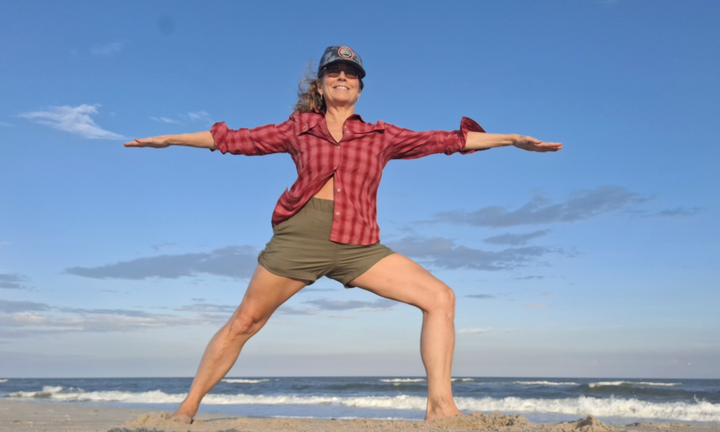
I’d hiked mountains, swum rivers, practiced yoga everywhere — forests, beaches and deserts. I’d begun to dance again.
Dr. Jen had opened a door. Then my exploration took its own adventurous course. I attended shaman ceremonies in Santa Fe, past-life regressions in Sedona, yoga for scoliosis in Asheville, and sought Chinese medicine in Montana. Through specialized Schroth therapy, I was learning to stand and to breathe — basic bodily capacities — in whole new ways. Caroline had done her best with the structure given; it was up to me, now, to counter a lifetime of adaptive misalignment.
Yet full recovery meant going deeper. Through somatic therapy, I was facing the neglect of the past and learning to release not just my parents, but me, from the blame and shame of our wounding history — and, with it, the tension held in my body over decades.
This was a great weight off my shoulders — and off Caroline. The willful eldest in me, determined to make everything OK when it just wasn’t, could simply, with practice, with daily, moment-by-moment reminders, surrender.
Courtesy of Anne Marina Pellicciotto
My spine was no straighter, but it also wasn’t more crooked, and it had not sunk into vital organs. The pain hadn’t vanished, but it wasn’t debilitating. Most days it mostly receded, hovering around 1, 2 or 3. When the pain did flare up, I knew how to calm the flames — rest or swim or soak in a tub instead of pretending the ailing away or buying into its inevitable worsening.
I wasn’t cured. Curing is passive and temporary. Healing, on the other hand, is an active, ongoing process that involves not just body, but mind, heart and spirit.
My healing continues. Now four years in, I see this as a lifelong journey, deepening the connection to myself, learning to nurture the child within — showering her with the loving care she always deserved.
Despite my best efforts, there may still come a day when spinal fusion is necessary. By then, I trust my body-mind will be prepared to make that decision from a place of love, not fear, and transform a cure into healing.
Anne Marina Pellicciotto (Marina), founder of SeeChange, is a mind-body coach, speaker and yoga instructor who guides individuals to live boldly and creatively. A three-time recipient of the D.C. Arts and Humanities fellowship for literature (FY24-26), she was nominated for a 2024 Pushcart Prize. Marina completed her debut memoir, “Strings Attached,” and is seeking representation. This essay is drawn from a work in progress, “Crooked Spine Chronicles: A Midlife Nomad Journey to Healing.” Learn more about her writing and healing at www.seechangeconsulting.com.
Do you have a compelling personal story you’d like to see published on HuffPost? Find out what we’re looking for here and send us a pitch at [email protected].