
🔴 Website 👉 https://u-s-news.com/
Telegram 👉 https://t.me/usnewscom_channel
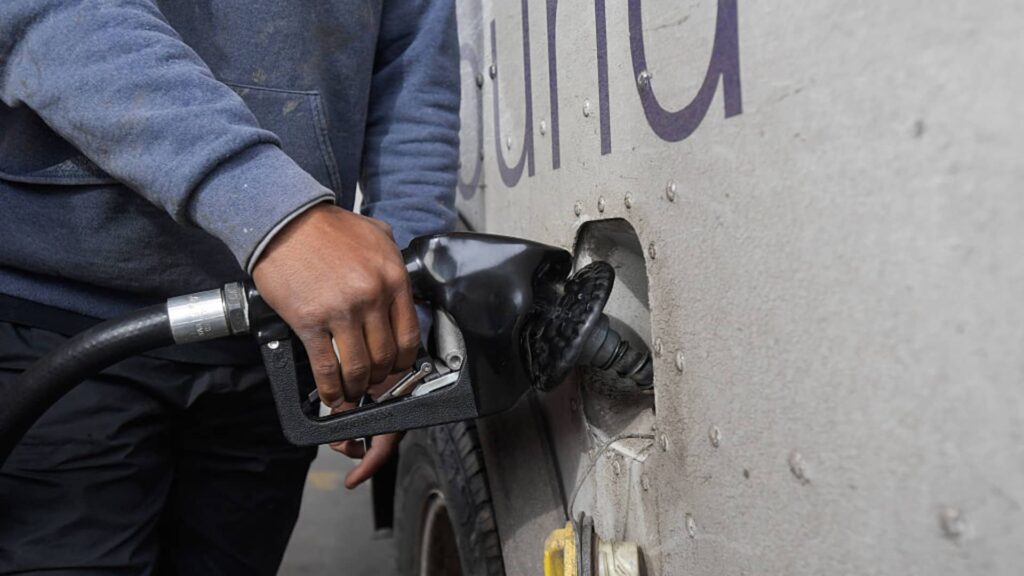
A driver refuels a vehicle at a Wawa gas station in Media, Pennsylvania, US, on Monday, March 2, 2026.
Matthew Hatcher | Bloomberg | Getty Images
With oil spiking to $100 a barrel and the job market essentially paralyzed, the threat of stagflation again is looming over the U.S. economy and financial markets.
High inflation and slow growth present a double threat, as stimulative measures such as interest rate cuts and government spending only aggravate inflation. Persistently higher prices in turn can put a damper on the labor market as well as the consumer spending that drives more than two-thirds of the U.S. economic engine.
“I have been concerned about the threat of stagflation for a long time, in part because there are so many different inflationary pressures on the economy,” CME Group chief economist Erik Norland said. “You have huge budget deficits, inflation above target, and central banks are easing policy anyway. And then you add to that $100 per barrel oil.”
Markets were rattled again Monday over the prospect of prolonged fighting in the Middle East. Early in the session, U.S. crude oil soared past the $100 a barrel mark for the first time since 2022, though prices eased heading into the afternoon.
crude prices
The surge in energy costs came just a couple days after the Bureau of Labor Statistics reported that the economy lost 92,000 jobs in February while the unemployment rate edged higher to 4.4%. The weak jobs number followed a pattern of stagnant job growth that began in early 2025, raising fresh fears that the air had been let out of a strong growth spurt through most of last year. Total job growth for all of 2025 — 116,000 — was 5,000 less than the monthly average for the prior year.
At the same time, core inflation as measured through the Federal Reserve’s preferred gauge last stood at 3%, a full percentage point above the central bank’s target.
Stagflation flashback
The economy last saw an oil-induced stagflation jolt in 2022 following Russia’s invasion of Ukraine, but even then it was nothing like the severe pattern in the 1970s. Similar fears perked up when the Trump administration levied aggressive tariffs in April 2025.
To be sure, multiple stagflation threats have come over the years, mostly failing to materialize as the economy stabilized.
For most economists and Wall Street strategists, the primary factor this time is duration. If the Iran situation can be resolved in a few weeks, as President Donald Trump has promised, any stagflationary shock likely will be muted. Oil futures are pointing to lower prices through the year, but that can be an unreliable guide to which way prices eventually head.
“Higher oil prices, higher inflation, that leads to a shock,” said Jim Caron, chief investment officer of portfolio solutions at Morgan Stanley Investment Management. “But if oil prices stay up for long enough, then it becomes a growth scare, so then bond yields will start to come down. If bond yields are coming down because people are worried about growth, then you’re in the stagflation mode.”
Bond yields have mostly risen during the Iran crisis, indicating investors are pricing in an inflation scare from the oil price surge.
Similarly, markets are paring back expectations for Federal Reserve interest rate cuts, betting that the central bank will be more focused on defending its 2% inflation goal than it will boosting a labor market that is showing both a low level of hiring and firing.
“The US economy and stock market are stuck between Iran and a hard place currently. So is the Fed,” wrote market veteran Ed Yardeni, founder of Yardeni Research. “If the oil shock persists, the Fed’s dual mandate would be stuck between the increasing risk of higher inflation and rising unemployment.”

Yardeni said he has raised his odds of 1970s-style stagflation to 35% as the Iran war “is the latest stress test of the U.S. economy’s resilience since the start of the decade.”
Most economists think the pass-through costs of rising oil to the rest of the economy are minimal. However, Yardeni noted that rising fuel prices threaten to exacerbate food inflation as oil is used to make fertilizer.
The Fed reaction
For their part, Fed officials tend to look through such gyrations when formulating policy. But extended pressures can influence policy.
Prior to the U.S.-Israeli attack on Iran, futures traders were pricing in June for the next Fed rate cut, with at least one more before the end of year. That first cut has now been pushed out to September — July at the earliest — and no second reduction in 2026. The implied fed funds rate by the end of the year is now 3.21% from its current 3.64%.
“This is probably the worst scenario for monetary policy, and we will probably hear the term stagflation repeated once again together with an ‘Iranian crisis,'” wrote Eugenio Aleman, chief economist at Raymond James. “We don’t think that this new scenario will make Fed officials change their mind regarding monetary policy for now and that they will wait to get more data on the risks for their dual mandate between inflation and employment.”
Indeed, other economic signals outside of the labor market are fairly strong.
The Atlanta Fed is tracking second-quarter GDP growth of 2.1% — significant step down from the prior three quarters but still fairly strong. Reports last week indicated both the manufacturing and services sectors were in expansion during February, though January’s retail sales numbers were down 0.2%.
“While $100 per barrel oil is unsettling for stocks, the inflation, stock market and earnings picture are each in a better position now than they were in March 2022, the last time that oil prices crossed $100 during the aftermath of Russia’s invasion of Ukraine,” Carol Schleif, chief market strategist at BMO Private Wealth, said in a note. “The key here is the duration of the elevation in prices and the conflict itself. The shorter the duration, the more likely the impact would be temporary and the economy resilient.”