
🔴 Website 👉 https://u-s-news.com/
Telegram 👉 https://t.me/usnewscom_channel
It’s pretty obvious where Grammarly went wrong, isn’t it? Blame AI. Grammarly’s parent company, Superhuman, has been in hot water and facing a class action lawsuit over its use of real experts’ names (and their perceived way of writing, editing, and thinking) in its now-discontinued Expert Review feature. The feature relied on AI to guess at how an expert like Tom’s Guide’s Mark Spoonauer might guide you in your writing.
The good news is that even Superhuman’s CEO, Shishir Mehrotra, agrees that the feature was essentially terrible. Speaking with The Verge’s Nilay Patel on the Decoder Podcast, Mehrotra admitted, “The feature was not a good feature. It wasn’t good for experts, it wasn’t good for users.”
Article continues below
Not getting paid
When Patel repeatedly pressed Mehrotra on how much he planned to pay Patel for the use of his, well, not exactly likeness, but persona, Mehrotra made it clear he does not believe Superhuman owes these experts anything for using their names and how they think (based on what the LLMs could glean from the Internet). Instead, he repeatedly turned to the idea that Grammarly (Superhuman) was more like YouTube.
“I think our main goal is to build a platform a lot like YouTube. You should choose to be on our platform. You should be able to choose and build an experience you trust. You should choose your business model. When you choose your business model, you should get paid for your contributions to it. That’s the model we’re working on. That’s really where I want to be.”
So on the one hand, Mehrotra conceded that Expert Review was flawed and maybe poorly executed (despite the fact that it existed for months but was buried so deeply that many didn’t notice). On the other hand, Superhuman (and Grammarly) will continue to lean heavily on AI to help experts build monetizable personas that users can tap into for expert guidance.
Theoretically, getting paid for the use of our knowledge is, on the surface, a good thing, but Grammarly’s push into AI has, over the years, been a slippery slope and one that has not demonstrably improved the product.
Grammarly, I knew you when
The thing is, I’ve been a Grammarly user for years. In 2021, I documented many generally positive experiences with the tool that can live in your browser, watch everything you write, and try to help you improve it.
Much of my use was cleaning up spelling errors and typos, but I did appreciate the occasional grammar assist. All major errors are highlighted in a helpful red, and you need only hover over the offending word or phrase for a suggested fix, which you select to accept the correction.
Over time, though, Grammarly has become more pushy, with pitches for premium assistance (I’ve never paid for the service) and pop-up boxes that promise to fix your writing but mostly just block your view until you dismiss them.
As the use of AI increased, Grammarly’s suggestions seemed less and less helpful. Granted, I never used the Expert Review feature and do not know whether my name/persona could be found there, but some of Grammarly’s suggestions and evaluations of my prose seemed off/confused, or lacking proper context.
Keeping up with the LLMs
Grammarly didn’t have much choice but to dive into AI. After all, millions of people are now not only relying on AI like ChatGPT and Gemini to clean up their writing but sometimes asking the LLMs to do the writing for them.
The AI revolution was probably diminishing the perceived utility of a quiet, but helpful writing assistant like Grammarly. The company had to get more aggressive. Renaming itself Superhuman in 2025 was part of that. The company would no longer be known simply as a grammar assistant. It would be a platform and a people enhancer.
Building expert personas to assist in that mission is unsurprising. After all, AI Persona building is already a cottage industry. Late last year, I reviewed Napster View AI. While it had a suite of pre-built personas, it also let you build your own AI one and then add it to the company’s library of experts.
It was mostly just weird, but at least Napster asked permission.
Grammarly got ahead of itself and built those AI experts based on real people without asking permission. Yet despite its current troubles, Superhuman wants to build an AI persona library, mainly because experts want it.
Grammarly got ahead of itself and built those AI experts based on real people without asking permission.
Mehrotra insisted that the idea to build the original system basically came from his discussions with YouTubers and “a really prominent book author.”
“They all told me the same thing. It’s a really hard world for experts out there right now. It’s really hard to drive connection.” What they’re looking for is a more persistent fan connection, and, ostensibly, the Expert AI persona could be one way to do it.
Despite that goal, Grammarly (Superhuman) failed, “It didn’t deliver on either side of it, really. We ended up with an experience that was pretty suboptimal for the user and obviously suboptimal to the expert,” Mehrotra told Patel.


Grammarly’s Expert Reviews could return, assuming any expert wants to work with them, with both real expert permission and a revenue split between Superhuman and the living, breathing expert.
Whether or not that ever moves forward will probably depend on the outcome of Angwin’s Class Action Lawsuit.
A small expert persona test
Image 1 of 6

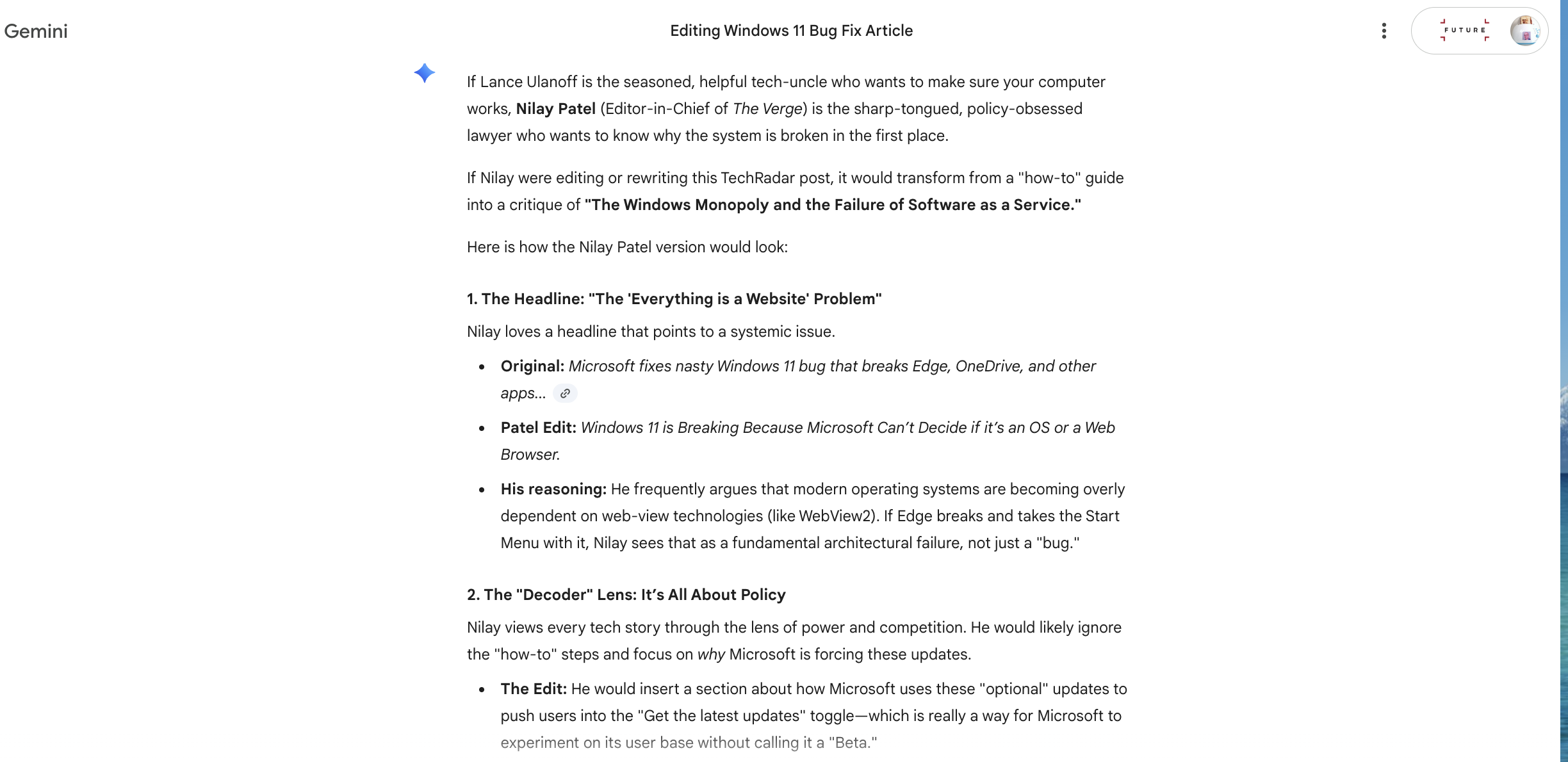

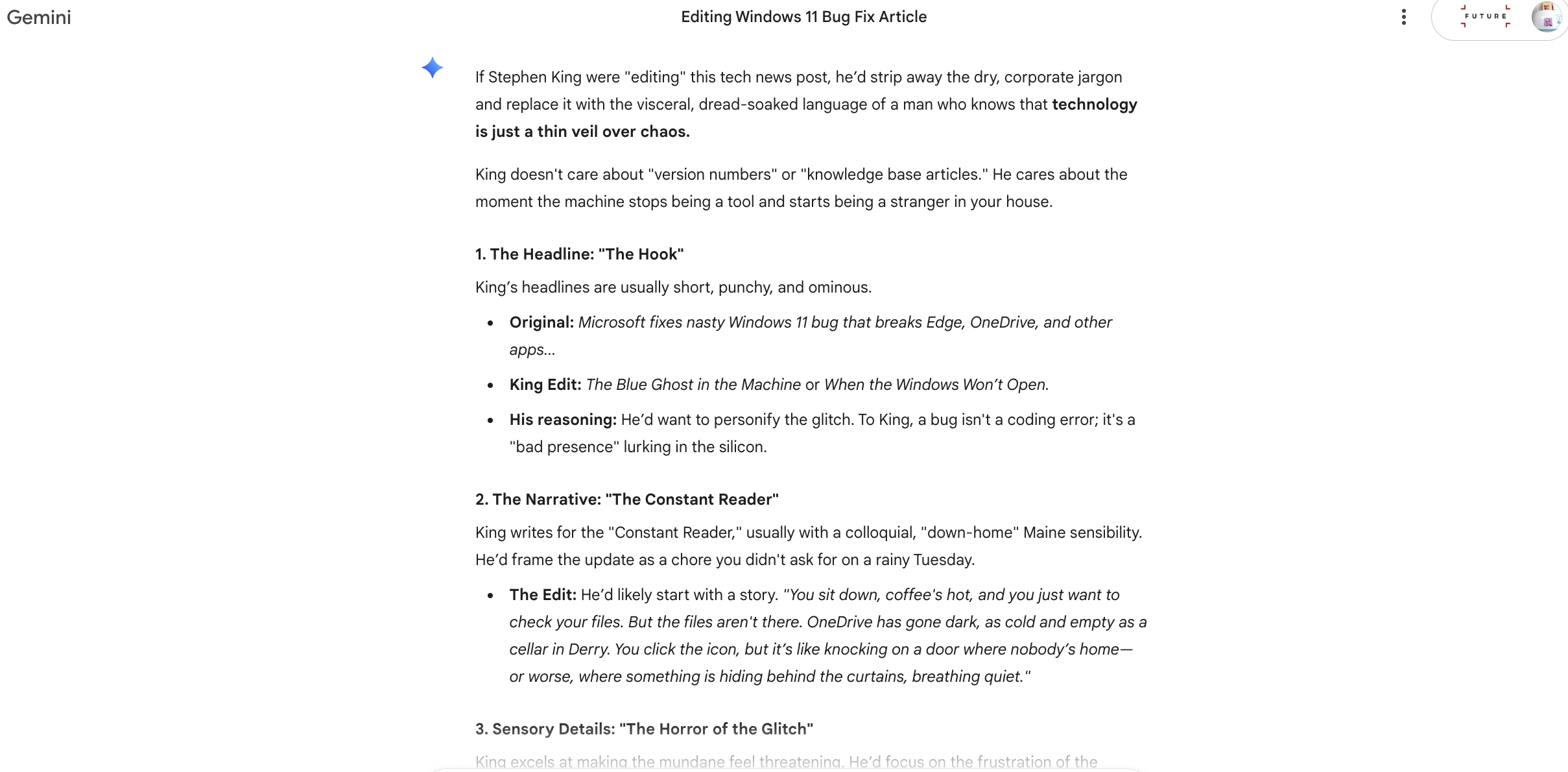


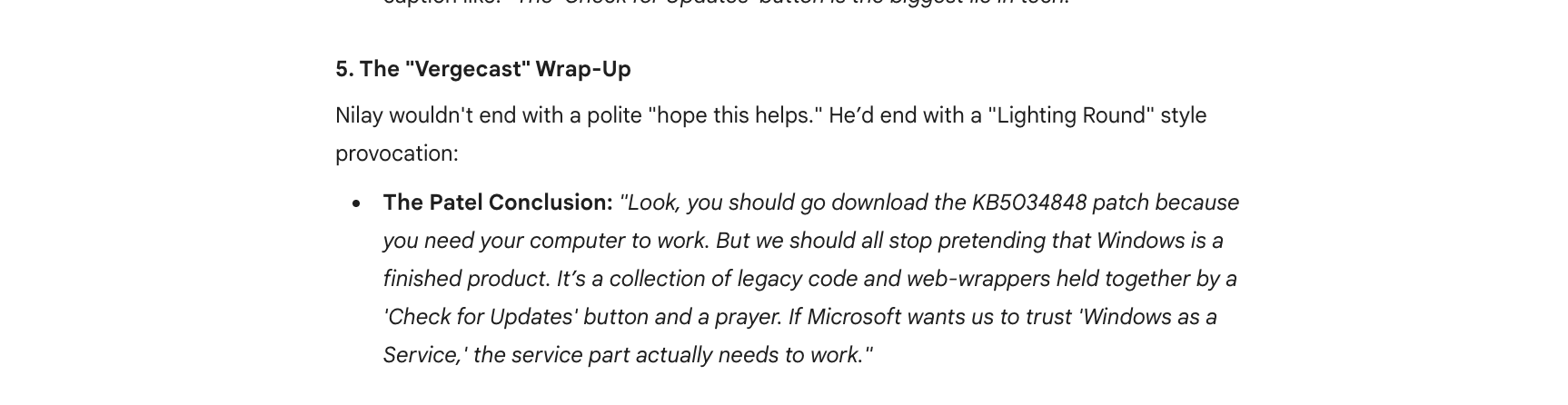

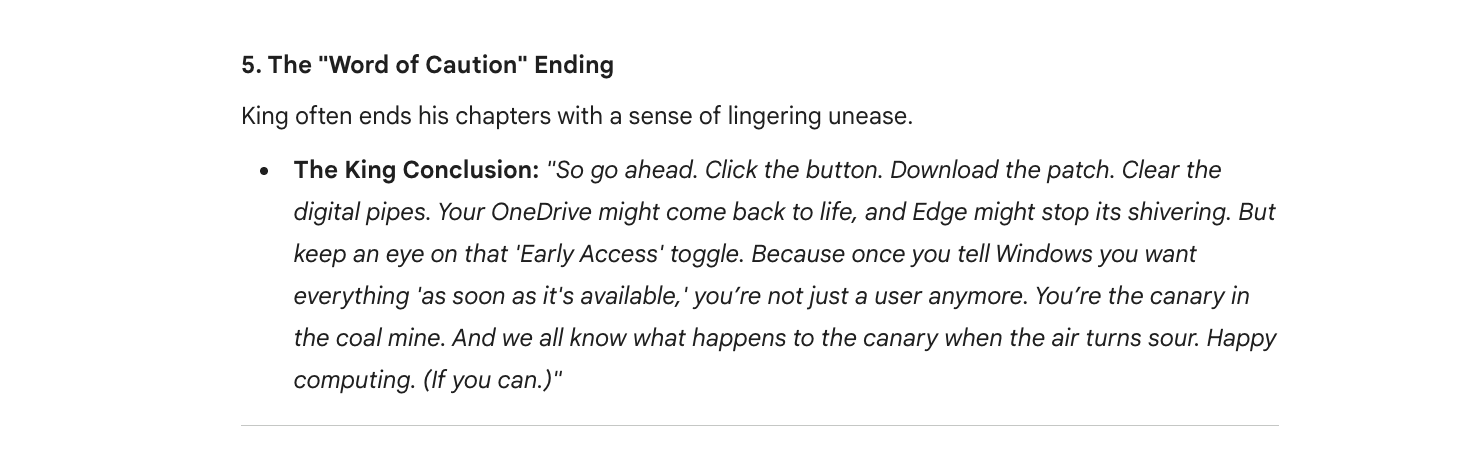
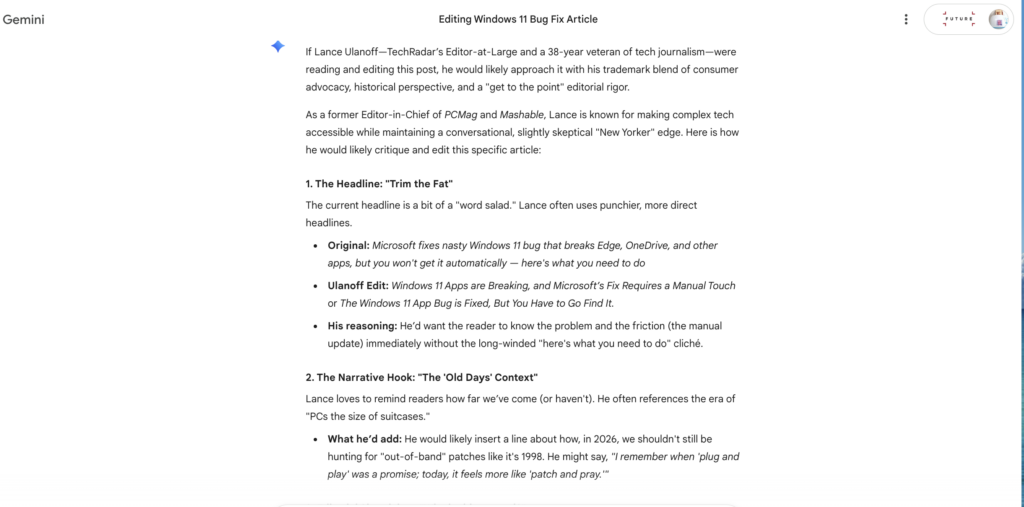
In the meantime, I was struck by something else Mehrotra said. He was talking about how desperate people are for guidance from someone they admire, “They try to do that today with LLMs. They go to ChatGPT and Claude and say, ‘What would Nilay think about my writing?’ That was the inspiration for what the user was trying to do.”
It hadn’t occurred to me that Claude, ChatGPT, or Gemini could not only help you improve your writing but might also have insight from well-known writers.
As an experiment, I handed Gemini a link to a general tech news story from TechRadar and asked it, “If Lance Ulanoff were reading and editing this post, what would he say?”
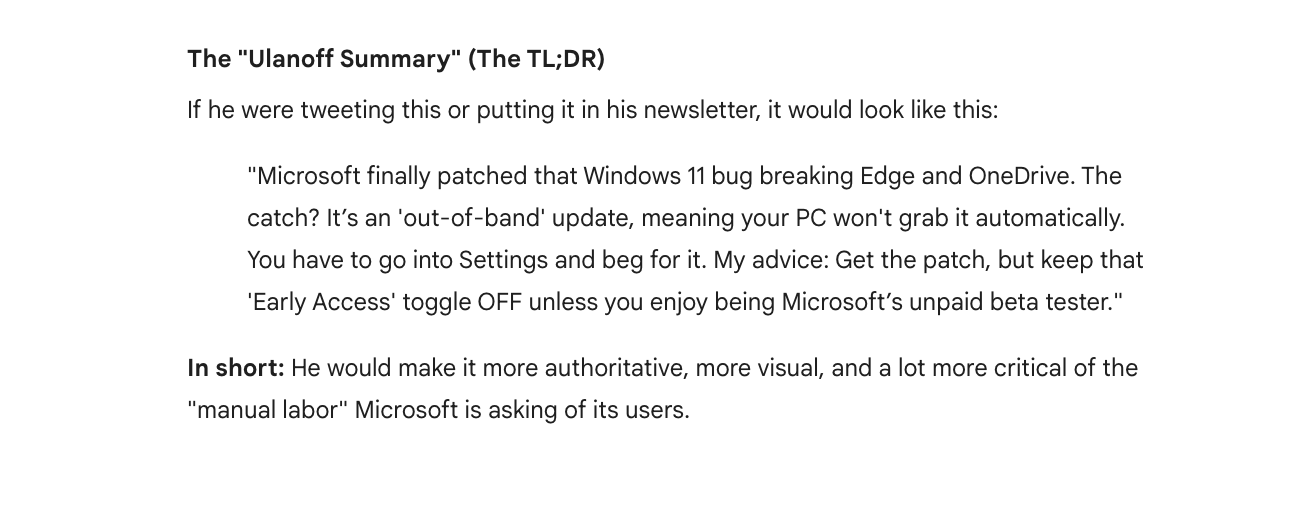
The response was detailed and compared the original text with how I might approach the text. It even crafted a potential social media post in my voice. When I switched it to The Verge’s Nilay Patel, the response was no less detailed. Gemini compared my approach to his and, yes, wrote a Patel-style conclusion. Naturally, I had to try Stephen King. The LLM gave him the same treatment, with a detailed analysis of the writing and a King-style conclusion.
My point is, yes, what Grammarly did was wrong and off-putting. Offering “experts’ as if they had permission is wrong (the fine print made it clear they did not, and these were not the real people), but it’s only one step removed from what is possible today on most other mager AI platforms.
Gemini did not hesitate to attempt to write in my, Patel, or King’s voice. None of us is being paid for the analysis which is being offered in our names.
Perhaps the Grammarly/Superhuman lawsuit will set a precedent for the use of our personas across all kinds of media. But I doubt it. At best, this gets settled out of court; at worst, it gets dismissed entirely. At least Grammarly was embarrassed into removing the feature. But like a game of whack-a-mole, this won’t be the last pirate persona army to take our names in vain.
Follow TechRadar on Google News and add us as a preferred source to get our expert news, reviews, and opinion in your feeds. Make sure to click the Follow button!
And of course, you can also follow TechRadar on YouTube and TikTok for news, reviews, unboxings in video form, and get regular updates from us on WhatsApp too.