

🔴 Website 👉 https://u-s-news.com/
Telegram 👉 https://t.me/usnewscom_channel
Facebook now accounts for the vast majority of scams on social media, according to an explosive new study – and critics claim it’s because Mark Zuckerberg’s tech giant is more focused on making money than protecting customers, The Post has learned.
Last year, Meta forecast it would earn $16 billion – or 10% of its revenue – by running scam ads, according to bombshell documents obtained last month by Reuters. Critics say the eye-popping number confirms that fraud has effectively become a core part of the company’s business — especially at Facebook, which boasts more than 3 billon monthly active users.
The documents revealed Meta bans accounts only if its systems flag an at least 95% chance that they are committing fraud — an absurdly high bar that invites fraudsters with minimal policing, critics say. What’s more, the more suspicious the ad buyer, the higher the fees for posting ads — a supposed deterrent to bad behavior which instead amounts to “pay to play,” experts say.
Erin West, a former California prosecutor who has founded a nonprofit to combat online scams, said the documents prove Meta is turning a blind eye to the fraud because it is a “major moneymaker” for the company.
“To know that Facebook is aware of this and they tolerate it – and in fact, they even command additional fees from the worst offenders – is egregious,” West said. “The practice itself is outrageous, jaw-dropping, unacceptable, but when you think about it story by story, it really becomes horrific.”
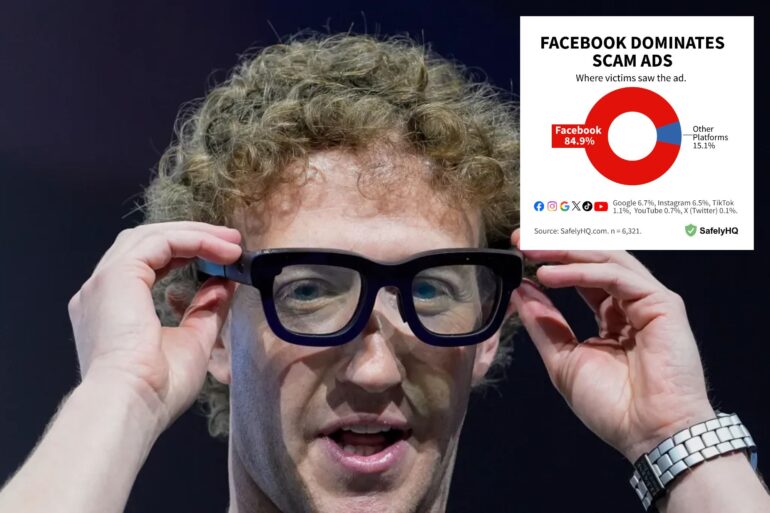
SafelyHQ, a fraud reporting platform, has collected more than 50,000 verified complaints from online scam victims. When the reports mention where the victims got scammed, Facebook is cited a whopping 85% of the time, according to data exclusively obtained by The Post.
Other platforms, including Meta-owned Instagram, Google, TikTok, and X account for the remaining 15%.
The reports are only a tiny fraction of the big picture, according to Patrick Quade, the CEO and founder of SafelyHQ. The Federal Trade Commission says most fraud goes unreported, and Quade says just 12% of scam victims who submit reports identify a host site.
“For 50,000 people to find us and independently document their losses implies a victim count in the tens of millions,” Quade told The Post. “This isn’t ‘cherry-picking’—it is the overflow of a systemic failure that Meta’s own documents confirm.”
Brian Kuhn, a 68-year-old California resident, says he was scammed out of $70 while trying to buy classic vinyl records by James Brown, The Dead Kennedys, Bob Dylan and the Buzzcocks from a “going out of business” sale on Facebook. The sale turned out to be a fake, and the records never arrived.
“It felt a little creepy that they seemed to know my taste so well,” Kuhn told The Post. “I somehow blame myself equally, but that doesn’t excuse Facebook from allowing the thieves to prey on people.”
Meta’s scam ad epidemic has drawn attention on Capitol Hill, where US Sens. Josh Hawley (R-Mo.) and Richard Blumenthal (D-Conn.) have demanded a federal investigation.
“Perversely, Meta reportedly charges higher rates for ads that it suspects might be fraudulent — in effect, imposing a scam tax that provides an additional lucrative revenue stream that it knows is tied to fraud,” the senators wrote in Nov. 22 letter.
Meta spokesman Andy Stone said the leaked documents “present a selective view that distorts Meta’s approach to fraud and scams.”
Stone said Meta’s practice of charging suspected scammers more in its ad auctions have proven effective, with internal tests showing a decline in scam reports as well as a slight decline in ad revenue. The company also recently said it has expanded its advertiser verification efforts.
“We aggressively fight fraud and scams because people on our platforms don’t want this content, legitimate advertisers don’t want it and we don’t want it either,” Stone said in a statement. “Scammers are persistent criminals whose efforts, often driven by ruthless cross-border criminal networks that operate on a global scale, continue to grow in sophistication and complexity.”
Over the last 15 months, the company said reports about scam ads have declined by more than 50%. Meta has removed more than 134 million scam ads this year alone.
The internal documents obtained by Reuters showed Meta researchers have been warning for years about the extent of the company’s ad fraud problem, and how it seemed to be trailing rivals in cracking down.
One May 2025 presentation estimated that Meta was involved in one-third of all successful scams in the US, the report said. In a separate April 2025 review, the company concluded it was “easier to advertise scams on Meta platforms than Google.”
In October, a Delaware-based Facebook user named Betty got scammed by a Facebook ad for Laura Geller cosmetics. She said she was suspicious because the goods were cheap and required PayPal, but decided to buy anyway because the ad featured Laura Geller’s logo and branding.
Instead, she got cheap knockoff products from a Chinese label she didn’t recognize.

“Believe me, that’s all you see are ads,” Betty said. “You like one thing or look at something or you make a comment about one thing and then these ads appear. Obviously, some are fake and you can tell that. Some are really good – they’re fake, but you really can’t tell at first.”
In total, SafelyHQ has compiled more than 5,000 verified reports of scam ads specifically on Facebook and Instagram.
“The ‘fox’ isn’t even guarding the hen house – it’s charging a toll for other foxes to walk right in,” Quade said. “This is an epidemic. Meta’s system is algorithmically trapping regular citizens in e-commerce scams, while their policy protects $16 billion in scam revenue. The time for voluntary oversight is over.”
Online watchdog Consumer Reports has also called on the FTC and state attorneys general to clamp down.
The “elephant in the room” is Meta’s reliance on protections offered by Section 230, which protects social media sites from being held liable for third-party content, according to Justin Brookman, Consumer Report’s director of tech policy.
Policy tweaks, such as adding an exception for Section 230 for paid advertising, would force Meta to take action, he argued.
“It would certainly realign the incentives to make Meta care more about all the fraud and scams and illegal activity on their platforms,” said Brookman.
The real fix, according to Quade, won’t come until regulators begin treating high-volume ad gatekeepers like Meta as if they are financial institutions rather than social media companies.
That could include strict “know your consumer” or “know your business” rules requiring Meta to properly vet its advertising partners at its own cost.
“You can’t let the company profiting from the crime be the one in charge of stopping it,” Quade said.