

🔴 Website 👉 https://u-s-news.com/
Telegram 👉 https://t.me/usnewscom_channel
Prominent conservatives including Steve Bannon are urging the Trump administration to reject an increasingly popular argument that tech giants are using to rip off copyrighted material to train artificial intelligence.
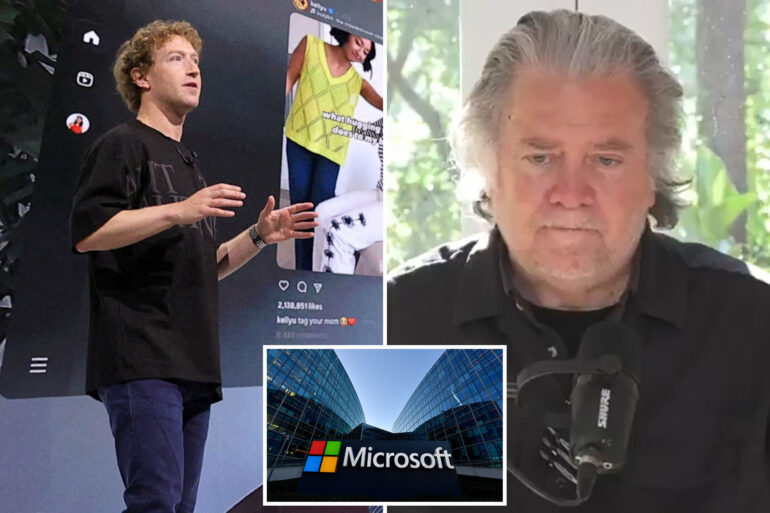
So-called “fair use” doctrine – which argues that the use of copyrighted content without permission is legally justified if it is done in the public interest – has become a common defense for AI firms like Google, Mark Zuckerberg’s Meta and Microsoft who have been accused of ripping off work.
The argument’s biggest backers also include White House AI czar David Sacks, who has warned that Silicon Valley firms “would be crippled” in a crucial race against AI firms in China unless they can rely on fair use protection.
“China is going to train on all the data regardless, so without fair use, the US would lose the AI race,” Sacks wrote on June 24.
Bannon and his allies threw cold water on such claims in a Monday letter addressed to US Attorney General Pam Bondi and Michael Kratsios, who heads the White House’s Office of Science and Technology Policy.
“This is un-American and absurd,” the conservatives argued in the letter, which was exclusively obtained by The Post. “We must compete and win the global AI race the American way — by ensuring we protect creators, children, conservatives, and communities.”
In August, Punchbowl News reported that Microsoft and Meta had organized dinners in an effort to woo former Trump administration figures with hawkish views on China to their side of the AI copyright debate.
In their letter, the conservatives argue Big Tech’s national security argument has been undercut by the spread of frivolous uses for AI including pirated cartoon characters and creepy sexualized AI chatbots.
“While AI leadership is undeniably important for US geopolitical goals, one hardly needs a machine learning degree to question the national security imperative of unlicensed SpongeBob productions or erotic chatbots,” the letter said.
The conservatives point to clear economic incentives to back copyright-protected industries, which contribute more than $2 trillion to the US GDP, carry an average annual wage of more than $140,000 and account for a $37 billion trade surplus, according to the letter.
In some cases, AI giants have struck licensing deals to pay for content, such as OpenAI’s deals with The Post’s parent News Corp, Axel Springer and others.
Other disputes have resulted in lawsuits, such as News Corp’s suit against Perplexity or the New York Times’ suit against OpenAI and Microsoft.
The letter notes that money is no object for the companies leading the AI boom, which “enjoy virtually unlimited access to financing” and are each valued at hundreds of billions, if not trillions of dollars.
“In a free market, businesses pay for the inputs they need,” the letter said. “Imagine if AI CEOs claimed they needed free access to semiconductors, energy, researchers, and developers to build their products. They would be laughed out of their boardrooms.”

The Post has reached out to the DOJ and the White House for comment.
The letter is the latest salvo in a heated policy divide as AI models gobble up data from the web. Critics accuse companies like Google, Microsoft, OpenAI and Meta of essentially seeking a “license to steal” from news outlets, artists, authors and others that produce original work.
The letter cites a recent submission by the Big Tech-funded Chamber of Progress, which urged the White House on Oct. 27 to “intervene in legal cases to defend generative AI training as fair use, challenge excessive statutory damages and oppose the class certification of enormous numbers of plaintiffs.”
Chamber of Progress suggests that Trump should issue executive orders compelling the Justice and Commerce Departments to intervene on behalf of tech companies that face copyright infringement suits – and argues it is essential to ensure “maximum” AI development.
Bannon is President Trump’s former chief strategist who has become one of Big Tech’s most vocal critics. He co-signed the letter alongside Mike Davis, a close ally of Trump and influential MAGA lawyer who founded the Internet Accountability Project.
Other signatories include Nick Solheim, CEO of American Moment; Will Chamberlain, senior counsel at Article III Project; Aiden Buzzetti, president of the Bull Moose Project, Daniel Suhr, president of the Center for American Rights; Jeff Mazzella, president of the Center for Individual Freedom, and Joel Thayer, president of the Digital Progress Institute.