

🔴 Website 👉 https://u-s-news.com/
Telegram 👉 https://t.me/usnewscom_channel
OAN Commentary by: Kenin M. Spivak
Monday, March 23, 2026
More than 100 Trump family members, supporters, and advisors were targets of Democrats’ lawfare after the 2020 presidential election, including more than a dozen Trump lawyers who were disbarred, or suffered other financially devastating discipline for giving legal advice to Trump and his campaign.
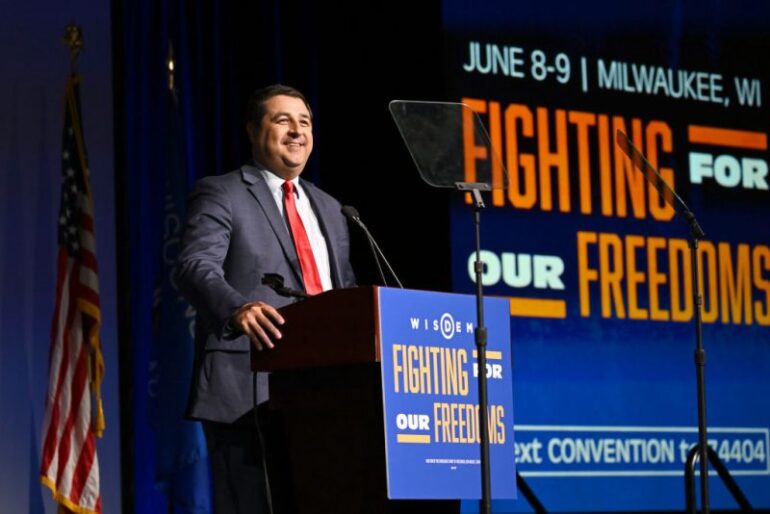
Jim Troupis is one of those lawyers. Troupis spent more than 30 years at the pinnacle of Wisconsin’s legal profession before his life was turned upside down for advising Donald Trump about potential fraud in the 2020 election. The abuse began with frivolous complaints to the Wisconsin Election Commission (WEC) and state bar. Then, Wisconsin Attorney General Josh Kaul, another Democrat seeking fame in the pantheon of Donald Trump-haters, unfathomably indicted Troupis for doing that which Kaul said he should do.
It violates due process for a state to indict someone for following its advice, or to suppress exculpatory evidence. Yet, Kaul did both, leveraging misconceptions about alternative electors to falsely allege that Troupis led Republicans to commit election fraud.
Troupis received his law degree from Northwestern University and began his career in Illinois, before moving to Madison, Wisconsin. There, as chair of the litigation practice at Michael Best & Friedrich, he was instrumental in taking the firm from 12 lawyers to a nationwide force. Troupis was highly respected for his counsel on election law, with clients such as the Republican Party, governors, judges, the state legislature, numerous presidential campaigns, and voter integrity programs. He was a principal author of Wisconsin’s recount statute and election law, and served on the Special Joint Legislative Committee on Election Law. From 2015 to 2016, he was a circuit court judge.
Shortly after the 2020 presidential election, Trump advisor Reince Priebus recruited Troupis, who was then retired, to guide the Trump campaign on potential challenges to the Wisconsin results, a recount, and selecting electors. Troupis informed Kaul’s office and counsel for the Biden campaign of plans to select electors and schedule a ballot. Neither objected. In December 2020, Wisconsin’s assistant attorney general shared this information with the WEC. It did not object.
In briefs filed in the Wisconsin Supreme Court that month, Troupis and Kaul litigated whether the court should hear the Trump campaign’s request for a recount on an expedited basis. Kaul argued there was no urgency because the Republican electors could vote, and both the Democratic and Republican “certificates would then be presented to Congress for its ultimate decision” in January. Based on that position, Troupis advised the court that the Trump campaign would proceed with its elector process. Ultimately, the Wisconsin Supreme Court ruled 4-3 against a recount.
In January 2021, Congress certified the Wisconsin Biden slate and Biden-Harris as the winners of the 2020 presidential election. The following month, the U.S. Supreme Court denied certiorari to the Trump campaign’s efforts to reverse the Wisconsin results.
Democrats then filed numerous bar complaints against Troupis and a complaint with the WEC asserting that Troupis violated the state’s election laws, and requesting the Milwaukee district attorney investigate criminal violations “affecting the administration of government and forgery.” In February 2022, after reviewing the complaint, Kaul’s office advised the WEC that that there was no basis to proceed. As a result, the WEC unanimously denied the complaint. The bar complaints remain pending.
Thirteen months later, in June 2024, contrary to his previous advice and the WEC’s determinations, Kaul indicted Troupis and two other campaign advisors for allegedly creating forgeries by preparing documents for the Trump electors. The indictment was premised on a novel theory that though the documents were correctly executed by their signatories, and were what they purported to be, they were “forgeries” because they did not acknowledge that their effectiveness depended upon the outcome of the certification process. Yet, everyone involved knew this, including the electors whom Kaul now alleges were defrauded.
If the electors were defrauded (they were not), Troupis had no role in the deception. The evidence shows that Troupis neither advised nor interacted with the electors. A separate law firm did so. That exculpatory evidence was omitted from the indictment. Kaul then unsuccessfully sought to seal the evidence, including his previous legal opinions, and to gag Troupis from discussing the case, so that only Kaul’s calumny would be available to the media and public.
Kaul’s case suffers numerous other defects, including the Constitution’s Supremacy Clause, which gives Congress the power to select among competing slates of electors. As Kaul acknowledged, to preserve Trump’s rights, his electors had to complete their ballot in a timely manner.
In 1876, early returns had Samuel Tilden winning the popular vote in his race against Rutherford B. Hayes, but he needed Florida, Louisiana, or Oregon to win the Electoral College. In each of those states, both campaigns alleged fraud, and both fielded elector slates for congressional certification. The ballots were sent to Congress, which deadlocked; Republicans controlled the House and Democrats the Senate. Congress formed a commission which declared Hayes the winner.
A decade later, Congress passed the Electoral Count Act which reduced the risk of disputes. Nonetheless, in 1960, two slates of electors were selected in Hawaii, and both cast their ballots. Vice President Nixon resolved that dispute. The same problem almost recurred in 2000 during the Bush-Gore election. But for an error made by the Gore team, Gore could have arranged for an alternative elector slate. Florida then would have had time for a recount, which likely would have changed the outcome of the election.
Due process and democracy require that those who advise candidates not risk poverty or prison merely for being on the losing side. The next time a Democrat rants about preventing existential threats to democracy, Josh Kaul would be a good place to start.
(Views expressed by guest commentators may not reflect the views of OAN or its affiliates.)
Kenin M. Spivak is founder and chairman of SMI Group LLC, an international consulting firm and investment bank. He is the author of fiction and non-fiction books and a frequent speaker and contributor to media, including RealClearPolitics, The American Mind, National Review, television, radio, and podcasts.
What do YOU think? Click here to jump to the comments!
Sponsored Content Below