🔴 Website 👉 https://u-s-news.com/
Telegram 👉 https://t.me/usnewscom_channel
Authored by Chris Summers via The Epoch Times,
The Trump administration recently suspended the processing of all immigration applications from 19 countries, including Afghanistan, citing national security and public safety concerns.
The Dec. 2 decision came a week after an Afghan national who had been allowed into the United States under a Biden-era program was charged with shooting two National Guard soldiers near the White House. The ambush killed one of the victims and left the other in critical condition.
The White House’s move comes amid a global migration crisis, in which millions of people have left their home countries in Latin America, Africa, and Asia for the affluent economies of North America and Europe.
Although the United States was founded by immigrants, experts say that times have changed, and the country has become too popular a destination that now action is needed to restore a functioning immigration system.
“How this country was founded, and the ethos and numbers of people in the 1600s, 1700s, and 1800s are very different than what we’ve been experiencing,” Lora Ries, director of the Border Security and Immigration Center at The Heritage Foundation, told The Epoch Times. “And so our immigration system has just been run away, whether it’s illegal or legal.”
“We need to pop this bubble and get control over our country, [with] a lawful, manageable and orderly immigration system.”
The countries affected by the Dec. 2 memorandum were Burma (also known as Myanmar), Chad, the Republic of the Congo, Equatorial Guinea, Eritrea, Haiti, Iran, Libya, Sudan, Yemen, Burundi, Cuba, Laos, Sierra Leone, Togo, Turkmenistan, and Venezuela. Most of these countries have high visa overstay rates or poor vetting procedures.
In August, the Pew Research Center analyzed Census Bureau data and said 53.3 million immigrants were living in the United States in June 2025.
According to the Migration Policy Institute, immigrants made up 14.8 percent of the population in 2024, a rate the United States has not seen since 1890.
“Our inn is not only full, it is overflowing,” Ries said. “So other countries need to step up and pitch in.”
Push and Pull Factors in Migration
In 2024, the United Nations’ population division published data that suggested a record 304 million people lived in a country other than their country of birth.
That figure—which represents 3.7 percent of the world’s 8.2 billion people—was up from 275 million in 2020.
That number would include the 42 million people who, in June 2025, the United Nations refugee agency said have left their home country due to “persecution, conflict, violence, human rights violations or events seriously disturbing public order,” plus 8.4 million who are claiming asylum in another country.
War and political violence are push factors in some parts of the world, says Paul Morland, demographer and author of “The Human Tide: How Population Shaped the Modern World,” but he said they were less significant than people’s age-old desire to improve their standard of living.
“A bigger story than the security one is the economic one, because that’s always there,” Morland told The Epoch Times.
He noted that the Congo, which has had an ongoing civil war for several years, has not generated large numbers of migrants to Europe or North America, while India and Pakistan—which have been largely peaceful—have seen large numbers move to the West.
Many times, migrants use the persecution justification to pursue the economic motive, Ries noted.
“There are 193 countries on this planet, so if you are truly fleeing for your life, then you should go to the first safe country that you enter,” she said, “You should not be able to country shop and go through multiple safe countries without getting protection there, just because you want to get to the U.S.”
Cultural differences play a role in immigration’s impact on the host country, said Morland.
“What has a very big impact is when people from very radically different cultures arrive,” he said, “They look very different, their practices are very different, their belief systems and values are very different. And the assumption has to be that they will take longer to integrate.”
In America, immigration has historically been associated with positive outcomes, Javier Palomarez, president and CEO of the United States Hispanic Business Council, told The Epoch Times.
“Since its inception, America has thrived by attracting the best and brightest from around the world to contribute to our innovation, economy, and society as whole,” said in a statement sent by email.
“After all, America was founded on the idea that you could leave your former life behind, start anew, and build something for yourself and your family.”
There are reasons behind that success.
“This idea is reliant on the invisible pillars that hold this nation together and attract contributors from around the world: freedom, opportunity, respect for family, patriotism, law and order, and a strong set of rules and guidelines that enable competition and encourage growth,” said Palomarez.
The “ubiquity of English” in much of Africa, Asia, and Latin America also made the United States and Britain attractive for many migrants, said Morland.
Birth of the Immigration Law Industry
In the 1990s, migrants and human traffickers began to realize that if they could get into their destination country and then claim asylum, they could use legal avenues to prevent being deported, Tony Smith, a former director general of the UK Border Force, told The Epoch Times.
“This gave birth to an industry of immigration lawyers who would support migrants who entered your country illegally,” Smith said. “That had the effect of preventing removals, at least temporarily, whilst that application was processed.”
He said the fact that the asylum-seekers had usually passed through numerous safe countries en route made no difference.
“You have people from all over the world coming in through Mexico because they want to go to the U.S.,” said Smith. “They’re not interested in getting refuge in Mexico or South America.”
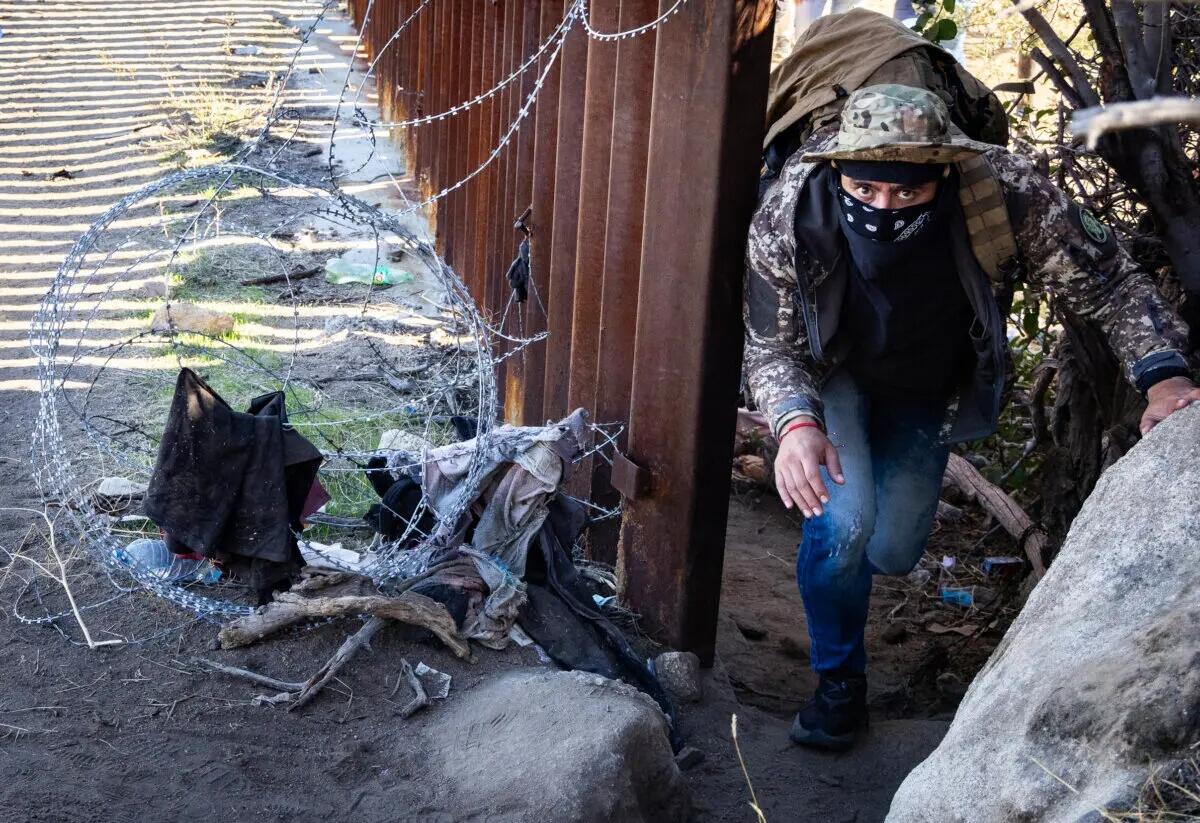
A masked migrant illegally crosses into the United States outside of San Diego, Calif., on Dec. 5, 2023. John Fredricks/The Epoch Times
But President Donald Trump has upended the system.
“He is doing things that actually will horrify some judges and some lawyers,” said Smith, “[but] he’s had a very significant effect, both in terms of reducing illegal migration across the southern border, but also in terms of the inland activity by [U.S. Immigration and Customs Enforcement] to arrest people who should not be in the U.S., and by exerting political pressure on those countries that have traditionally said, ‘We’re not taking our own people back again.’”
Morland said in countries with grinding poverty, long-distance migration is unlikely.
“Ironically, it’s when people get off the floor [that migration happens],” Morland said. “They get a bit of money. They get an iPhone. They can see what the world’s like. They can afford an airfare. They maybe have already got an uncle in London or Paris. That’s when they move, not when they’re absolutely dirt poor and ignorant sitting in the village.”
Morland said it is also unlikely that migrants would return to countries like Afghanistan, Syria, or Sudan even when peace is restored.
“If the Taliban were overturned, and a beautiful liberal democracy were formed in Afghanistan, I hardly think anyone could go back,” Morland said. “Over many, many years, if that then led to economic prosperity, maybe.”


He said “unforced remigration” is going to be fairly limited from countries such as the United States, Canada, and Germany, where per-capita incomes are $50,000 or more.
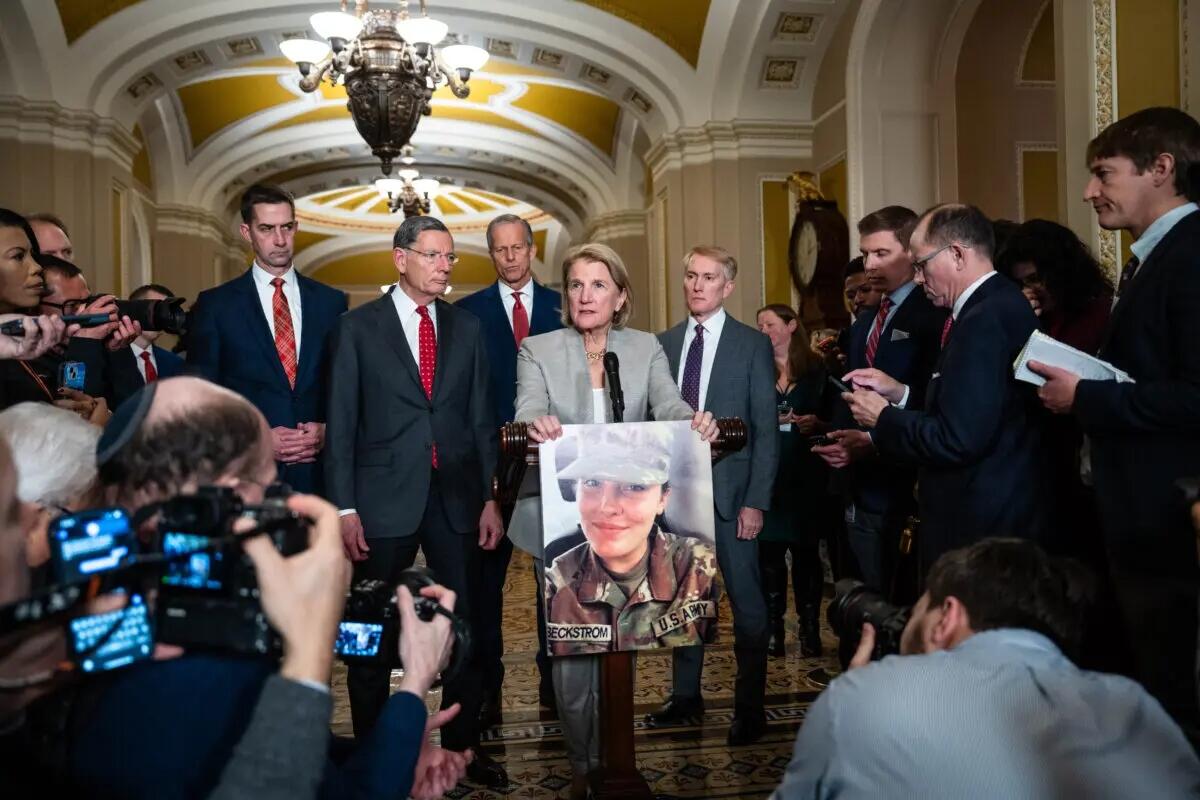
Sen. Shelley Moore Capito (R-W.Va.) holds a photo of Army Spc. Sarah Beckstrom, a West Virginia National Guard member who was shot near the White House on Nov. 26, in Washington on Dec. 2, 2025. Madalina Kilroy/The Epoch Times
National Security and ‘Open Border Welfare State’
Rahmanullah Lakanwal, 29, the Afghan national who has been charged with the first-degree murder of Army Spc. Sarah Beckstrom, 20, and assaulting Staff Sgt. Andrew Wolfe with intent to kill, in Washington, had worked with the CIA during the war in Afghanistan.
He was one of around 76,000 Afghans allowed to resettle in the United States under a Biden-era resettlement program, Operation Allies Welcome.
It has since faced intense scrutiny from Trump and other U.S. officials over allegations of gaps in the vetting process.
Ries said the president’s actions were a valid response to the Washington shooting, and what the Biden administration had done “in terms of opening the border, and mass paroling of hundreds of thousands, if not millions, of inadmissible aliens from around the world.”
Trump’s return to the White House this January also marked the culmination of many American voters’ frustration with the country’s immigration-related policies and concerns about national security, Ries noted.
“People got so fed up with the open border welfare state that we were living in that they voted against that last November,” she said.
“They wanted the border secure. They wanted the portable aliens removed, and they want taxpayer dollars to go to Americans first, not people who aren’t supposed to be here.”
Declining Birth Rate in the US
The global migration crisis also comes amid wildly contrasting fertility rates between the West and the Third World.
Africa has some of the highest rates in the world. Somalia, Chad, Niger, and the Congo all have fertility rates of six or above.
In 1960, the fertility rate in the United States was between four and five. By 2023, that number had halved to 2.2, approaching 2.1, the minimum level at which a population is able to replace itself from one generation to the next.
Macroeconomist Jesús Fernández-Villaverde called low fertility rates “the true economic challenge of our time” in a February report for the American Enterprise Institute.
Palomarez, the president and CEO of the United States Hispanic Business Council, said immigration has been part of the solution for this challenge.
“At the end of the day, especially given our declining birth rate, our nation is reliant upon a steady stream of immigrant workers and entrepreneurs,” Palomarez said.
Ries said the baby bust in the United States should be addressed at a fundamental level.
“The falling fertility rate in America is the result of a long-term destructive campaign against marriage, families, and having children, and so we just need to wake up from this decades-long nightmare of anti-family, anti-marriage, anti-children policies and agenda, and return to how God made us.”