

🔴 Website 👉 https://u-s-news.com/
Telegram 👉 https://t.me/usnewscom_channel
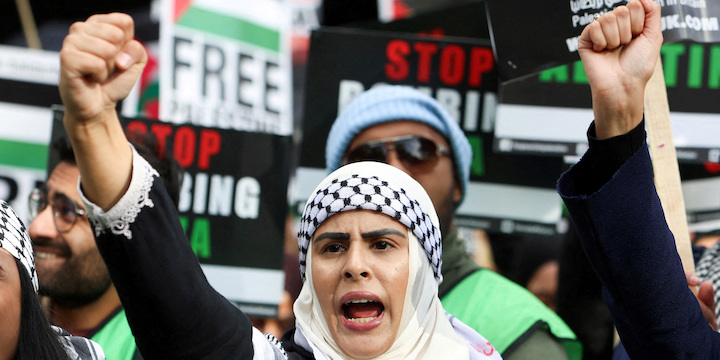
Illustrative: Demonstrators protest in solidarity with Palestinians in Gaza, amid the ongoing conflict between Israel and Hamas, in London, Oct. 28, 2023. Photo: Reuters/Susannah Ireland
In the West today, Jews and non-Jews speak anxiously about antisemitism. They debate incident statistics, survey results, attitudes toward Israel, and the distinction — supposedly crucial — between hostility to Jews and hostility to the Jewish State.
Enormous intellectual and financial energy is invested in measuring all of this. Yet these debates are largely beside the point. They are a proxy for a darker, unspoken question: could another Holocaust happen?
Statistics cannot answer that question. They were never designed to. Nor can opinion surveys, however sophisticated.
After more than a decade of empirical research into antisemitism in Western societies, I have reached a conclusion that will sound extreme but is, I believe, unavoidable: another catastrophe for the Jews is not only possible but increasingly probable.
This is not because of a sudden resurgence of old-fashioned hatred, but because Western societies are undergoing a profound spiritual and political transformation — and Jews are once again positioned as expendable.
The West has largely de-Christianised. In the vacuum left behind, it is constructing an alternative creed powerful enough to provide meaning, cohesion, and moral orientation to societies that are fragmented, diverse, and unsure of themselves. One of these creeds is pro-Palestinianism. It functions not merely as a political stance, but as a civic religion.
Civic religion is not a new concept. It refers to the shared rituals, symbols, and moral narratives that bind a nation together when traditional faith weakens. What is new is the content. Pro-Palestinianism offers a simple moral universe — victim and oppressor, innocence and guilt — at precisely the moment when Western societies feel incapable of enforcing older lines of belonging and authority.
This helps explain several developments that otherwise appear baffling.
First, the speed and intensity of the Gaza War protests. Within days of October 7, 2023 — before the war had meaningfully unfolded, before casualty figures could be invoked — hundreds of thousands were already mobilised across Britain and Western Europe. The slogans evolved over time, but the mobilisation was instant and relentless. This was not spontaneous outrage reacting to unfolding facts. It was something closer to ritualised response.
There is no need to invoke conspiracy. The machinery behind this mobilisation is visible and long-established. Its urgency does not stem from the Middle East, but from Europe itself. Western societies are grappling with the integration of large immigrant populations, many from Muslim-majority countries, for whom identification with the Palestinian cause is emotionally immediate. Aligning national moral narratives with this cause is a low-cost way to signal inclusion, empathy, and shared purpose. Call it appeasement if you like; the deeper issue is insecurity. Societies that lack confidence in their own values are reluctant to discipline, because discipline presupposes a shared line — and the line is gone.
Second, the sheer disproportionality of the Palestinian issue in European politics. Governments fall, ministers resign, parties form, and retailers boycott over Gaza, while conflicts with far greater strategic relevance — Russia’s war in Ukraine, for example — fade into the background. Palestinian flags saturate cultural spaces, from city streets to school fundraisers to the inner doors of pub toilets. Avoiding the messaging now requires active withdrawal from public life.
This is not noble universalism. It is selective moral inflation. Gaza has “won” the competition for Western attention because it serves an internal function. Casting Israel as a supreme criminal and Palestinians as ultimate victims fits the sensibilities of newly arrived populations whose integration is deemed essential, and progressive movements unhappy with what they deem racism and elite supremacy in their own nations. Pro-Palestinianism promises social harmony, or at least the appearance of it. The reward is cohesion; the price is intellectual honesty.
Third, the widespread willingness to ignore — or actively deny — the atrocities of October 7. The denial is often explained as bad faith or manipulation. I think something simpler is at work. The violence was too alien, too disturbing for contemporary Western sensibilities. It does not fit the moral script that pro-Palestinianism requires. And so it must be softened, relativised, or erased. This is not endorsement of terrorism; it is narrative necessity. Civic religions, like traditional ones, cannot tolerate facts that undermine their moral clarity.
Finally, there is the strangest alliance of all: pro-Palestinianism’s ability to unite groups with fundamentally incompatible worldviews. The most striking case is the enthusiastic embrace of the Palestinian cause by segments of the LGBT community. The contradiction is obvious. Israel is the most LGBT-tolerant society in the Middle East; Palestinian and broader Muslim societies are not. In Gaza, homosexuality can be a capital offense. Yet the alliance persists.
This is not confusion. It is strategy. In Western societies, LGBT rights remain culturally contested, particularly among immigrant communities. Embracing a shared moral cause costs little and builds goodwill where it is most needed — at home, not abroad. Pro-Palestinianism functions as a bridge, allowing incompatible groups to coexist under a single moral banner.
Put together, these puzzles point to a single conclusion. The West is experiencing a genuine spiritual crisis. The sensibilities of the West today are secular, Islam is not attractive for the same reason that Christianity was abandoned. Nihilism cannot integrate diverse populations. And they are diverse. Very large minorities among the young generations in major Western European cities, at times 20%-40%, are Muslim or of Muslim heritage. A new glue is required — one that is emotionally compelling, morally binary, and accessible across cultural divides. Pro-Palestinianism fits the role perfectly.
But civic religions have consequences. They demand sacrifices. Historically, societies stabilise themselves by offloading tension onto those least able to resist. Jews, numerically small and symbolically charged, have always been vulnerable in such moments. There is little reason to believe this time will be different.
I am not predicting gas chambers. At least, I do not insist on them. History rarely repeats itself so neatly. Disenfranchisement, exclusion, informal expulsion, and moral abandonment are more likely. They will be framed, as always, in the language of justice and peace.
The uncomfortable truth is this: pro-Palestinianism did not arise despite Western weakness, but because of it. And until Western societies confront the spiritual emptiness that made this new faith necessary, they will continue to demand offerings. Jews have seen this altar before.
Dr. Daniel Staetsky is an expert in Jewish demography and statistics. He is based in Cambridge, UK.
This content is courtesy of, and owned and copyrighted by, https://www.algemeiner.com and its author. This content is made available by use of the public RSS feed offered by the host site and is used for educational purposes only. If you are the author or represent the host site and would like this content removed now and in the future, please contact USSANews.com using the email address in the Contact page found in the website menu.