
🔴 Website 👉 https://u-s-news.com/
Telegram 👉 https://t.me/usnewscom_channel
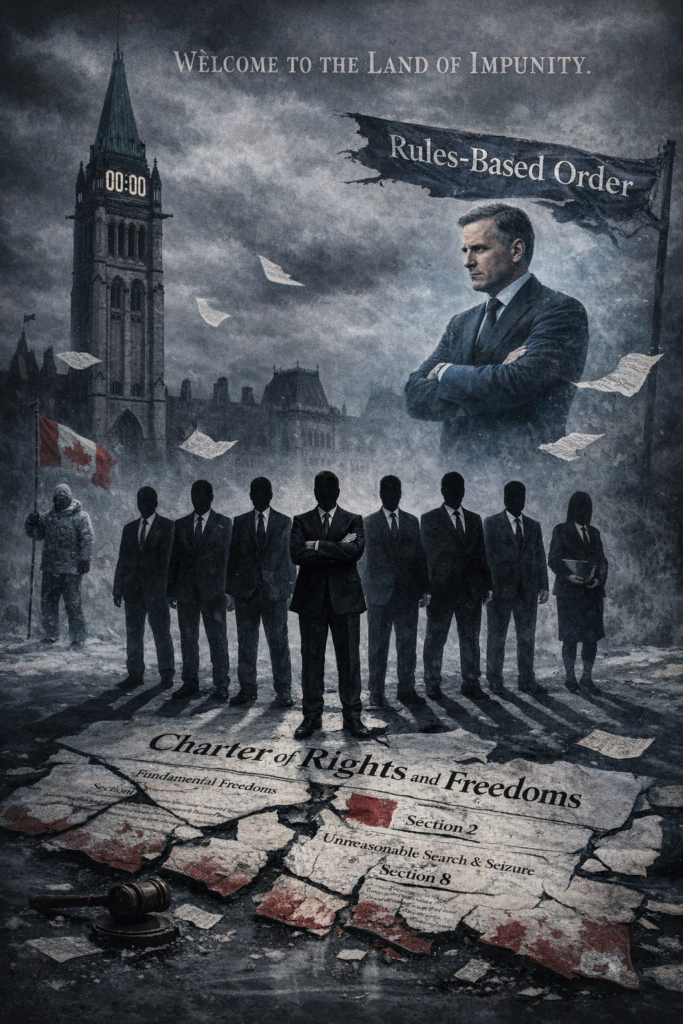
Two courts have ruled. Six ministers remain. One Prime Minister stays silent. Welcome to Canada, where the government violating the Charter of Rights and Freedoms carries precisely zero consequences.
On January 16, 2026, the Federal Court of Appeal unanimously ruled that the Canadian government’s invocation of the Emergencies Act violated the Charter of Rights and Freedoms. Four days later, Prime Minister Mark Carney stood before the assembled political and business elite at Davos, Switzerland, and delivered a passionate defense of the rules-based international order, championing “legitimacy, integrity, and rules” as the foundation of global cooperation to a fawning audience.
He spoke eloquently about values. About respect for human rights. About the importance of sovereignty and territorial integrity. About how might does not make right. About how middle powers must stand together for constitutional principles against the arbitrary exercise of power.
He said nothing about the court ruling that found that his predecessor’s government, members of which remain in his cabinet, violated Canadians’ constitutional rights. He has said nothing since. The government has not indicated whether it will appeal to the Supreme Court. As of this writing, no minister who participated in the decision has resigned or been removed from cabinet.
Boastful abroad. Silent at home. Carney can make claims to defend Canadian sovereignty at Davos, but when he shies away from a historical and massive violation of civil rights by the ministers who surround him in cabinet, he endorses a trampling of the sovereignty the people represent in a liberal democracy. Even in a constitutional monarchy like Canada’s, the sovereignty of the people finds expression through their Charter rights. Those rights were violated. The Prime Minister’s silence is complicity.
Welcome to the land of impunity.
Facts That Are Not in Dispute
In February 2022, the Trudeau government invoked the Emergencies Act, a War Measures Act-like law, against the Freedom Convoy protesting the excesses of the COVID lockdowns. Nearly two years later, in January 2024, Federal Court Justice Richard Mosley ruled the invocation unreasonable and unconstitutional. He found it violated sections 2(b) and 8 of the Charter: freedom of expression and protection against unreasonable search and seizure. Chrystia Freeland, then Minister of Finance and Deputy Prime Minister, quickly jumped in front of cameras to announce the government would appeal.
The appeal failed. In January 2025, the Federal Court of Appeal unanimously upheld Justice Mosley’s ruling. All three judges agreed that the protests “fell well short of a threat to national security.” They rejected the government’s expansive interpretation of emergency powers. They found the freezing of bank accounts without objective standards unlawful. They ruled that threatening peaceful protesters with $5,000 fines violated their fundamental rights.
Two consecutive courts. Unanimous decisions. Constitutional violations confirmed. What happened next? Nothing.
Nine Ministers, Zero Consequences
Collective cabinet responsibility is a foundational principle of Westminster democracy. When cabinet makes a decision, all ministers share responsibility for that decision. This is not an abstract theory. It is how cabinet government functions. In February 2022, the Trudeau cabinet collectively decided to invoke the Emergencies Act. Courts have now twice ruled their decision violated the Constitution.
At least nine ministers who sat in that cabinet have been involved with Mark Carney’s government. Six remain in cabinet today. Anita Anand, who was the National Defence Minister in February 2022, now holds the portfolio of Foreign Affairs. Sean Fraser, who managed Immigration during the invocation, now serves as Justice Minister. Dominic LeBlanc, who handled Intergovernmental Affairs when emergency powers were deployed, now manages Canada-U.S. Trade. François-Philippe Champagne, Innovation Minister in 2022, now oversees Finance. Mélanie Joly moved from Foreign Affairs to Industry. Patty Hajdu shifted from Indigenous Services to Jobs and Families.
Two more served in Carney’s cabinet but have since resigned. Chrystia Freeland, who, as Deputy Prime Minister and Finance Minister, ranked among the most senior voices supporting the Emergencies Act in February 2022, served in Carney’s cabinet as Transport and Internal Trade Minister until her resignation in September 2025. Steven Guilbeault, Environment Minister during the invocation, held the Canadian Identity and Culture portfolio in Carney’s government until his resignation in December 2025 over disagreements over energy policy.
Not one has resigned, been fired, or even acknowledged the court rulings. I am inclined to compare them to Ostriches, but I do not want to imply that they should be unjustly slaughtered.
The situation grows worse. There are two other ministers from that February 2022 cabinet who never joined Carney’s cabinet but were involved with the PM. Instead, Mark Carney’s initial choice for Chief of Staff was Marco Mendicino. As Public Safety Minister in the Trudeau cabinet, Mendicino joked with David Lametti about crushing the protestors with tanks, and later “testified” in Committee, repeating falsehoods and propaganda that the peaceful protestors had tried to burn Ottawa residents alive in an apartment building. Mendicino also repeatedly claimed the Emergencies Act was invoked “on the recommendation of law enforcement.” RCMP Commissioner Brenda Lucki testified under oath that while her agency was consulted, it “never requested nor recommended” the Act’s use. Ottawa’s interim police chief confirmed he did not request the invocation. Ontario Provincial Police gave similar testimony. Mendicino’s justifications for the Charter violations were demonstrably false. His reward for these falsehoods? Carney named him interim Chief of Staff in March 2025. He served in that capacity until July, when he departed to join a law firm.
Then there is David Lametti, once at McGill University, whom Carney briefly named Principle Secretary. Lametti was Attorney General in Trudeau’s government at the time of the invocation. Lametti is now out of the country in New York City, as Canada’s Representative to the United Nations, replacing Bob Rae. You’re reading that right! One of the architects of one of the most significant violations of civil rights in Canada now represents Canada among the nations of the world at the international institution that gave us the Universal Declaration of Human Rights.
The Prime Minister’s Silence
Mark Carney’s position proves even more troubling than the retention of ministers who approved Charter violations. On February 7, 2022, one week before the Emergencies Act was invoked, smelling political blood in the water, Carney wrote in the Globe and Mail that the Freedom Convoy represented “sedition.” He demanded that authorities “choke off the money” financing the protests. “Anyone sending money to the convoy should be in no doubt: You are funding sedition,” he wrote. “Canadian authorities should take every step within the law to identify and thoroughly punish them.”
Internal RCMP emails later revealed that officers ridiculed Carney’s legal analysis. Bankers pretending to be lawyers. They noted that his definition of sedition appeared to be copied from an American dictionary and failed to meet Canada’s legal standard, which requires “use of force.” The prediction proved accurate. No protester was ever charged with sedition. Of 230 arrested, only 119 faced charges, typically for mischief, a catch-all charge.
Carney had advocated for financial measures that courts twice ruled violated the Charter. When asked recently about his characterization of the protests, he refused comment. As Prime Minister, Carney has made no statement about two consecutive court rulings finding that his predecessor’s government violated Canadians’ Charter rights. He has retained six ministers who participated in that decision. He appointed a minister as his Chief of Staff, who justified those violations with proven falsehoods. He has offered no apology to those whose rights were violated, no explanation for how his government will prevent such abuses, and no acknowledgment that constitutional violations occurred.
The silence is complete. It is also deliberate.
The Westminster Pretense
Defenders of this status quo will invoke Westminster tradition. Ministerial responsibility, they will say, is a convention. It is flexible, subject to political judgment, not a rigid rule requiring resignation. This characterization is technically correct. It is also irrelevant.
The question is not whether ministers are legally compelled to resign. The question is whether a regime unaccountable for such constitutional violations can still call itself a democratic state. Does this question not arise? When six ministers who approved Charter violations continue to govern under a Prime Minister who publicly advocated for those same violations, and when a minister who justified them with proven falsehoods becomes the Prime Minister’s Chief of Staff, has Canada crossed a threshold that should trouble anyone who values constitutional democracy and individual rights?
Consider the closest precedent. In 2019, Boris Johnson’s government suspended Parliament. The UK Supreme Court unanimously ruled Johnson’s prorogation unlawful. Opposition leaders demanded his resignation. Former Conservative Attorney General Dominic Grieve stated Johnson should resign “as a matter of constitutional principle.” Johnson refused. He weathered the storm and continued governing. He eventually resigned three years later over an entirely different scandal.
The Canadian situation exceeds even that troubling precedent. Johnson faced a single court ruling for a single unlawful act. Canada has two consecutive court rulings confirming the government’s blatant Charter violations, but all is quiet. The absence of consequences has transformed ministerial responsibility from a meaningful accountability mechanism into an optional political convention, ignored when politically convenient.
The Impunity Principle
What Canada is witnessing represents the metastasis of a new constitutional principle: Cabinet decisions that violate the Charter carry no consequences for ministers involved. The mechanism is simple, even elegant. Courts can rule actions unlawful. They have done so, twice. Individual citizens can sue for damages, though this requires resources most lack and years most cannot afford. Parliament can demand accountability, but the opposition lacks the votes to compel it. The Prime Minister can fire ministers, but Carney retains them. Voters can punish the government, though this remedy awaits the next election and depends on the public sustaining attention to constitutional violations amid competing concerns, it seems unlikely. The election last year came on the heels of the first ruling, and the Laurentian voters still threw their support behind the ruling party.
Since ministerial responsibility exists as convention rather than law, and since conventions depend on political enforcement rather than legal compulsion, ministers who violate the Charter face consequences only if political actors choose to impose them. When the Prime Minister declines to speak, let alone act, when Parliament lacks the votes, when the media plays interference and moves to the next story, impunity prevails. This is not a one-off in the Westminster system. It has become a new-normal feature.
If cabinet can invoke emergency powers without meeting the legal threshold, freeze citizens’ bank accounts without due process, threaten peaceful protesters with fines, have courts twice rule these actions violated fundamental rights, and face zero accountability, what exactly does the Charter protect? Progressives who actively love and use the courts to advance their policy agendas are also silent.
If a province were the culprit in similar transgressions, the federal government would be all over it. But who holds Ottawa accountable? The answer grows increasingly clear. The Charter does not protect citizens from their central government. It protects nothing that matters when constitutional rights collide with the central executive power.
People in Saskatchewan and Alberta, already pushing to free themselves from Ottawa’s abuses, will take notice.
The Remedies That Don’t Exist
Individual Freedom Convoy participants can sue for Charter damages. These cases will take years. They will cost fortunes. They may eventually provide compensation to specific individuals. But individual remedies do not create institutional accountability. They do not deter future governments from similar abuses.
Parliamentary opposition can raise the issue in Question Period. The government can ignore them, and has. Without votes for a confidence motion, parliamentary scrutiny becomes theatre. Provinces can challenge federal overreach. But provincial objections do not restore violated rights or punish those responsible.
Voters can punish the government at the next election. This remedy requires making Charter violations a central issue. It requires sustaining public attention. It requires trusting the electorate to prioritize constitutional principles over immediate economic concerns. These are substantial requirements in a democracy where attention spans are short, economic anxieties run deep, and the mainstream press is coopted.
What Canada lacks is any automatic legal mechanism to hold ministers accountable when they violate citizens’ Charter rights. Courts can declare violations. Courts have done their job in this case. But enforcing consequences requires political will. When the Prime Minister who committed violations disagrees with court rulings, when the Prime Minister who advocated for violations stays silent, and when the ministers involved continue serving, the system has no remedy. The constitutional architecture fails at precisely the moment it matters most.
And it may be worse. If Ottawa appeals, the Supreme Court may hear the case. Its Chief Justice already maligned the protesting citizens whom Mark Carney called seditionists. It will be embarrassing for the Court if the case comes to them.
The Precedent Being Set
The Emergencies Act violations establish a template for future governments. The steps are straightforward. Invoke extraordinary powers beyond the legal threshold. Violate Charter rights in the service of political objectives like protecting the economic fortunes of a floundering government. When courts rule actions unlawful, ignore the rulings. Retain all ministers involved. Never acknowledge wrongdoing. Never discuss it. Ignore it. Face no consequences.
Future governments will study this precedent closely. If the federal cabinet can violate the Charter with impunity, twice confirmed by courts, why restrain executive power at all? The Emergencies Act was supposed to replace the War Measures Act with strict safeguards and high legal thresholds. Those thresholds were ignored. The safeguards failed and there are no consequences to be enforced.
What signal does this send about the next emergency? The next crisis? The next time a prime minister finds the Charter inconvenient? The answer should alarm anyone who values constitutional limits on power.
What Westminster Tradition Actually Required
Classical Westminster doctrine is unambiguous. When courts rule government actions unlawful, ministers involved should acknowledge the ruling publicly. They should answer to Parliament for their role. They should apologize for the violations. They should offer their resignation or be removed by the Prime Minister. At the absolute minimum, the Prime Minister should address court rulings finding his predecessor’s government violated fundamental rights.
None of this has occurred. The silence is not accidental. It is policy.
Mark Carney owes Canadians answers:
- Do you acknowledge two courts ruled the Emergencies Act invocation unlawful?
- Do you accept that Charter rights were violated?
- Do you stand by your February 2022 column calling protesters seditious?
- Why have you retained six ministers who participated in the violations?
- Why did you appoint Marco Mendicino as Chief of Staff after his false statements about law enforcement recommendations?
- What will your government do to prevent such abuses in future?
- Will you apologize to those whose rights were violated?
- The ministers who participated in invoking the Emergencies Act owe answers:
- Do you accept that your decision violated the Charter?
- What justified freezing citizens’ bank accounts without due process?
- Why did you support measures that threatened peaceful protesters?
- Do you believe the court rulings were correct?
These questions are unlikely to be answered. The government will maintain its silence. The divided opposition lacks votes to compel responses. The fawning media, still inebriated from the Davos Speech, will keep quiet and move to the next story. The constitutional violations will fade from public consciousness. This is how impunity works in Westminster systems. Not through defiance of institutions, but through the silent erosion of conventions. Not through rejecting accountability, but through ignoring calls for it until they dissipate into the noise of daily political combat.
The Land of Impunity
Canada markets itself as a nation of laws, rights, and accountability. The Charter of Rights and Freedoms was supposed to mean something. Progressives keep inventing rights to include. It represents a solemn guarantee that government power has limits and citizens have protections from rulers. Two courts have said those limits were exceeded and those protections violated. No one resigns over constitutional violations. No one apologizes. No one is held accountable.
The Emergencies Act violations revealed something profound about contemporary Canada. Ministerial responsibility is dead. The Charter is optional. When executive power collides with fundamental rights, power wins.
This is Canada now. A country where violating the Charter carries precisely zero consequences for those who swore to uphold it. Yet, the Prime Minister can bask in standing ovations from world leaders, praising a fictitious international “rules-based order.”
This is the land of impunity.
Haultain Research is a reader-supported publication. To receive new posts and support our work, consider becoming a free or paid subscriber
This content is courtesy of, and owned and copyrighted by, https://peckford42.wordpress.com and its author. This content is made available by use of the public RSS feed offered by the host site and is used for educational purposes only. If you are the author or represent the host site and would like this content removed now and in the future, please contact USSANews.com using the email address in the Contact page found in the website menu.