

🔴 Website 👉 https://u-s-news.com/
Telegram 👉 https://t.me/usnewscom_channel
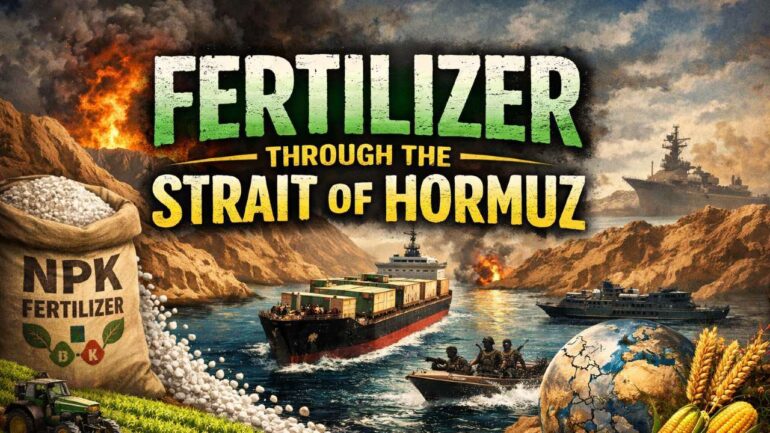
The closure of the Strait of Hormuz has escalated beyond energy markets and is now a direct threat to global food supplies, with fertilizer shipments and natural gas flows choked off and planting seasons at risk. This piece lays out how fertilizer dependencies, supply chain disruptions, national responses, and geopolitical choices are converging to create a real food security emergency. It argues from a Republican perspective that the United States must lead firmly to restore commercial traffic and secure supplies for farmers. Expect stark consequences worldwide if the corridor stays closed through the spring planting season.
Rerouting fertilizer and energy flows overnight isn’t possible; production and transport are tightly linked to the Strait of Hormuz. About a third of global nitrogen fertilizer and roughly half of the sulfur used for phosphate travel through that narrow waterway, so a prolonged shutdown is not a minor disruption. With planting windows fast approaching, delays translate directly into lower yields and higher food prices.
Another world crisis sparked by the war in Iran may also be in the offing. That’s because the region’s oil and gas production has made it one of the world’s leading exporters of nitrogen fertilizers, which are indispensable to the global food system. To produce the chemicals used to grow much of the planet’s crops, natural gas is broken down to extract hydrogen, which is combined with nitrogen to make ammonia, and then mixed with carbon dioxide to make urea. All told, nearly a third of the global trade for nitrogen fertilizer passes through the Strait of Hormuz, while almost half of the world’s sulfur, essential in producing phosphate fertilizers, also travels through the corridor.
Fertilizer plants depend on steady LNG supplies to run, and when ship routes are blocked, production falls. Producers in India, Pakistan, and other regions are already seeing declines because their gas supplies largely come through the Gulf. Those declines lock in higher food prices even if the conflict later cools, because farmers will have missed critical application windows.
Already, fertiliser plants in India and Pakistan are facing production declines given the disruption to natural gas supplies from the Middle East. Gulf countries targeted in the war supply nearly all of Pakistan’s LNG imports, 72% of Bangladesh’s and 53% of India’s.
Even if deescalation occurs, the conflict has likely locked in a food price hike in the coming months. The longer the war continues, the greater the shock to food security as energy and fertiliser prices remain elevated.
American farmers are feeling the squeeze too, with dealers warning shipments may not arrive in time for spring. When a Virginia grower hears “we can’t get the fertilizer,” that’s not a headline, it’s a production reality that affects corn, soy and wheat yields. One-off shortages become a systemic threat if enough farms are affected across states.
John Boyd Jr., a fourth-generation farmer in Virginia who grows soybeans, corn and wheat, said his fertilizer supplier recently warned him that shipments may not arrive as expected.
“The dealers are telling me we can’t get the fertilizer,” Boyd told NBC News in an interview this week. “Due to the war and the bombing through that area, the fertilizer isn’t moving.”
Fertilizer is essential to food production, he said, and it must be applied before crops are planted.
“If I don’t apply fertilizer, that means I won’t have the yields to make my crop,” Boyd explained.
Farm organizations are raising the alarm and urging quick, effective action to stabilize supplies. The problem is not theoretical; it’s logistical and political, and it demands leadership. When production inputs vanish, markets rippled by fear and hoarding make the situation worse for vulnerable nations.
The war in Iran has led to the closure of the Strait of Hormuz, a critical shipping route not only for oil and gas, but also for fertilizers needed to produce the world’s food.
“We cannot grow without it. There is absolutely no way you get around it,” said Stacy Simunek, president, Oklahoma Farm Bureau.
Roughly half the global population relies on food grown with synthetic nitrogen fertilizers, so this is not just an agricultural problem for wealthy nations. A shortfall in fertilizer supplies compounds hunger where people are already food insecure, pushing crises into catastrophe. The timing ahead of spring planting makes it urgent.
About 4 billion people on the planet eat food grown with synthetic nitrogen fertilizers. Roughly half of the global population, in other words, is alive because of these chemicals converted into nutrients for plants, said Lorenzo Rosa, who researches sustainable energy, water, and food systems at the Carnegie Institution for Science at Stanford University.
China, the world’s largest fertilizer producer, has moved to curb exports to protect domestic supply, which tightens the global market further. That national self-protection is understandable, but it deepens shortages elsewhere and accelerates a scramble for what remains. Countries that relied on open trade routes are now competing for limited volumes at higher prices.
China is tightening controls on fertilizer exports as disruptions linked to the conflict in Iran ripple through global crop-nutrient markets and push prices higher. Authorities have asked exporters to halt outbound shipments of nitrogen-potassium fertilizer blends while reiterating existing restrictions on urea exports, according to people familiar with the matter. The steps appear aimed at protecting domestic supply and stabilizing prices as farmers prepare for the spring planting season, a period when demand typically peaks in the country’s vast agricultural sector.
People familiar with the situation said the latest directives have effectively paused overseas shipments of most fertilizer types, including compound varieties that had still been moving abroad after China loosened some urea limits last year. One key exception is ammonium sulfate, which accounted for about half of the country’s fertilizer shipments last year and remains unaffected for now.
Washington officials say they are searching for alternative sources and working to minimize disruptions, but action must be more than words. Restoring safe passage through the Strait of Hormuz is the fastest way to stabilize the market, and that may require clear U.S. resolve. On the world stage, American leadership is the most reliable path to prevent a spiraling food crisis.
The United States has been informed by most of our NATO “Allies” that they don’t want to get involved with our Military Operation against the Terrorist Regime of Iran, in the Middle East, this, despite the fact that almost every Country strongly agreed with what we are doing, and that Iran cannot, in any way, shape, or form, be allowed to have a Nuclear Weapon. I am not surprised by their action, however, because I always considered NATO, where we spend Hundreds of Billions of Dollars per year protecting these same Countries, to be a one way street — We will protect them, but they will do nothing for us, in particular, in a time of need. Fortunately, we have decimated Iran’s Military — Their Navy is gone, their Air Force is gone, their Anti-Aircraft and Radar is gone and perhaps, most importantly, their Leaders, at virtually every level, are gone, never to threaten us, our Middle Eastern Allies, or the World, again! Because of the fact that we have had such Military Success, we no longer “need,” or desire, the NATO Countries’ assistance — WE NEVER DID! Likewise, Japan, Australia, or South Korea. In fact, speaking as President of the United States of America, by far the Most Powerful Country Anywhere in the World, WE DO NOT NEED THE HELP OF ANYONE! Thank you for your attention to this matter. President DONALD J. TRUMP
Europeans say they won’t put personnel in harm’s way, preferring diplomacy to naval escorts, but diplomacy can take time we no longer have. Real security of shipping lanes may require a combination of deterrence, allied naval presence, and rapid diplomatic pressure. The choice is stark: act decisively or watch fertilizer and food shortages deepen worldwide.
“Nobody is ready to put their people in harm’s way in the Strait of Hormuz,” EU foreign policy chief Kaja Kallas told the Reuters news agency on Tuesday. “We have to find diplomatic ways to keep this open so that we don’t have a food crisis, fertilizers crisis, energy crisis as well.”