
🔴 Website 👉 https://u-s-news.com/
Telegram 👉 https://t.me/usnewscom_channel
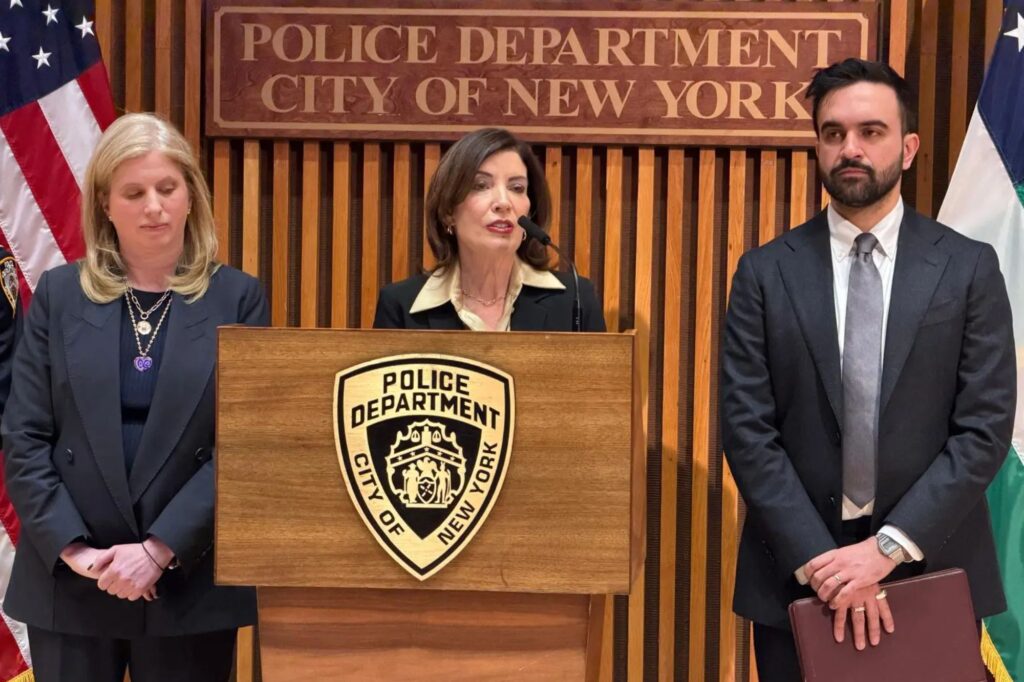
At last week’s 2025 year-end crime briefing, Commissioner Jessica Tisch cited multiple successes tied to the NYPD’s relentless focus on crime hotspots and the gang members within them; the rundown was impressive and encouraging — except for one major category: juvenile crime.
So what gives?
Maybe it’s the state’s 2018 Raise the Age law.
Year over year, murders in New York City were down some 20% in 2025, robberies down almost 10%, and thefts and burglaries down modestly; shootings were at their lowest levels ever.
Juvenile crime, however, kept rising.
“While we have made historic gains, generally, fighting violent crime, we have not turned the tide yet on youth violence,” Tisch told the media at One Police Plaza.
The commissioner said 14% of shooting victims were under age 18 in 2025 (up from 9% the previous year), and 18% of gun-violence perpetrators were minors, too.
Both percentages represent high-water marks since the NYPD began tracking the measure in 2018 — the year provisions of Raise the Age first went into effect.
Raise the Age increased the age of criminal responsibility to 18, resulting in the vast majority of 16- and 17-year-old offenders being routed to Family Court.
There they escape sanctions like jail and prison.
“Once in Family Court,” former Bronx Assistant District Attorney Dyer Halpern wrote in a 2023 Manhattan Institute report, “most defendants will never see a judge. They will receive diversionary adjustment by the probation department, and their case will be closed.”
There are two possible explanations for juvenile crime’s sharp divergence from broader crime trends.
Perhaps juvenile crime is an anomaly, so unlike other crime categories that it’s immune to the policing strategies that pushed shootings, homicides and other serious crimes down.
Or perhaps Raise the Age itself is making youth crime worse.
Choosing between the two possibilities would be harder if communities across the rest of the state weren’t seeing similar problems.
But they are. Crime among teens is rising statewide.
That’s prompted district attorneys from around the state to renew calls for changes to the Raise the Age law.
Mary Pat Donnelly, Rensselaer County DA and president of the District Attorneys Association of the State of New York, told The Post last week that Gov. Kathy Hochul must revise the legislation to “adequately tackle the rise in youth gun violence across our state.”
Changes to the law “should focus both on the rehabilitation of adolescent offenders and community safety,” Donnelly said.
Yet that may not be much help: Any claim that we know how to reliably “rehabilitate” offenders — of any age — should be met with deep skepticism.
According to a recent Manhattan Institute review of the literature on rehabilitation, there just isn’t much evidence to support the notion that such programs have any real effect — and that’s true of those targeted at both juveniles and adults.
Changing human behavior — let alone that of an unruly teen — is no easy task.
Policymakers shouldn’t assume that any program can reorient the antisocial dispositions of youthful offenders.
Instead, Hochul should concentrate on filling the gaps that Raise the Age poked in the justice system — gaps through which far too many teenagers fall through every day.
Even modest fixes could make a big difference: Youth Part judges could be given access to a juvenile defendant’s full criminal history, for example, and the inquiry that determines whether cases get removed to Family Court could require putting public safety considerations first.


We must understand, however, that the anti-incarceration left did this on purpose.
After all, an advocacy-group recently bragged, “Raise the Age is working as intended.”
Their intent was to keep juveniles out of the adult system and out of jails and prisons.
By that measure, it has been a success.
But by measures that matter far more — such as whether young offenders are safer or leading more productive lives — Raise the Age has failed.
The most recent crime numbers make this clear, and they reinforce what the data have been telling us since this law went into effect.
According to the Mayor’s Office for Criminal Justice, the share of serious violent felony arrests of juveniles in New York City rose from 9.8% in 2018 to 13.1% in 2022, to 15.6% in 2024 — to 23.3% in 2025.
Juvenile offending must be considered an urgent problem.
Taking those concerns seriously may not require blowing up Raise the Age in its entirety, but Albany should put a fix on the table in the current legislative session.
Those who still believe that any form of incarceration is too harmful for teens will resist calls to reconsider the more lenient approach embodied in Raise the Age.
They should ask themselves: Is it right to make teen shooting victims pay for that generosity?
Rafael A. Mangual is the Nick Ohnell fellow at the Manhattan Institute for Policy Research and author of the book “Criminal (In)Justice.”