
🔴 Website 👉 https://u-s-news.com/
Telegram 👉 https://t.me/usnewscom_channel
Halfway through the 119th Congress, it’s time to take a look at Republican leadership’s report card.
With razor-thin majorities in both Houses, Republicans have succeeded in extending President Donald Trump’s tax cuts and defunding public broadcasting and foreign aid.
But there are storm clouds on the horizon. Democrats are looking to take back the lower chamber in the 2026 midterms, while Republicans are engaged in a health care policy push, the fate of which is very uncertain.
With the new year upon us, it’s worth looking back at the moments when Republicans have triumphed and struggled in getting results out their unwieldy coalition.
Johnson’s Reelection Bid
The first item on the agenda for Speaker of the House Mike Johnson, R-La., was getting reelected as the chamber’s top-ranking member in January.
Just as the gavel was difficult to come by when former Speaker Kevin McCarthy was ousted in 2023, it was difficult to maintain.
In the first round of votes, Republican Reps. Thomas Massie of Kentucky, Keith Self of Texas, and Ralph Norman of South Carolina all cast their votes against Johnson, while Rep. Chip Roy, R-Texas, defiantly abstained from voting.
Eventually, after communication with the White House and with Johnson, enough holdouts agreed to elect him, but with the understanding that he would commit to fiscal conservatism.
After Johnson was reelected, fiscal hawks made clear they expected an aggressively conservative approach from Johnson throughout the Congress.
“I think we had some reservations that are sincere, based on the speaker’s past 15 months as the speaker,” Rep. Scott Perry, R-Pa., told The Daily Signal in a phone interview at the time. “But we have steadfast support of the president and his timely certification, and so we don’t want to imperil that. And so, it’s a balance. But we also wanted to send a signal that business as usual around here is not going to stand.”
He added, “The speaker is on notice that if he’s going to continue to lead like he has over the last 15 months, it’s not going to end well,” he continued.
The ‘Big, Beautiful Bill’
The “Big, Beautiful Bill” stands as the most important piece of legislation passed in the 119th Congress thus far.
The first few months of President Donald Trump’s new administration were consumed by feverish debates over a budget reconciliation bill that would extend and expand on Trump’s 2017 tax cuts, put work requirements into the Medicaid program, and reverse much of President Joe Biden’s green energy policies, and fund mass deportation efforts.
The bill started out in the House, where for months leadership faced pressure from various camps within their narrow majority. The benefit of a budget reconciliation bill is its immunity to the Senate’s 60-vote filibuster threshold, allowing leadership to focus solely on acquiring Republican votes.
On the one hand, there was the SALT faction. These blue-state Republicans demanded an increase to the cap on state and local tax deductions for their constituents, which allow Americans to deduct their local taxes on their federal tax returns.
The SALT faction emerged with a win, as the bill boosted its deduction cap up to $40,000 a year, up from $10,000 in 2024.
Then there was the House Freedom Caucus, which exerted pressure on the speaker every step of the way. From the beginning, they made their demands clear: matching new tax cuts to spending cuts to make up for potential revenue losses, ending the subsidization of green energy, and cost-saving reforms of Medicaid.
The House was able to perform a balancing act between these and other factions, sending the bill to the Senate before Memorial Day.
In the Senate, leadership had a shorter time frame for turning the bill around. Surprisingly, the Senate included new conservative health care provisions, such as capping the health care provider tax—a tool used by states to extract more federal funds.
Additionally, the Senate expanded on the House’s tax cuts, making some conservatives in the House nervous about a departure from the House’s insistence on matching tax cuts with spending cuts.
On the other hand, the Senate aggressively cut out green energy tax incentives in the big, beautiful bill.
Ultimately, there were winners and losers in the Senate. Sen. Thom Tillis, R-N.C., voted against it due to the provider tax cap, and subsequently announced he would not be seeking another term when Trump threatened a primary challenge.
Sen. Rand Paul, R-Ky., also voted against it due to complaints over its increase to the debt ceiling, and Sen. Susan Collins, R-Maine, voted nay due to its entitlement reforms.
Others emerged with wins that ensured it passage, such as Sen. Lisa Murkowski, R-Alaska, who voted for the bill after a number of Alaska-related provisions were included, such as a tax deduction for Alaskan whaling captains.
At the end, Senate Majority Leader John Thune, R-S.D., succeeded in getting it across the finish line when Vice President JD Vance’s tie-breaking vote allowed it to pass by a 51-50 margin.
The bill then made it over to the House, where, despite significant changes in the Senate that made both moderates and hardliners uneasy, it finally passed on July 3 and was signed into law on Independence Day, July 4.
The Shutdown
This Congress made history for the wrong reasons this year, too.
Democrat demands over health care for illegal aliens and an extension of President Joe Biden’s COVID-19-era increases to premium tax credit levels resulted in the longest federal government shutdown ever.
The shutdown spanned 43 days from Oct. 1 to Nov. 12.
Republicans, under the leadership of Sen. John Thune, R-S.D., refused to the very end, arguing the subsidies are inflationary, prone to fraud, and prop up a broken system.
What ensued was weeks of repeated voting on a government funding stopgap mechanism.
Sen. John Fetterman, D-Pa., compared the ordeal to the movie “Groundhog Day,” as Republicans continued to put funding bills on the Senate floor and Democrats continued to reject them.
There were many unusual things about this shutdown, though. For one, Johnson decided to keep the House out of session up until the end.
Additionally, Trump’s trolling of Democrats went into overdrive with the president posting artificial intelligence-generated videos of Senate Minority Leader Chuck Schumer and House Minority Leader Hakeem Jeffries, both D-N.Y., in sombreros demanding health care benefits for illegal immigrants.
The shutdown eventually came to an end when a coalition of Democrats agreed to pass a funding package consisting of a clean funding extension combined with a package of appropriations bills and a promise of a vote on extending the premium tax credits.
It was soon thereafter passed by the House and sent to the president, ending a shutdown which strained every part of the federal government.
An Inconclusive Finish
It is an awkward moment for Republicans at the halfway point in this Congress, and especially in the House.
Although Democrats eventually gave in to Republicans in the shutdown battle, they did succeed in turning the Capitol’s focus towards the issue of the expiration of premium tax credits.
Therefore, it is still an open question who won the messaging battle during the shutdown given the health care emphasis has triggered both parties to propose health care cost solutions to close out the year.
Democrats are seldom confronted with the fact that they voted twice—without any Republican support—to have the current health care premium credits expire.
But Republicans still need to get a premium-slashing piece of health care legislation to the president’s desk. On Dec. 17, the House passed a health care package by a vote of 216 to 211 that could lower premiums by more than 10%.
There are potential signs of unease ahead of the midterm elections.


Having been consigned to a background role for the first half of the year, Democrats priorities have now retaken the Capitol Hill spotlight—namely, government subsidized health care.
What’s more, House GOP members have started to regularly go behind Johnson’s back to sign on to discharge petitions—a mechanism used to bypass leadership and force consideration of a bill.
Multiple bills have already passed the House after being advanced by petition—a bill to compel the release of files on the now-deceased convicted sex offender Jeffrey Epstein and another restoring federal workers’ union rights.
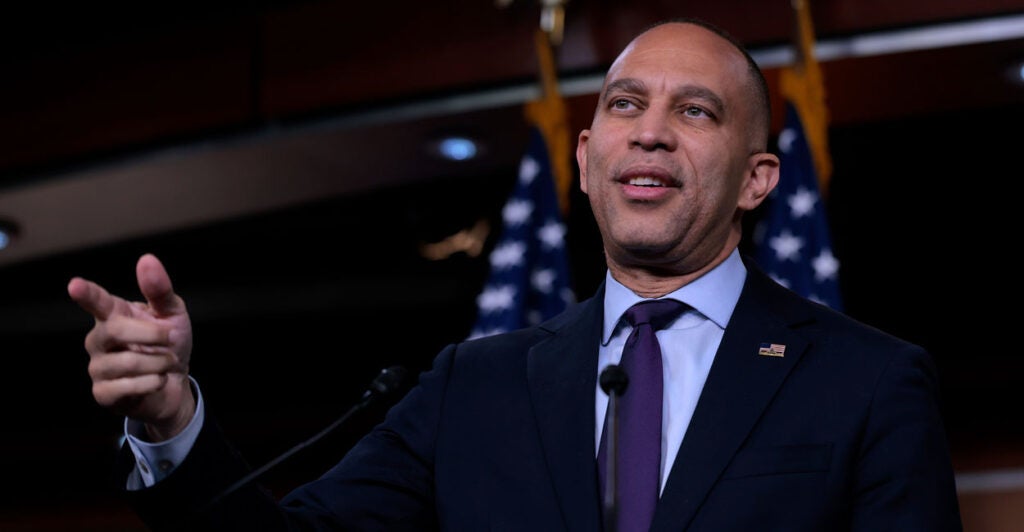
On the Wednesday before Christmas break, a group of moderate Republicans signed on to a petition backed by House Minority Leader Hakeem Jeffries, D-N.Y., which will force a vote on a three-year extension of the enhanced premium tax credits.
In some ways, the House is operating as one would expect it to with such narrow margins. The Republican party is an ideologically diverse coalition, yet leadership has done a relatively effective job of calming intraparty drama up to this point.
There have also been high-profile announcements of retirements in the House.
The most prominent was Rep. Marjorie Taylor Greene, R-Ga., once one of Trump’s favorite House members before an ugly falling out. Greene will resign her seat on Jan. 5, 2026.
Midterm Madness
Heading into 2026, expect affordability to be the top concern on Capitol Hill leading up to the 2026 midterms.
On Dec. 17, Trump spoke directly to the American people in a televised speech from the White House, in which he touted the Republicans’ success in slowing inflation, as well as securing the border.
The speech followed rallies held by both Trump and Vance in important Pennsylvania swing districts.
What comes next is a mystery, but historically, the party in the White House suffers in the midterms.
However, there is no clear indication Democrats have mended the fractures in their coalition that were exposed in 2024—which saw Hispanic and Middle Eastern voters shift to the Republican Party, as well as dismal turnout for Democrats from black voters.
Democrats also saw their positions on immigration and transgenderism thoroughly rejected in 2024, while narratives on abortion access and Trump as a threat to democracy did not yield results.
Additionally, the House map includes many more Democrat-represented districts won by Trump than Republican-represented districts won by Kamala Harris.
Republicans also have a Senate pickup opportunity in Michigan, where former Rep. Mike Rogers narrowly lost in 2024, as well as in Georgia, where they hope to unseat Democrat Sen. Jon Ossoff. There are also very real Democrat pickup opportunities in Maine and North Carolina.
The onus is now on Republicans in Congress to pass popular legislation and effectively counter Democrat messaging.
Should they fail and lose control of one chamber in Congress, the results are predictable: impeachment efforts, congressional investigations of the administration, and an inability to advance conservative legislation.
Elizabeth Troutman Mitchell contributed reporting.
The post Republicans’ 2025 Rollercoaster Comes to an End. Or Is It Just Beginning? appeared first on The Daily Signal.
This content is courtesy of, and owned and copyrighted by, http://dailysignal.com/ and its author. This content is made available by use of the public RSS feed offered by the host site and is used for educational purposes only. If you are the author or represent the host site and would like this content removed now and in the future, please contact USSANews.com using the email address in the Contact page found in the website menu.