
🔴 Website 👉 https://u-s-news.com/
Telegram 👉 https://t.me/usnewscom_channel
New York has been ground zero for one of the worst taxpayer abuses in the history of Medicaid, and now it’s poised to get much worse: A labor union plans to skim hundreds of millions of dollars from Medicaid in New York.
Albany’s Consumer-Directed Personal Assistance Program was set up to help people with serious disabilities avoid costly full-time care in nursing homes.
The idea was to pay caregivers with funds from Medicaid (the joint state-federal health-care program for the poor and disabled that now accounts for about 10% of federal spending) to help patients live independently, saving taxpayers’ money.
But lax rules, bad actors and social media converged to make CDPAP’s costs balloon.
Subway ads and TikTok videos showed people how they could get “free” money to care for a relative or friend.
Hundreds of middleman agencies sprang up to cash in, handling payroll and paperwork on each new sign-up.
By last year, CDPAP was paying about 400,000 people.
The cost: roughly $11 billion — with federal taxpayers picking up most of the tab.
Its massive size made policing CDPAP’s abundant fraud impractical.
One state probe found multiple people getting paid to “care” for a single patient — who lived in South Asia.
Gov. Kathy Hochul, ostensibly concerned about the price tag, got state lawmakers to eliminate most CDPAP middlemen.
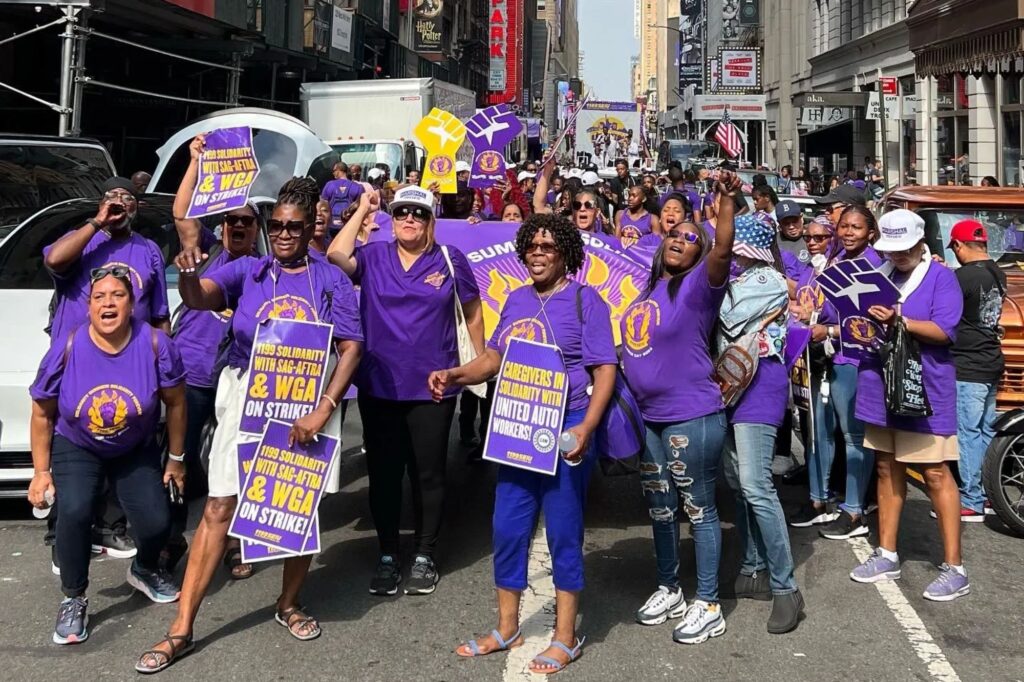
But now the other shoe is dropping: 1199 SEIU, the state’s largest health-care union, is angling to unionize CDPAP workers, leaning on Public Partnerships LLC (a/k/a PPL) , the state’s new head middleman, to do so.
This isn’t your granddad’s idea of a labor union.
It’s almost the complete opposite: CDPAP caregivers don’t work together.
They don’t have one boss, but a couple hundred thousand — the patients.
And they work in extremely intimate settings, for patients who must literally trust them with their lives.
Those patients should, and must, have the power to hire, train or fire them.
What would 1199 bring to the table in this scenario? It’s already up to Albany to boost providers’ pay or benefits.
Would 1199 push to limit how “consumer-directed” CDPAP is, by imposing union discipline rules that make it harder to fire bad employees?
Would the union try to tell CDPAP patients with profound disabilities that they no longer decide whether a caregiver gets a key to their home, or can dress and bathe them?
It sounds absurd — but these questions need to be posed, because unionizing CDPAP is a cash grab first; the consumers are an afterthought.
Similar scenarios have played out in several states, including New York, in recent decades.
Subsidized child-care providers, many of whom watched their neighbors’ kids at home, were surprised in 2009 when unions including the United Federation of Teachers began taking a cut of their state payments, following a sham mail-ballot election in which few providers voted.
Elsewhere, SEIU and a few other unions started skimming from Medicaid payments given to parents caring for children with disabilities.
The US Supreme Court cracked down in 2014, ruling that such caregivers are answerable to individual consumers, not to state agencies, and can’t be forced to pay a union.
But Hochul’s law makes PPL a private “employer,” so unionizing its caregivers would mean 1199 could force every one of them to pay a 2% tribute — or get fired.
At the current number of CDPAP caregivers, 1199 would snag another $200 million a year.


PPL is likely cooperating because doing so is something akin to buying protection from mobsters.
Everyone in Albany has seen the 1199-financed attack ads lobbed at governors and other state officials who question the size or efficacy of Medicaid.
If this unionization scheme succeeds, such public lobbying would explode.
The union won’t just have an incentive to keep the caregiver sign-up rules loose — it will have a fiduciary duty to keep wasting public money, and to pressure lawmakers for more.
It’s utterly unprecedented in scale and scope.
The fact that management is teaming up with labor to further bilk taxpayers, seemingly with Hochul’s blessing, means Washington must act.
During President Donald Trump’s first term, federal regulators issued rules meant to shield Medicaid recipients from dues-skimming schemes crafted by governors and their union boosters.
The Biden administration promptly reversed those fixes.
This time, the feds must first focus on tightening the patient eligibility rules of CDPAP-like programs, to reserve this care for people who truly need it.
That would fit neatly in the next government funding bill, since federal taxpayers are losing money every day the Albany spigot stays open.
It would also help trim some fat from the state budget, where Medicaid is now the biggest single expense.
But if 1199’s ploy proceeds, New York taxpayers will be stuck supporting the nation’s most costly Medicaid program — and the union that’s keeping it that way.
Ken Girardin is a fellow at the Manhattan Institute.