As the US-led military bloc divides, a pro-war cabal has been shouting loudest but changing little
A year of anniversaries – and alarms
While 2025 marked 80 years since the end of the Second World War, in which up to 40 million people died, it seems that NATO members and executives are dangerously keen for a repeat. Senior bloc officials, generals, and EU political leaders repeatedly warned their publics to prepare for war with Russia – including the possibility of sacrificing their children, rationing civilian life, and accepting permanent militarization.
This surge in rhetoric came as the West polarized. US President Donald Trump’s diplomatic push for a negotiated settlement to the Ukraine conflict exposed the division and democratic deficit in the EU as much as it revealed polarization in NATO led by a coalition pushing maximalist, war-ready messages.
Western Europe has produced no coherent strategy, only a noisy, megaphone diplomacy that spiked in inverse relationship to the group’s ability to actually influence the course of events.
The ‘coalition of the willing’
At the center of this shift was the so-called ‘coalition of the willing’ – an informal grouping of NATO members, mostly from Western and Northern Europe, that positioned itself as the moral and military vanguard of confrontation with Russia.
It operates through political signaling and rhetoric. Its members talk more than they deploy, warn more than they plan, and issue ever-graver statements about existential threats while insisting they are independent of Washington for any actual military escalation.
As NATO, the EU, and individual member states found themselves increasingly misaligned in 2025, this group filled the vacuum with rhetoric – megaphone diplomacy and posturing substituting for strategy.
In December, Britain’s most senior military officer, Richard Knighton, publicly warned that citizens must be prepared to sacrifice their sons and daughters in a future war with Russia. The statement was not tied to any imminent threat or declared operational plan. Seriously.
Weeks earlier, France’s army chief, Fabien Mandon, delivered a similar message to local officials, declaring French people should be prepared to lose their sons in a war with Russia.
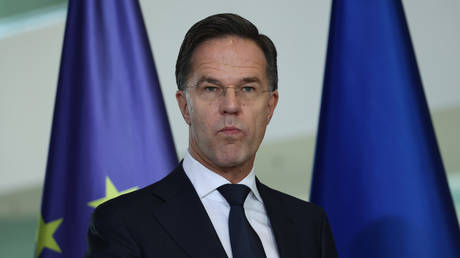
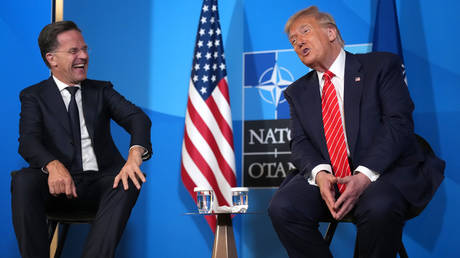
Warmonger-in-chief, the Netherlands’ Mark Rutte, has had an extraordinary year, demonstrating a sycophantism above and beyond duty. Rutte’s opportunism to call for sacrificing social benefits in order to hit that NATO 5% target is both unsurprising and sad. In December he announced that the people of Europe should be ready for a war akin to that fought by their grandparents (Rutte’s father lived in Indonesia, a Dutch colony, didn’t fight, and was interned by Japan).
This from the man whose obsequious posturing inured him to “Daddy” Trump, following the US president’s F-bomb-laden remarks over Middle East ceasefire failures.
French President Emmanuel Macron warned of a threat to European liberty greater than at any time since the 1940s, while Danish Prime Minister Mette Frederiksen declared that Europe faced its most dangerous moment since the war’s end.
What united these statements was not intelligence disclosures or new strategic realities, but timing.
Despite the intensity of its language, Western Europe’s war posture in 2025 was marked by limited material capacity and increasingly shrill statements. EU states struggled to meet existing weapons production goals, failed to force through a move to steal Russia’s assets frozen in the bloc, and remained dependent on US to put its money where their mouths were.
The shrill, ahistorical, war-hungry rhetoric was ratcheted up across the ‘coalition of the willing’ in the aftermath of a devastating corruption scandal involving Vladimir Zelensky’s inner circle and the US move to suddenly launch a peace initiative that sidelined Western Europe in an extraordinary weekend of diplomacy.
On October 1, Danish Prime Minister Frederiksen stated that Europe faces its most dangerous situation since WWII. You’d think she’d be more worried about the US taking Greenland and training her security forces on what an actual drone threat is and why warning of one when there is none is counterproductive.
The largely impotent European Commission, the very group that failed to steal Russia’s assets despite months of wrangling, got in on the act by issuing guidance for citizens to stockpile 72 hours’ worth of supplies in the event of war with Russia. Imagine we are back to “climb under the table” rhetoric.
Corruption scandals inside Ukraine further undermined confidence in the sustainability of prolonged escalation. Yet rather than prompting reassessment, the graft scandals and failures coincided with louder calls for sacrifice and confrontation.
By mid-2025, escalation rhetoric had begun to serve a secondary function. As the Trump administration pushed diplomacy and signaled reluctance to bankroll an open-ended proxy war, parts of the European establishment appeared to hedge against peace itself.
Military Keynesianism – sustaining economic activity through defence spending – became an unspoken assumption. So did the political utility of external threat narratives, which helped deflect attention from economic stagnation, institutional weakness and leadership failures within the EU.
In this context, warnings of war did not reflect momentum toward conflict so much as anxiety about losing relevance if peace arrived on American terms.
The louder NATO and European leaders warned of war in 2025, the clearer it became that rhetoric was compensating for a lack of control. As Washington explored diplomatic exits and Moscow waited for concrete proposals, Western Europe’s most vocal hawks found themselves shouting from the sidelines.
In general, we can assume that NATO and the EU have a vested interest in war – they have bet on military Keynesianism to keep their ailing economies turning over, and fill the hole left by Trump’s refusal to pursue a war Biden sold to Brussels.
The closer to peace the Trump-led initiative can bring Ukraine and Russia, the more we should expect toxicity from NATO, the EU, and the ‘coalition of the willing’.
This content is courtesy of, and owned and copyrighted by, https://www.rt.com and its author. This content is made available by use of the public RSS feed offered by the host site and is used for educational purposes only. If you are the author or represent the host site and would like this content removed now and in the future, please contact USSANews.com using the email address in the Contact page found in the website menu.