

🔴 Website 👉 https://u-s-news.com/
Telegram 👉 https://t.me/usnewscom_channel
Rabbi Arthur Schneier, a 96-year-old Holocaust survivor, believed he had outlived a time in which anyone would have to fear entering or leaving their house of worship.
Four months ago, that belief evaporated in an instant.
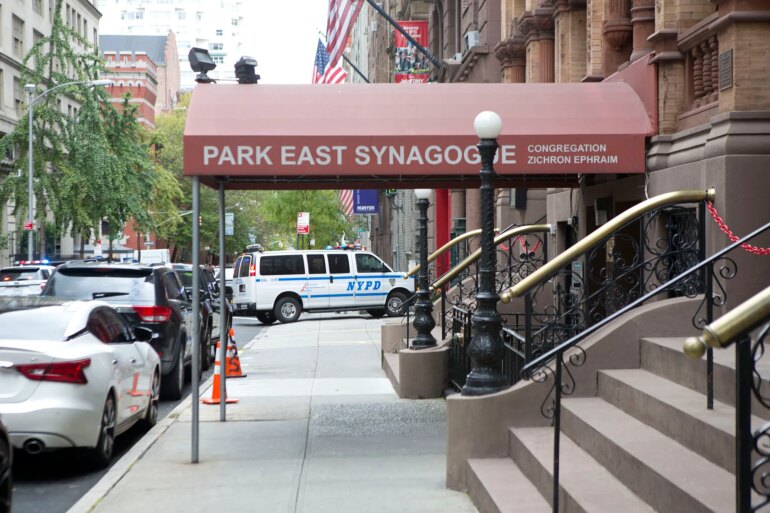
In November, protesters outside Park East Synagogue, Rabbi Schneier’s own Manhattan congregation, literally crossed a line.
Instead of remaining behind a designated barricade and protesting peacefully, they headed directly for the synagogue’s entrance, creating a threatening and unsafe environment for congregants.
The city acknowledged that the situation at Park East could have been handled a lot better — that the entrance was not kept clear, and that the space outside was “chaotic” and difficult for congregants to enter and exit.
Because this was more than an innocent protest: It was intimidation and harassment that ultimately interfered with the congregants’ right to worship freely.
If this can happen outside a synagogue, it can happen outside a church, a mosque, a temple or any place where people gather in faith, in learning or in community.
The moment we tolerate such interference at the doors of one house of worship, we weaken the foundation of safety for all.
Weeks later, a similar scene unfolded outside a yeshiva in Kew Gardens, Queens.
The result was the same: New Yorkers trying to enter their house of worship were afraid to do so because of targeted obstruction and intimidation.
That should never happen in our city.
And as a public official, I vowed to prevent it from happening again.
As one of my first official actions as City Council speaker, I was proud to introduce new legislation that turned that promise into meaningful policy.
On Thursday, the council will have the opportunity to pass this bill, putting it on a path to becoming law.
While upholding the right to peacefully protest, this bill requires the NYPD to develop a plan to address and contain the risk of physical obstruction, physical injury, intimidation and interference around houses of worship when a protest is imminent.
That plan will determine whether a security perimeter is needed — and if so, how far the perimeter should extend from building entrances and exits.
The goal of creating these security perimeters is simple: Establish protocols that ensure safe access to enter these sacred spaces, and prevent what we saw at Park East and Kew Gardens from happening anywhere else.
But these measures don’t just protect one single community — they protect all communities, regardless of the faith they practice or the place where they study.
A basic covenant of our city is that everyone who lives here deserves to be safe and to feel safe.
It is the City Council’s official responsibility as well as our moral duty to preserve this covenant.
At the same time, it’s imperative that we uphold the constitutional rights of the constituents we serve.
As a key part of these bills, we’re also making sure that implementing security perimeters does not curtail free speech or free assembly.
Those unalienable rights will not be touched, nor will our freedoms be weakened — whether it is the freedom to practice religion or the freedom to express what you believe.
New York has always protected the right to protest: loudly, visibly and passionately.
It’s what our history is built on.
That will not change — under this bill, the right to peacefully protest outside houses of worship will remain unfettered.

But the right to protest does not include denying others their rights to worship as they please.
That’s the line this legislation draws.
It also brings in something we’ve been missing: transparency.
Right now, responses to these situations can be inconsistent and unclear.
Under this bill, the NYPD will be required to publicly articulate how decisions are made: when perimeters are used, how they are sized, how long they last and how both safety and protest rights are upheld.
By codifying clear expectations for the NYPD, we are moving from ambiguity to accountability, guaranteeing the protection of congregants and protesters alike.
At moments like this, we have a responsibility to act in the name of protecting New Yorkers from every walk of life.
As the daughter of a Holocaust survivor, I carry a deep understanding of what happens when fear takes hold at the doors of our communities.
I know, too, the importance of standing up for religious freedom for all — as when I supported the Islamic Cultural Center near Ground Zero despite intense public opposition.
Antisemitism is rising at historic rates. So is Islamophobia.
So are many forms of hate — and we must step up to combat them.
The City Council is proud to take immediate and impactful steps to uphold safety, freedom and transparency that should be guaranteed to everyone.
That’s what it takes to protect New Yorkers — and that’s what our legislation delivers.
Julie Menin is speaker of the New York City Council.