

🔴 Website 👉 https://u-s-news.com/
Telegram 👉 https://t.me/usnewscom_channel
Mayor Mamdani promised New Yorkers Jan. 1 he would “replace the frigidity of rugged individualism with the warmth of collectivism.” Luckily, psychiatrists have not yet classified “rugged individualism” as a mental illness. But Mamdani’s vision of cozy collectivism is tricky to reconcile with what I saw in Communist Romania in November 1987.
I arrived in Bucharest after taking the Orient Express from Budapest, Hungary. In pre-Communist times, that train epitomized capitalist decadence. In the Soviet era, the lavish cuisine was replaced by far more attentive service — more or less. Armed guards in Transylvania repeatedly searched my cabin and then locked me inside it so my Western ideas would not contaminate any devout Commies.
The train arrived in Bucharest four or five hours behind schedule. Let’s hope Mamdani is not relying on Romanian refugee planners to fulfill his promise to “make buses fast and free.”
When I checked into the only hotel permitted to offer rooms to Westerners, I was practically tackled by a beefy prostitute who was likely also a government spy. She kept nudging me to “go upstairs.” She cooed gutturally: “Why are you here in Bucharest?”
“I’m a tourist,” I said. Actually, I was working as a journalist, but I hadn’t disclosed that on my visa application. OK, technically, I was in Romania illegally, but what are technicalities among friends?
“But it is so cold outside,” she said. “Let’s stay inside. Aren’t you lonely?”
Not a chance: This woman radiated “honey trap.” Besides, I had a strict rule to never tussle with any woman who had a better mustache than I did.
The Romanian regime was even more paranoid than Alex Jones. When I asked the ornery hotel concierge for a map of the city, he glared hatefully at me: “We have no maps. If there is some place you want to go, you tell me what it is, and I will tell you how to get there.”
My hunch was that guy didn’t make a living from tips.
In his inaugural speech, Mamdani touted an array of new subsidies such as free child care as linchpins for “the lives we fill with freedom.” But government handouts are often far more expensive than they first appear.
The Communist regime boasted of providing free health care to Romanians, but women were trapped in a real-life “Handmaid’s Tale.” Because boosting birth rates was part of the Five-Year Plan, the government outlawed contraception and abortion. It forced all women between the ages of 18 and 40 to have a monthly gynecological exam to ensure no one robbed the state by terminating a pregnancy. Ten thousand Romanian women died from illegal abortions, and far more were left maimed.
In Romania, “warmth” was an abstraction that existed primarily in propaganda campaigns exalting the supreme leader, Nicolae Ceaușescu. To save energy to fulfill the Five-Year Plan for factories, the government routinely cut off the electricity to hospitals, causing 1,000 deaths the previous winter. The infant mortality rate was so high, the government refused to register children as being born until they survived their first month.
On the streets, my bulky Aussie-style canvas hat marked me as a foreigner. People stopped me and pleaded for packs of Kent cigarettes — the de facto second currency — they could use to bribe doctors to get health care for their sick children. Food shortages caused pervasive gauntness in this former “breadbasket of Europe.” The government responded to rising hunger with a publicity campaign on the danger of overeating.
In prior visits to Czechoslovakia and East Germany, I had been hounded by the secret police so I knew not to pull out any notebook to jot down my observations as I walked the streets of Bucharest. Instead, I wrote single words on the palm of my hand I could later use as a fishhook to pull up a string of memories.
As I was walking across the airport tarmac to catch my Lufthansa flight out of Romania, a guard shouted for me to halt and came running up with his submachine gun bouncing off his ample belly. He grabbed my left arm and, pointing at my palm, demanded to know: “WHAT IS THIS?!?”

I looked closely at my hand, then I looked at the guard.
“It’s ink.”
He paused, squinted, nodded his head knowingly, and then waved me on to the plane.
A few weeks later, those palm notes appeared in a New York Times piece I wrote headlined “Economic Collapse: Eastern Europe, the New Third World.”
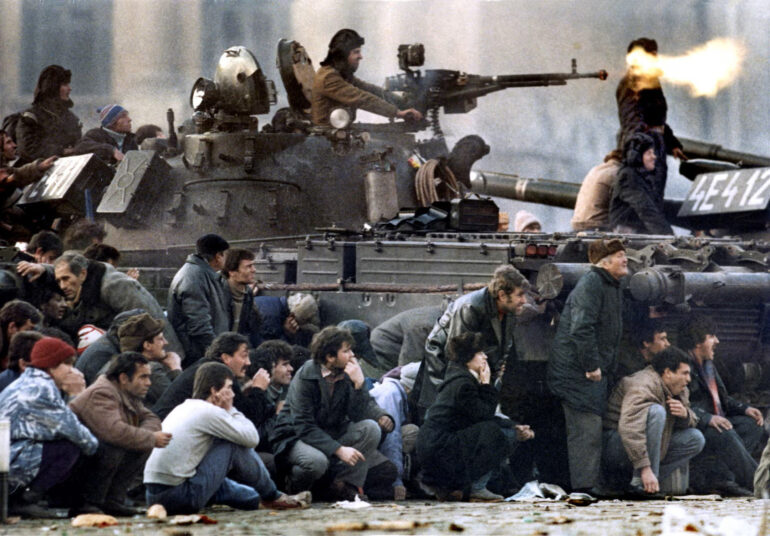
Ceaușescu and his wife were lined up against a wall and summarily executed roughly two years before Mamdani was born. Ceaușescu’s lofty rhetoric no longer swayed the Romanians he had long oppressed.
In his victory speech on election night, Mamdani declared his supporters “chose . . . hope over tyranny.” But giving boundless power to his own supposed good intentions will be a recipe for ruin for the new mayor. Will Mamdani speedily turbocharge the cynicism that he boasted of vanquishing?
James Bovard is the author of 11 books, including “Lost Rights: The Destruction of American Liberty.”