
🔴 Website 👉 https://u-s-news.com/
Telegram 👉 https://t.me/usnewscom_channel
When my children walk into our synagogue, the first person they see isn’t a rabbi or friends.
It’s a guard with a gun, standing outside.
This is how Jewish life works in America today.
When we sign our kids up for summer camp, preschool or even a holiday program at our synagogue, there is always a line item on the bill labeled “security.”
When my daughter celebrated her bat mitzvah, we had to pay an extra fee for an armed guard outside the building while friends and family gathered.
This is simply the cost of Jewish life in America.
But every now and then, something happens that reminds you exactly why that guard is there.
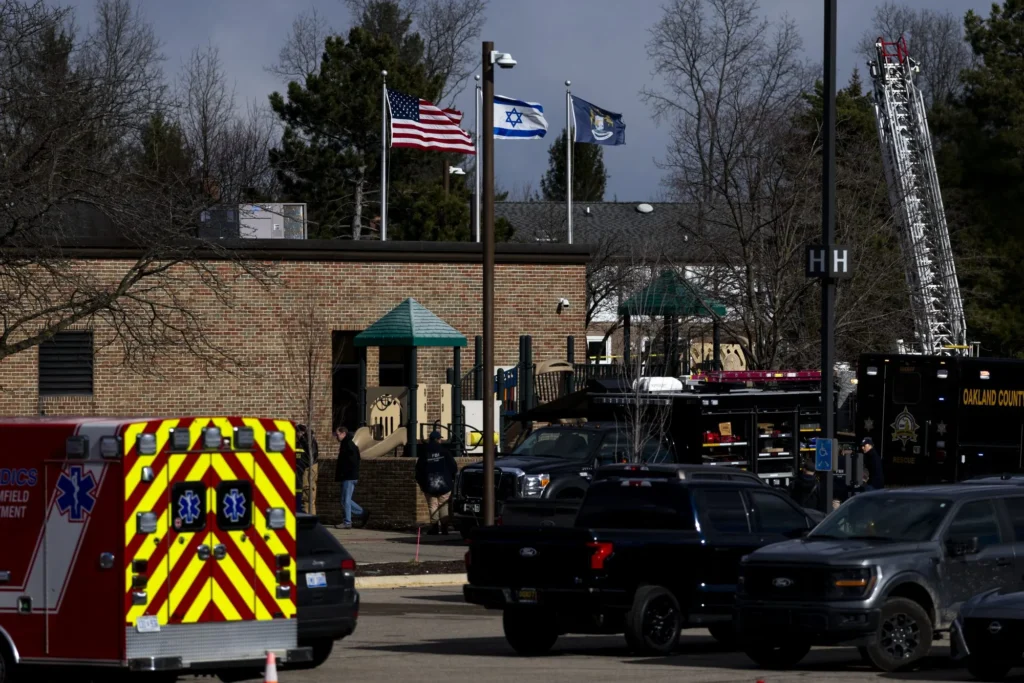
On Thursday afternoon in West Bloomfield, Mich., a man drove a vehicle packed with explosives into Temple Israel, one of the largest reform synagogues in the United States.
Inside the building, roughly 140 young children attended the synagogue’s preschool.
Per authorities, the attacker rammed the building and opened fire before he was ultimately stopped by armed security.
A mass-casualty attack against a building full of Jewish children was miraculously avoided because of the bravery and fast thinking of the armed guard inside.
What prevented catastrophe was preparation.
Just weeks before the attack, the synagogue had hosted FBI training for staff and security personnel on how to respond to an active shooter.
That training, combined with the presence of armed guards, meant the difference between tragedy and survival.
The thwarted attack was a stark reminder that Jewish institutions operate under a level of threat that most non-Jewish Americans never have to think about.
The part that should outrage every American: We’re largely paying for our own protection.
Across the country, synagogues and Jewish schools spend hundreds of millions of dollars every year on guards, reinforced doors, surveillance systems and security training.
In other words, the community most frequently targeted for religious hatred is also expected to shoulder the financial burden of defending itself against that hatred.
In theory, protecting houses of worship should be a core responsibility of the state.
In practice, it often isn’t.
Local police departments across the country are struggling with manpower shortages and recruiting crises, and they simply don’t have the personnel to station officers outside synagogues every weekend.
If a congregation calls and asks for an on-duty officer on Friday night or Saturday morning, the answer is often the same: We’d love to help, but we don’t have the officers available.
When a police officer is standing outside a synagogue, there’s a good chance the synagogue itself is paying for it.


Either the congregation covers the officer’s overtime pay directly, or the funding comes through nonprofit security grants lobbied for by Jewish communal organizations.
Either way, Jewish institutions end up subsidizing their own protection from terrorism.
There is a federal program intended to help: The Nonprofit Security Grant Program, administered by the Department of Homeland Security, provides funding for synagogues, churches, mosques and other faith-based institutions to install security infrastructure and hire security personnel.
But the program has long been underfunded relative to the scale of the threat.
Jewish organizations, such as the Orthodox Union, have been urging Congress to allocate roughly $500 million for nonprofit security grants, which would provide about $320 million to Jewish institutions alone.
The request is not extravagant when one considers the reality: Jewish institutions are targeted far more frequently than any other religious community in the United States.
Yet that funding is caught in Washington’s dysfunction: The Department of Homeland Security funding bill, which includes these grants, is stalled as Republicans and Democrats fight over other issues.
While the stalemate drags on, synagogues and schools are left waiting for resources that could save lives.
Congress needs to see this is an emergency. If lawmakers can’t resolve their broader dispute, they should pass emergency security funding for faith-based institutions separately immediately.
Jewish children, and the guards standing between them and the next attacker, shouldn’t have to wait for Washington to get its act together.
Bethany Mandel writes and podcasts at The Mom Wars.