

🔴 Website 👉 https://u-s-news.com/
Telegram 👉 https://t.me/usnewscom_channel
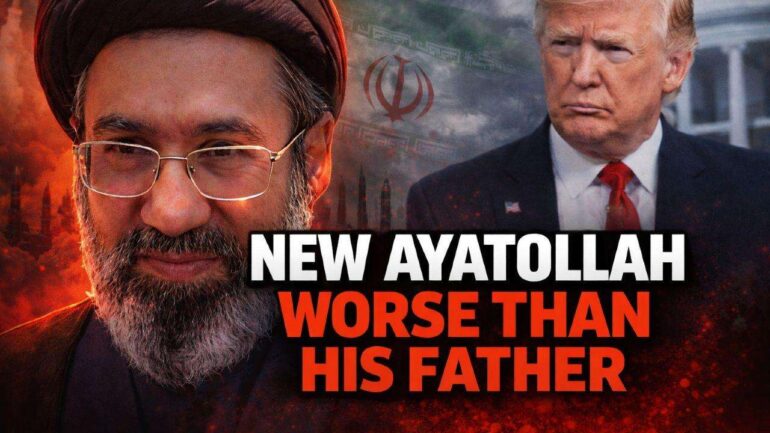
The new Supreme Leader of Iran, Mojtaba Khamenei, was installed in a vote shaped by military pressure and chaos after a U.S.-Israeli strike killed his father, and his rise exposes a brittle regime leaning harder on force, secrecy, and offshore wealth than on any real religious legitimacy. This article lays out who he is, how he was chosen, what he controls, and why his elevation matters to U.S. policy now. Read this with the basic assumption that Tehran’s next moves will be driven by the IRGC and a leader whose authority rests on coercion and cash, not popular consent.
Mojtaba Khamenei was named Supreme Leader in the early hours of March 8, 2026, days after the strike that killed Ayatollah Ali Khamenei and members of his family. The Assembly of Experts announced the decision with the line “By a decisive vote, the Assembly of Experts appointed Ayatollah Seyyed Mojtaba Hosseini Khamenei as the third Leader of the sacred system of the Islamic Republic of Iran.” That wording was meant to convey unity, but the scene behind the curtain was anything but unified.
Reports describe relentless IRGC pressure on Assembly members, including in-person meetings and phone calls in the run-up to the vote. Several clerics raised objections about dynastic optics and Mojtaba’s thin religious resume, and eight members threatened to boycott a follow-up session over what they called “heavy pressure” from the IRGC. Those dissenting voices were effectively sidelined by a security apparatus determined to lock the succession in place.
Mojtaba holds the clerical rank of hojjatoleslam, a mid-level designation rather than ayatollah, which poses an obvious legitimacy problem for a leader whose authority is supposed to be rooted in religious standing. His father faced the same gap in 1989 and had the law altered to smooth the path to power, and the regime appears poised to do the same again for the Khamenei name. That pattern—bending rules to preserve a dynasty—speaks to how power actually operates in Tehran.
President Trump was blunt and public in his response, telling ABC News, “He’s going to have to get approval from us. If he doesn’t get approval from us, he’s not going to last long. We want to make sure that we don’t have to go back every 10 years, when you don’t have a president like me that’s not going to do it.” Trump also dismissed Mojtaba as a “lightweight,” and Washington’s rejection has become part of Tehran’s internal bragging points. For hardliners, being hated by the U.S. is proof of ideological fitness.
Mojtaba’s biography blends battlefield connections and clerical schooling. He joined the IRGC in 1987, served in the Iran-Iraq War, and built long-term ties with men who would become security chiefs. Those relationships are now the backbone of his power, and analysts say he is more likely to lean on the IRGC than his father did, effectively trading religious authority for military backing.
His record on dissent is stark. Mojtaba is widely believed to have personally supervised the violent crackdown on Green Movement protesters in 2009, and he reportedly played a role in shaping the 2005 election that installed Mahmoud Ahmadinejad. That history of manipulation and violence is not incidental; it is the governing playbook that critics say will define his rule.

Financially, Mojtaba is no ascetic. Investigations have tied him to a global property and finance network that includes high-value assets in London and Dubai, held through intermediaries and shell companies. Reported holdings include two luxury apartments in London overlooking the Israeli Embassy and 11 mansions in Hampstead, North London, purchased through front men and offshore entities — a portfolio estimated at hundreds of millions.
His mentor and theological influences matter. Mojtaba studied under the late Ayatollah Mohammad Taghi Mesbah Yazdi, who called for killing Iranian youths who promoted “Western immorality.” That affiliation offers a window into the ideological current guiding him: harsh social control married to militant foreign policy. This is not a cleric oriented toward nuance or compromise.
Despite his new status, Mojtaba has been unusually opaque to the Iranian public. He has never held formal government office, never run for election, and has delivered almost no public speeches. Many Iranians know him as a shadowy figure who ran the corridors of power rather than as a public leader, and that secrecy has been a deliberate part of how he accrued influence.
>
Geopolitically, his rise likely tightens the bond between Tehran and the IRGC and raises the risk of escalation rather than negotiation with the West. The United States now faces a choice: press the advantage militarily and support internal elements seeking change, or treat this as a permanent rejection of diplomacy and respond accordingly. Either way, Iran’s next moves will be shaped by a leader whose claim to power depends less on jurisprudence and more on muscle and money.