
🔴 Website 👉 https://u-s-news.com/
Telegram 👉 https://t.me/usnewscom_channel
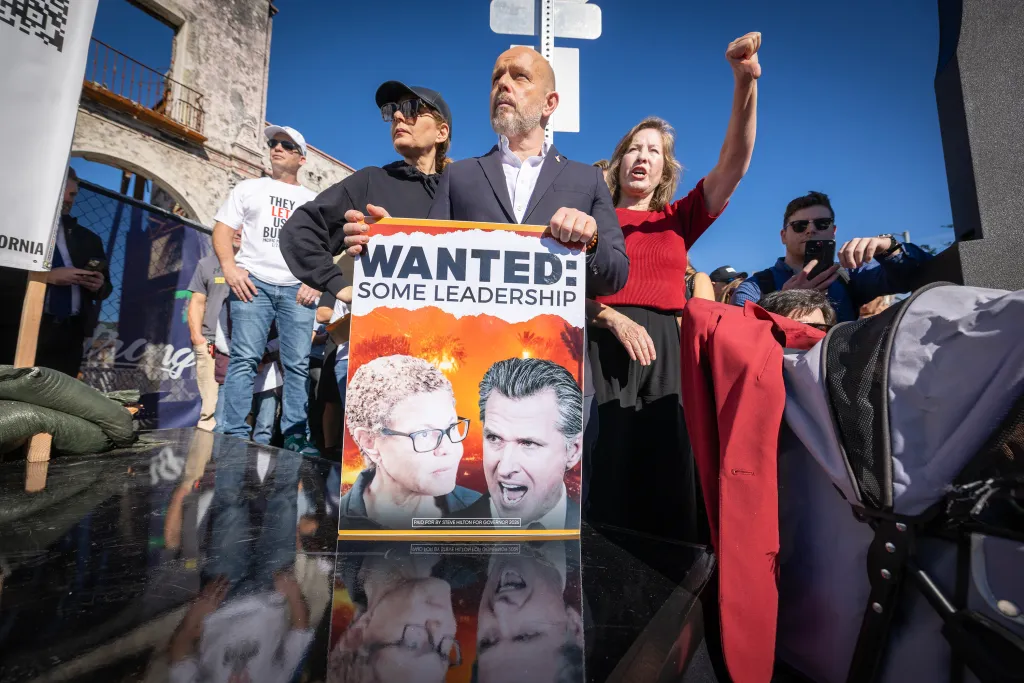
A crowded field of eight California Democrats is splitting the race for governor, as the coalition behind outgoing Gov. Gavin Newsom begins to fracture.
The result could be unthinkable: Republican victory in November.
Party leaders tried, and failed, to convince some of their own gubernatorial candidates to drop out of the race before Friday’s filing deadline.
The warning was blunt: Too many Democrats will split the vote and allow two Republican candidates to qualify for the general election under the rules of California’s “jungle” primary.
California adopted its unique primary system, also known as the “top-two” system, through a statewide ballot measure in 2010. All candidates appear on the same primary ballot, regardless of party, and the two candidates who receive the most votes advance to the general election.
The reform was supposed to weaken party machines and reward moderation. Instead, it sometimes leaves parties scrambling to control their own candidates and avoid electoral accidents.
Democrats have reason to worry. They faced this same scenario in the 2014 race for California controller, where a crowded Democratic field of prominent candidates nearly produced a Republican-only general election in one of the bluest states in America. Democrats ultimately avoided that embarrassment, but only barely.
More than a decade later, the Democrats see the same dynamics emerging.
Polling shows several Democratic gubernatorial candidates clustered within just a few percentage points of one another — while two Republicans, Steve Hilton and Chad Bianco, remain ahead of the pack.
Each of the Democrats represents a different faction within the party. Each is strong in his or her own right. Each can make the case for staying in the race.
San Jose Mayor Matt Mahan, for example, appeals to moderate, tech-friendly voters. Northern California’s Congressman Eric Swalwell is mobilizing progressive voters with a strong anti-Trump message. Former Rep. Katie Porter is doing the same, but with her SoCal flair.
Download The California Post App, follow us on social, and subscribe to our newsletters
California Post News: Facebook, Instagram, TikTok, X, YouTube, WhatsApp, LinkedIn
California Post Sports Facebook, Instagram, TikTok, YouTube, X
California Post Opinion
California Post Newsletters: Sign up here!
California Post App: Download here!
Home delivery: Sign up here!
Page Six Hollywood: Sign up here!
Former State Controller Betty Yee is drawing support from moderate Democrats and Asian-American voters. Former Los Angeles mayor Antonio Villaraigosa and former Attorney General Xavier Becerra are competing for Latino voters, with Becerra also benefiting from union support.
Each campaign has staked out its own natural constituency, and each believes it can survive a crowded primary.
The growing divide between the Democratic activist base and the broader Democratic electorate makes the contest even more complicated.
At the recent California Democratic convention in San Francisco, party delegates who participated in a straw poll showed enthusiasm for Becerra and Yee, even though they are not polling in the top 5 candidates among voters statewide.
This isn’t simple electoral chaos. It’s the unraveling of the governing coalition Newsom held together for nearly a decade — one that blended environmental groups, organized labor, progressive activists, and business-friendly moderates.
Now those factions are competing for post-Newsom dominance.
Sign up for the California Morning Report newsletter
California’s top news, sports and entertainment delivered to your inbox every day.
Thanks for signing up!

Republicans face their own dynamics — but simpler math.
Hilton, a political commentator, and Bianco, the sheriff of Riverside County, appear to be splitting the Republican vote, each drawing somewhere around 15% to 20% support in early polling.
With Democrats dividing the majority vote eight ways, Hilton and Bianco could qualify for the general election — separately, or together — with barely 20% of the primary vote, or less.
That’s exactly the kind of outcome Democratic Party leaders are desperate to prevent.
As always in California, ultimately, the odds still favor Democrats. It is far more likely that at least one Democrat qualifies for the general election, and just one Republican, at most.
And the Democrats’ overwhelming registration advantage means that whichever Democrat survives the primary with breath in his or her lungs — even in second place — will likely win the governorship.
But even then, the bigger issue for California Democrats will remain: Can they find a compelling leader who can unite the party around a popular set of issues?
After June 2, we may find out.
Pete Peterson is dean of Pepperdine University School of Public Policy and its Braun Family Dean’s Chair.