
🔴 Website 👉 https://u-s-news.com/
Telegram 👉 https://t.me/usnewscom_channel
Memelord governors are coming for your unhinged political brainrot.
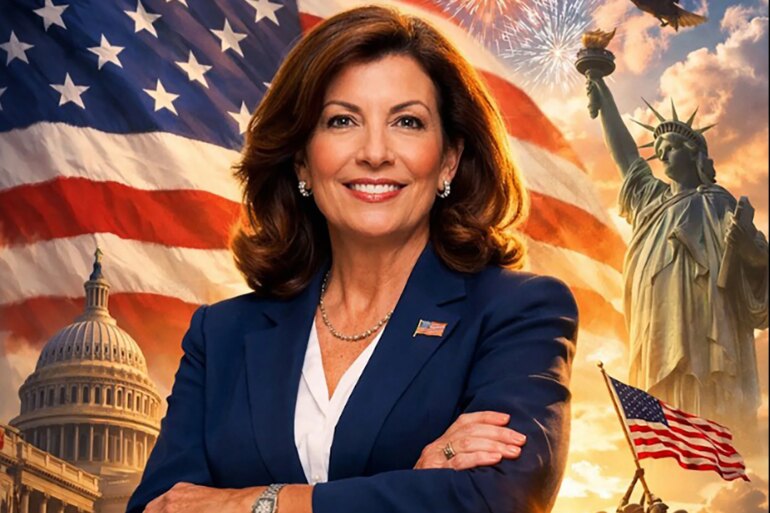
Despite being an avid user of AI when it suits her online presence, Gov. Kathy Hochul has made cracking down on AI-generated political speech a priority. Post an AI-generated picture of a candidate in a prison jumpsuit? The governor’s coming after “fraudsters” like you.
Her plan involves banning the distribution of “materially deceptive media” about a candidate, posted without their consent and within 90 days of an election, if it is shared to “influence the result of an election.”
Translation: If you use AI to make political statements during election season, you’d best keep your mouth shut if you want to evade New York’s proposed scheme to turn courts into Ministries of Truth.
Thankfully, Hochul’s cure for AI-assisted political speech won’t fly under the First Amendment.
In a free society, people exaggerate and get things wrong all the time. That’s allowed because the First Amendment doesn’t permit the government to punish speech just because it’s false, misleading or hyperbolic. Otherwise, fear of jail time or costly litigation would leave us mum. Yes, defamation and fraud exist, but they are narrow categories of unprotected speech that require proof of concrete harm like reputational injury or financial loss.
They don’t confer a free-floating power to Albany to decide what you’re allowed to see.
As Justice William Brennan wrote in New York Times Co. v Sullivan, our nation is committed “to the principle that debate on public issues should be uninhibited, robust and wide-open, and that it may well include vehement, caustic and sometimes unpleasantly sharp attacks on government and public officials.”
Vehement, caustic and, at times, sharply unpleasant attacks are precisely the kind of speech the governor’s proposal would target.
Imagine a viral meme showing Gov. Hochul endorsing President Trump for a third term. It’s absurd. That’s the joke. But if the image looks realistic enough, could it qualify as “materially deceptive” — i.e., something a “reasonable person” would find “visually or audibly indistinguishable from reality”? What about a video showing the governor with laser eyes — one of her favorite online motifs?
Memes aside, a vague standard that hinges on whether something looks “too real” risks sweeping in plain old political commentary. And even if the state insists it would only target the worst actors, and exempt satire and parody, the chilling effect persists. When the rules are ambiguous and the penalties unclear, speakers, platforms and publishers tend to err on the side of silence. Why take the risk?
That kind of self-censorship is disastrous for a democratic, self-governing society.

Hochul isn’t the first to try. California, led by fellow memelord Governor Gavin Newsom, passed a set of laws with the same goal in 2024 — and they were quickly enjoined by a federal court. Just recently, a similar Hawaii law suffered the same fate. Judges understand that laws targeting AI are still regulating core political speech.
None of this means we’re powerless to protect our elections. Existing laws against defamation, fraud and voter protections still apply. Platforms can set their own rules, too. And exposing falsehoods with facts remains our most powerful remedy. If a misleading deepfake of an elected official is circulating online, then newspapers, online commentators, even the official themselves can and should publicly call it out.
But there is a profound difference between punishing fraud and giving politicians broad authority to decide which election-related images are too “deceptive” for public consumption. That’s our job, not theirs.
Voters aren’t as stupid as the memes they (and their political leaders) sometimes create. And the First Amendment entrusts the people, not the government, to discern truth and falsity in the political arena.
That’s how a free country works.
John Coleman is legislative counsel for AI and free expression at the Foundation for Individual Rights and Expression.