
🔴 Website 👉 https://u-s-news.com/
Telegram 👉 https://t.me/usnewscom_channel
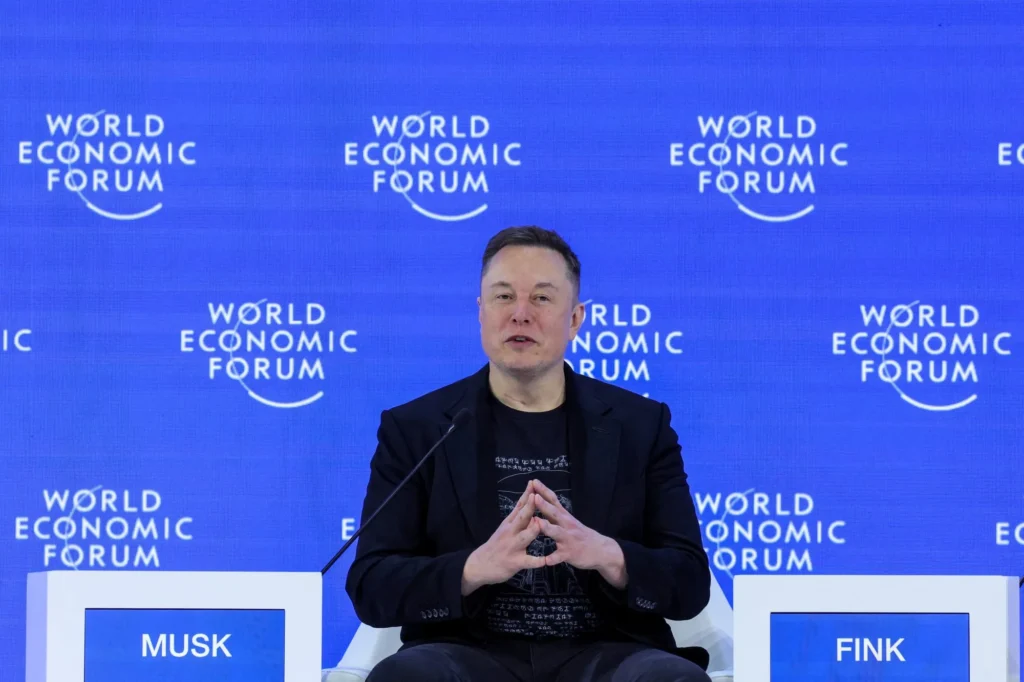
Larry Fink, president and CEO of investment firm BlackRock, interviewed Elon Musk, CEO of Tesla and SpaceX at the World Economic forum in Davos, Switzerland this week. They spoke about everything from AI to robotics to Mars, and Musk offered a vision of the future that’s coming more quickly than you might think. Here’s an excerpt of their conversation:
Larry Fink: So you’re presently building on AI, on robotics, on space, on energy, all at the same time. When you look across those efforts, what do they have in common from an engineering standpoint?
Elon Musk: Well, they’re all very difficult technology challenges, but the overall goal of my companies is to maximize the future of civilization, like basically maximize the probability that civilization has a great future, and to expand consciousness beyond Earth.
So if you take SpaceX, for example, that SpaceX is about advancing rocket technology to the point where we can extend. Life and consciousness beyond Earth, to the Moon, to Mars, eventually to other star systems. And I think we should always view consciousness, life as we know it, as precarious and delicate. Because to the best of our knowledge, we don’t know of life anywhere else.
You know, I’m often asked, are there aliens among us? And I’ll say that I am one, but . . .
We have 9,000 satellites up there. And not once have we had to maneuver around an alien spaceship. So I’m like, I don’t know. Bottom line is, I think we need to assume. Life and consciousness is extremely rare, and it might only be us. And if that’s the case, then we need to do everything possible to ensure that the light of consciousness is not extinguished, because the way I view it is, the image in my mind of a tiny candle in a vast darkness, tiny candle of consciousness, that could easily go out.
And that’s why it’s important to make life multi-planetary, such that if there is a natural disaster or a man-made disaster on Earth, that consciousness continues. That’s the purpose of SpaceX.
Tesla is obviously about sustainable technology and . . . And also, at this point, we’ve sort of added to our mission sustainable abundance. So with robotics and AI. This is really the path to abundance for all.
People often talk about solving global poverty, or essentially, how do we give everyone a very high standard of living? I think the only way to do this is AI and robotics, which doesn’t mean that it is without its issues. I mean, we need to be very careful with AI. We need to be very careful with robotics. We don’t want to find ourselves in a James Cameron movie. You know, “Terminator.”
But if you have ubiquitous AI that is essentially free or close to it, and ubiquitous robotics, then you will have an explosion in the global economy, an expansion of the global economy that is truly beyond all precedent.
Fink: How can that be created? How can it broaden the global economy?
Musk: In the benign scenario of the future . . . there will be such an abundance of goods and services because my prediction is that there’ll be more robots than people.
Fink: But how do you then have human purpose?
Musk: Yeah, I mean, you know, nothing’s perfect, but I mean it is a necessary, like you can’t have both. You can’t have work that has to be done and amazing abundance for all. . . .
But if you have billions of humanoid robots, and I think there will be, I think everyone on Earth is going to have one and going to want one. Because who wouldn’t want a robot to, assuming it’s very safe, watch over your kids, take care of your pets? If you have elderly parents, a lot of friends might have elderly parent, so it’s very difficult to take care them. Yeah, it’s expensive and they just aren’t enough young people to take care of the old people. So if you had a robot that could take care of and protect an elderly parent, I think that would be great.
That would be an amazing thing to have. And I think we will have those things. So overall, I’m very optimistic about the future. I think we’re headed for a future of amazing abundance, which is very cool, and definitely we are in the most interesting time in history.
Power play
Fink: So in the future that you talk about, the AI models, autonomous machines, rockets, depends on massive increases of compute, massive increases in energy, expensive energy, manufacturing scale. What are the bottlenecks to get there?
Musk: I think the limiting factor for AI deployment is fundamentally electrical power. It’s just, right, it’s energy. I mean, we’re seeing the rate of AI chip production increase exponentially, but the rate of electricity being brought online is negligible, 10%, 4% a year, max.
It’s clear that we’re very soon, maybe even later this year, we’ll be producing more chips than we can turn on.
Except for China, China’s growth in electricity is tremendous. They’re building 100 gigawatts of nuclear as we speak. Actually, solar is the biggest thing in China. . . .
China, just in solar, can do half of US electricity output per year. Solar is by far the biggest source of energy.
And that’s why one of the things we’ll be doing with SpaceX within a few years is launching solar-powered AI satellites because the space is really the source of immense power, and then you don’t need to take up any room on Earth. There’s so much room in space, and you can scale to hundreds of terawatts a year.
Fink: You and I have had these conversations before, but why don’t you tell the audience what would it take for the United States and what type of geography would it take to have that solar field to electrify the United States? And why aren’t we doing it?
Musk: Yeah, so, I mean, I guess a rough way to think about it is 100 miles by 100 miles, I’ll call it 160 kilometers by 160 kilometers of solar is enough to power the entire United States. Yeah, 100 mile by 100 mile areas is, I mean, you could take basically a small corner of Utah. Nevada. Nevada, New Mexico. Obviously, you wouldn’t want it all in one place. But it is a very small percentage of the area of the US to generate all of the electricity that the US uses.
And the same is true, actually, for Europe. You could take a small part. You can take. Relatively unpopulated areas of say Spain and Sicily and generate all of the electricity power that Europe needs.
Fink: So why don’t you think that there’s a movement toward that here and in the United States?
Musk: Unfortunately, in the US, the tariff barriers for solar are extremely high. And that makes the economics of deploying solar artificially high because China makes almost all the solar . . . We obviously don’t control the US tariff policy. But for other countries, China makes solar cells that are incredibly low cost.
Robo advancements
Fink: I know you’re going to be having a couple of big announcements on robotics and what it can do. I mean, when I went to the factory, you showed me those robots. You talked about billions of robots, but how quickly can they be deployed in a manufacturing setting? How quickly can it be utilized and be functional and create that abundance that you talked about?
Musk: Well, humanoid robotics will advance very quickly. I think we do have some of the Tesla Optimus robots doing simple tasks in the factory. Probably later this year, by the end of this year I think they’ll be doing more complex tasks. But still deployed in an industrial environment. And probably sometime next year, I’d say that by the end of next year I think we’d be selling humanoid robots to the public.
That’s when we are confident that it’s very high reliability, very high safety, and the range of functionality is also very high. You can basically ask it to do anything you’d like.
Fink: You’re already seeing that in Tesla cars, the software changes that you’re doing. And what is it, every quarter now a software change that upgrades the ability of the robot within the car?
Musk: Yes, the Tesla full self-driving software, we update it sometimes once a week and recently some of the insurance companies have said that it is actually so safe, Tesla full-self driving is so safe that they’re offering customers half-price insurance if they use has the force of driving in the car.
Fink: And that can be monitored by the insurance company? Is that part of the agreement?
Musk: Yeah. But I think self-driving cars is essentially a solved problem at this point. And Tesla’s rolled out a sort of robot taxi service in a few cities and will be very, very widespread by the end of this year within the US. And then we hope to get supervised full self-driving approval in Europe hopefully next month.
Fink: Really, that quickly.
Musk: And then. Maybe a similar timing for China, hopefully.
Space cents
Fink: I want to move to space, because historically, space is very capital-intensive. It’s historically been done by governments. Obviously, SpaceX changed the whole model. But we’ve seen it slow to scale, and now I’m starting to see it ramping up in what you’re doing and other things. Talk to us about the automation and AI, how it’s changing the economics in building and preparing for us in operating in space.
Get opinions and commentary from our columnists
Subscribe to our daily Post Opinion newsletter!

Thanks for signing up!
Musk: Well, the key breakthrough, the major breakthrough that SpaceX is hoping to achieve this year is full reusability. So no one has ever achieved full reusability of a rocket, which is very important for the cost of access to space. We’ve achieved partial reusability with Falcon 9 by landing the booster stage. We’ve now landed the booster over 500 times.
But we have to throw away the upper stage. The upper stage sort of burns up on reentry for Falcon 9.
So, and the cost of that is equivalent to a small to medium sized jet. But with Starship, which is a giant rocket, it’s the largest flying machine ever made.
Fink: That’s a rocket that you’re using for the idea of going to Mars, right?
Musk: Yeah, Mars and the moon, as well as for high volume satellite stuff. So Starship, hopefully this year we should prove full reusability for Starship which will be a profound invention because the cost of access to space will drop by a factor of 100 when you achieve full reusability.
It’s the same sort of economic difference that you would expect between, say, a reusable aircraft and a non-reusable aircraft. Like if you have to throw your aircraft away after every flight, that would be a very expensive flight. But if you only have to refuel, then it’s the cost of the fuel. And so that’s really the fundamental breakthrough that gets the cost-of-access to space. Below the cost of freight on aircraft. Under $100 a pound type of thing easily.
So it makes putting large satellites into space very cheap. And then when you have solar in space, you get five times more effectiveness, maybe even more than that, than solar on the ground. Because it’s always sunny. You don’t have a day-night cycle or seasonality or weather. And you get about 30% more power in space because you don’t have atmospheric attenuation of the power. Any given solar panel will do five times more energy and space than on the ground.
Fink: Is there any capacity in doing that and then taking that power and bringing it back to Earth? Is there a way of doing that or are you just taking that power and utilizing it for the needs, like building AI data centers in space?
Musk: It’s a no-brainer for building AI, solar-powered AI data centers in space . . . It is also very cold in space, if you’re in the shadow. So you just have, you have solar panels facing the sun and then a radiator that’s pointed away from the sun. So it has no sun incidence and then it just cooling, it’s just a very efficient cooling system. Net effect is that the lowest cost place to put AI will be space, and that will be true within two years, maybe three, three at the latest.
Bright future
Fink: So looking 10 or 20 years out, how would you describe success with AI or space technology, and where do you see it? Are you more certain what’s going to happen the next three years, or five or 10?
Musk: I don’t know what’s going to happen in 10 years, but the rate at which AI is progressing, I think we’ve . . . We might have AI that is smarter than any human by the end of this year.
And I would say no later than next year. And then probably by 2030 or 2031, call it five years from now, AI will be smarter than all of humanity collectively.
Fink: Do you see yourself ever going to Mars in your lifetime?
Musk: I’ve asked it a few times, like do I want to, you know, die on Mars? And I’m like, yes, but just not on impact.
Fink: Elon, thank you. Any last words?
Musk: Well, I think generally, I mean my last words would be, I would encourage everyone to be optimistic and excited about the future. Good. And generally, for quality of life, it is actually better to err on the side of being an optimist and wrong rather than a pessimist and right.