

🔴 Website 👉 https://u-s-news.com/
Telegram 👉 https://t.me/usnewscom_channel
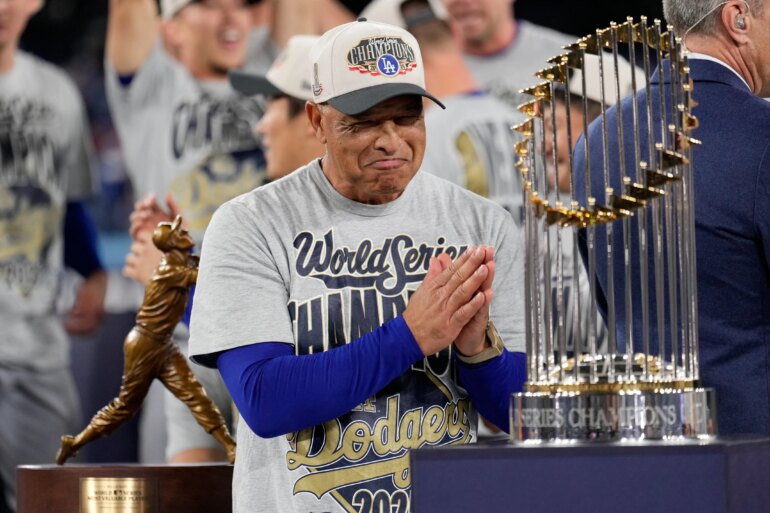
The Dodgers are the best team in baseball. And maybe just too good for baseball to continue as is.
That’s because the back-to-back World Series champions have such a huge lead in payroll that they might trigger a lockout.
Allow me to explain.
For many years, I’ve enjoyed watching games from my season ticket seats in Dodger Stadium, on the Loge level, behind home plate.
Ten games a season is enough to feel the rhythm of a year.
I’ve watched Mookie Betts justify every dollar of his $365 million contract. I’ve seen the organization structure Shohei Ohtani’s $700 million deal — with massive deferrals that dramatically reduce the present luxury-tax hit — to preserve long-term flexibility.
Download The California Post App, follow us on social, and subscribe to our newsletters
California Post News: Facebook, Instagram, TikTok, X, YouTube, WhatsApp, LinkedIn
California Post Sports Facebook, Instagram, TikTok, YouTube, X
California Post Opinion
California Post Newsletters: Sign up here!
California Post App: Download here!
Home delivery: Sign up here!
Page Six Hollywood: Sign up here!
I’ve watched the Dodgers commit $325 million to Yoshinobu Yamamoto, because frontline pitching wins in October. They extended Will Smith for $140 million. They gave Tyler Glasnow $136.5 million to anchor the rotation.
That’s not reckless spending. That’s calculated ambition.
And now that ambition has made the Dodgers the symbol in a fight that could trip up the entire sport.
But this isn’t just about payroll.
It’s about whether Major League Baseball is headed toward a salary cap battle that could ignite another labor war.
The Dodgers treat the Competitive Balance Tax as a cost of doing business. They structure contracts creatively. They absorb penalties. They build rosters designed not just to survive the brutal reality of 162 games, but also to play world champion-level postseason baseball.
That’s legal. It’s within the rules owners negotiated.
But for many owners, it’s become Exhibit A.
Owners argue that if one franchise can stack massive long-term commitments and still push payroll into historic territory, competitive balance suffers. Fans in smaller markets lose hope. A hard salary cap — paired with a floor — would restore fairness.
It sounds tidy. It isn’t.
Baseball already has a spending restraint: the luxury tax. Blow past the thresholds, and you pay escalating penalties.
The Dodgers pay. Other teams choose not to.
Spending isn’t mandatory. The system allows ambition — it doesn’t require it.
A hard cap changes that permanently. It doesn’t tax spending. It prohibits it.
Players view that as institutionalized collusion. Owners frame it as reform. That divide defines the coming negotiations.
The current labor agreement expires after the 2026 season. Negotiations are approaching.
Some owners have begun publicly floating structural changes. The players’ union has made clear it will never agree to a hard cap.
That’s not a minor disagreement. That’s a collision course.
If either side digs in — and history says that both will — baseball risks another lockout once the deal expires. We’ve seen that movie before.
And make no mistake: The Dodgers are central to the narrative shaping this fight.
When the Dodgers — along with a handful of other high-payroll teams, like the Mets — push the system’s limits, and turn that ambition into sustained championship contention, it sharpens the contrast.
It forces the uncomfortable question: Is the problem that Los Angeles spends too much, or that others spend too little?

As someone who invests my time and money into watching this team, I reject the idea that ambition is a disease.
Spending doesn’t guarantee a title. October proves that every year. A hot wild card team can torch a 100-win powerhouse in five games.
What spending buys is margin for error.
It buys depth when elbows give out in May. It buys insurance against slumps in August. It buys flexibility at the trade deadline rather than surrendering.
That isn’t a loophole. It’s competitiveness. And in LA, it’s good business.
Dodger Stadium remains one of the league’s attendance leaders. The brand moves merchandise nationwide. Premium ticket pricing holds because fans believe ownership is trying to win every year. October baseball becomes a civic event.
That investment is paying off — not just in the standings, but on the balance sheet.
Other owners should notice. Ambition isn’t a threat to the business model. It is the business model.
If other owners feel boxed out, they have options: invest more, draft better, develop smarter — or stop pocketing revenue-sharing checks while selling fans a five-year rebuild.
But a salary cap isn’t about smarter competition. It’s about cost certainty.
Once a hard ceiling is installed, it doesn’t just limit the Dodgers. It permanently reshapes the labor market. It caps what every star and breakout player can earn across the sport.
That’s why the union views it as existential.
The Dodgers didn’t create this dispute. But they’ve exposed it.
If baseball shuts down again, it won’t be because Los Angeles tried too hard.
It will be because some ownership groups around the league don’t want to invest aggressively in their teams — and don’t want others to be able to, either.
Jon Fleischman is a lifelong Dodgers fan and a political analyst. He writes at http://www.SoDoesItMatter.com.