
🔴 Website 👉 https://u-s-news.com/
Telegram 👉 https://t.me/usnewscom_channel
OAN Commentary by: Theodore R. Malloch
Wednesday, December 3, 2025
Gamay is a purple-colored grape variety used to make red wines, most notably grown in Beaujolais and in the Loire Valley. It is a very old cultivar, mentioned as long ago as the 14th century. It has been often cultivated because it makes for abundant production; however, it also produces wines of distinction when planted on acidic soils.
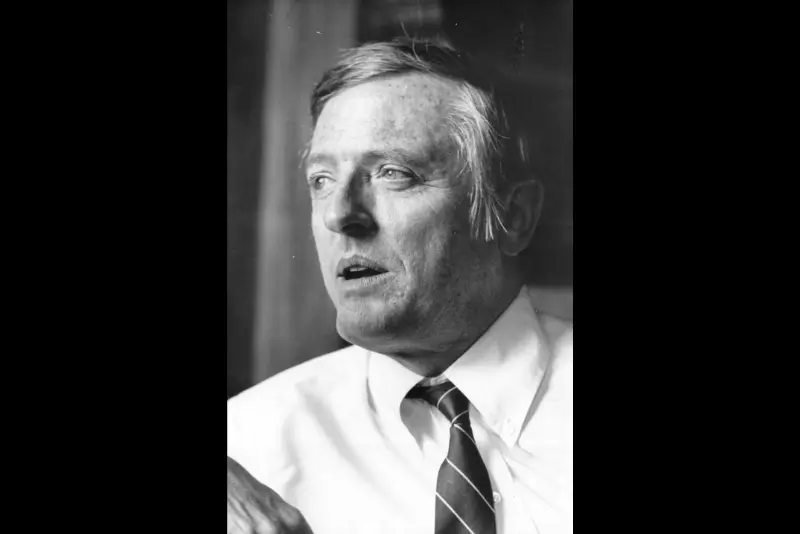
In 1951, a twenty-five-year-old Yale graduate published his first book, also now called GAMAY (God and Man at Yale), which exposed the extraordinarily irresponsible educational attitude that prevailed at his ancient alma mater. That book rocked the academic world and catapulted its young author, the highly productive, William F. Buckley Jr., into the public spotlight.
This seminal and acidic work of one of the most courageous conservative thinkers of the 20th and 21st centuries also laid the groundwork on which numerous other media voices and indeed, modern conservatism itself was built.
Buckley described how it all started when he was an undergraduate at Yale University from 1946 -1950. He wrote from his conscience. Buckley was very precise in describing how he felt traditional American values were being ignored, undermined, and distorted by academics. He made his case by citing specific classes, instructors, and textbooks.
Buckley earned the right to be the quintessential role model for conservatives because of his courage and gift of clearly communicating his argument in a logical manner. He was a master debater.
Advertisement
There were no ad hominem fallacies. He confronted issues head on. He even discussed his motive for writing the book by saying it was tied to his love for his alma mater and the country, in general. By that he meant his desire was for constructive change. It was in pointing out the errors that he hoped to achieve the positive resolutions he sought. He maintained this perspective his entire career and as a public intellectual.
Buckley remained a voice worthy of an audience in the marketplace of ideas for many decades. God & Man at Yale was the book that launched him and conservatism in America.
Buckley set the stage for what has become the most vibrant political and cultural force of our time: conservatism. Many forces made this phenomenon happen and those forces have influenced American culture, politics, economics, foreign policy, and all the other sectors of American life.
The rise of conservatism in these United States over the past eight decades has been one of the most important political developments of the age — not only for America, but also for the world. So, let’s raise a glass of our own Gamay, and go back in time to see how it all began—right there at Yale! Let’s praise the one and only: Bill Buckley on his 100th birthday.
I led the panel discussion at Yale twenty years ago celebrating Buckley then. He stands even taller today. Having grown up in a Philadelphia Presbyterian family of some grace that weekly watched Buckley’s, Firing Line, I have been steeped in Buckley’s mannerisms, wit, and charm from my youth. His zealous Catholicism didn’t always appeal but his razor-sharp mind and way with words became a legend. I met Buckley numerous times, and he was as good or better in person than on television.
It was in 1972 when I was a young undergraduate, at the height of the Vietnam protests, that I still fondly remember Bickley debating the Marxist pseudo-historian, Howard Zinn at Tufts University. The leftwing student activist crowd was pro-Zinn, but Buckley annihilated him. I saw another debate he had with the Socialist Prime Minister of Jamaica, Michael Manley, and the same occurred.
Many of us grew up reading The National Review now a fraction of what it once was and blatantly anti-Trump today. It helped groom a whole generation of conservative thinkers, thanks to its editor in chief, Buckley.
My two best recollections of Bill Buckley are the correspondence we had about the movie, Chariots Of Fire, I would argue the greatest film of all time. Buckley adored the Duke, who had the good sense and class to relinquish his race so that the Scottish Calvinist, Eric Liddell could avoid running on the sabbath but still take a gold medal at the 1924 Paris Olympics. I think Buckley very much saw himself in that mold.
Later in 2012, I put together and moderated a Liberty Fund seminar in one of Buckley’s favorite places, The New York Yacht Club, which as you all know, is in Newport, Rhode Island. We had about twenty of Buckley’s greatest admirers, biographers, and colleagues and we discussed his entire life’s work for three lovely days. He would have been most pleased.
As we all individually and collectively celebrate Buckley and his enormous contribution to America this season, perhaps the best way to honor him would be to raise some questions.
What would WFB say?
1. Buckley thought that the open society and the free society were not identical. In fact, he thought the open society paved the road to modern totalitarianism. Was he on target or overstating his case? What have the last two decades taught us?
2. Do you think Yale or any university for that matter is more secular and left wing now than when WFB’s call went out to withhold financial support until she ceased to undermine her student’s faith in Christianity and free markets? What can we do about it?
3. Why do you think the WASP elites ever adopted the philosophy of Buckley —that not only harmed their country but also undermined their very position as leaders of a Christian or a moral society? Is it too late?
4. WFB wrote in one of his most notorious passages in GAMAY that, “the duel between Christianity and atheism is the most important in the world and the struggle between individualism and collectivism is the same struggle reproduced on another level.” It is now later in the 21st century, in your estimation: has he been proved right or wrong?
5. GAMAY and Buckley’s entire corpus has been called a ‘testament to the power of one man to stand up for truth’. Is there such a thing any longer or has truth itself disappeared or been abandoned, relativized?
6. Why were Buckley’s critics so savage? I remind you, Ashburn, said, “under the guise of liberty Buckley attacks freedom; under the guise of knowledge, he denies the privilege of free investigation and dissent; under the guise of defending capitalism and religion he uses the technique of Dr. Goebbels; under the guise of academic freedom, he hides under the somber robes of theocracy.” Not gentle in the least. Have we lost civility, civilization, or both?


Send me your replies and we can conduct a little Buckley seminar online, if not at the still conservative, Buckley Institute at Yale.
(Views expressed by guest commentators may not reflect the views of OAN or its affiliates.)
Theodore Roosevelt Malloch is a scholar-diplomat-strategist. He has authored 18 books and taught at Yale and the University of Oxford, served at ambassadorial level for the US in the United Nations Geneva during the end of the cold war, and been a strategist to governments and many corporations. His latest book is, GREATNESS: The Trump Revolution and the Coming Golden Age for America.
What do YOU think? Click here to jump to the comments!
Sponsored Content Below