
🔴 Website 👉 https://u-s-news.com/
Telegram 👉 https://t.me/usnewscom_channel
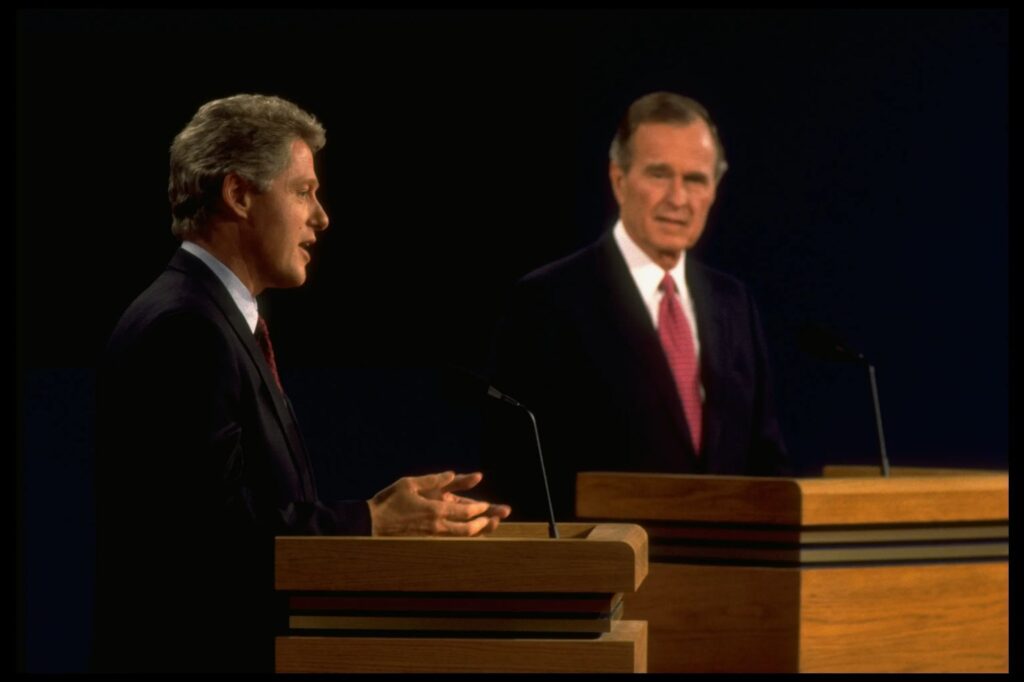
Back in 1992, as the presidential campaign approached, incumbent President George HW Bush was seen as a shoo-in for reelection.
The First Gulf War ended in 1991 with a spectacular US victory at the head of a coalition that had expelled Saddam Hussein from Kuwait with few losses.
For much of 1991, Bush’s approval ratings hovered between 90% and 70%.
By February 1992, an obscure Arkansas governor, Bill Clinton, emerged as the favorite Democratic nominee.
But he was written off as having little chance to knock off the popular Republican incumbent with far more foreign affairs experience.
Bush, however, had just lost his brilliant 1988 campaign manager, Lee Atwater, to cancer.
And third-party prairie-fire candidate Ross Perot had entered the race, drawing off conservative Bush support.
Most important, the US economy in 1990 had experienced a mild recession that had bottomed out in early 1991.
By the 1992 election, the United States was headed to full recovery.
In the last six months of 1992, GDP rebounded at an astonishing 4%.
The inflation rate in the months before the election was often less than 3%.
Even stubborn unemployment, at 7.3%, was starting to fall.
The eight-month recession officially ended in March 1991, followed by continual positive economic growth.
No matter: The canny Clinton campaign still ran on the directive “It’s the economy, stupid” and the slogan “Putting people first.”
Clinton’s theme song was the upbeat Fleetwood Mac hit “Don’t Stop,” highlighting the young Clinton-Gore ticket’s supposed contrast to the 68-year-old Bush.
Key to the Clinton campaign rhetoric was a false charge: “the worst job growth since the Great Depression.”
By November 1992, Clinton had convinced voters that the prior year’s recession was still in full force.
The doom-and-gloom, near-depression “recession” rhetoric, together with Perot’s third-party candidacy and Bush’s sluggish campaign, won Clinton the presidency with 43% of the popular vote.
In response, the Bush campaign had tried to trumpet the administration’s many foreign policy successes.
The Berlin Wall fell in November 1989.
The Cold War ended in a US victory.
Germany was reunified in October 1990.
In December 1989, Bush successfully removed the narco-dictator Manuel Noriega of Panama, who threatened the viability of the Panama Canal.
The Gulf War was won brilliantly by February 1991.
The nuclear START treaty was signed with the Soviet Union in July 1991, just before the USSR itself collapsed in December.
By any normal reckoning, Bush’s win should have been a certainty: spectacular foreign-policy successes and a rebounding economy after a brief recession that had ended 15 months before the November 1992 election.
Instead, the pseudo-recession of 1992 dominated the campaign.
Indeed, Bush’s many achievements overseas were cleverly distorted by Clinton as proof that the globe-trotting president was more interested in the world abroad than in “putting people first” at home.
As in Bush’s prior 1988 campaign, Atwater would have torn Clinton apart as inexperienced and disingenuous.


Atwater would have ordered Bush to talk nonstop about virtually no inflation, robust 4% economic growth and declining unemployment.
Instead, the lackluster Bush campaign team never caught on and was crushed.
The pseudo-recession of 1992 should remind President Donald Trump not to repeat the same mistake in the 2026 midterms.
Trump’s first 10 months of foreign policy achievements are almost as impressive as Bush’s entire four years.
He neutered the feared Iranian nuclear bomb project.
He ensured Israel could devastate the terrorist cabals of Hezbollah, Hamas and the Houthis, as well as their sponsor, theocratic Iran.
Instead of a trade war, he increased tariff revenue and signed fair trade agreements.
The border was closed shut.
Military recruitment rebounded to near-record levels.
Compared to the prior moribund Biden economy, Trump’s has set new precedents: record energy production and falling gas prices; inflation now below the 3% he inherited; and third-quarter GDP growth at a remarkable 4.3%.
But more important, 2026 may see even stronger economic growth, given a historic $10 trillion in foreign investment, tax cuts, deregulation, ever-greater energy production, huge investment in new technologies like AI and nuclear fusion, and dozens of favorable trade deals.
Yet the left, like the Clinton campaign of old, is talking nonstop about “affordability” — both ignoring the Democrats’ own dismal 2021-25 economic record and claiming Trump, like Bush, cares more about those overseas than those at home.
Whether the pseudo-recession of 2025-26 works as well as the fake 1992 recession now hinges on whether Trump learns from the past — and from now on fixates on the economy.
Victor Davis Hanson is a distinguished fellow of the Center for American Greatness.