

🔴 Website 👉 https://u-s-news.com/
Telegram 👉 https://t.me/usnewscom_channel
While Washington searches for ways to weaken Iran’s murderous rulers, our supposed NATO ally Turkey is working overtime to keep the mullahs alive — and in power.
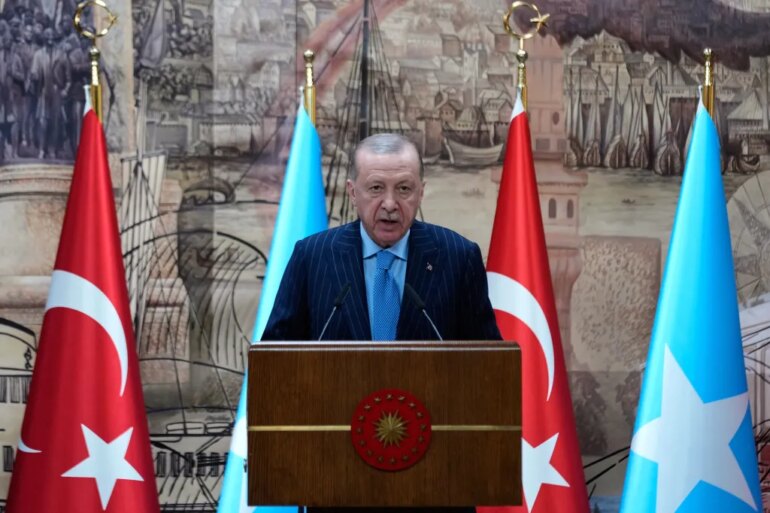
This week’s diplomatic tug-of-war over US-Iran negotiations is a win for Recep Tayyip Erdogan, Turkey’s Islamist strongman, who has led a cynical campaign to stall for time and block US and Israeli military action against the Islamic Republic after its brutal crackdown on civilian protesters.
He’s feigning concern that military action would spark “regional instability,” but his real goal is simple: Keep Iran’s theocracy from falling — and stop the emergence of a free, democratic state that would shatter his regional ambitions.
Along with Qatar and Egypt, Erdogan has reportedly proposed to both sides a three-year “deal” under which Iran would agree to limit its uranium enrichment, restrict its use of ballistic missiles and pause arms shipments to its regional allies
It would do nothing to relieve the suffering of Iran’s people.
And it would ensure the regime’s stability — allowing it to outlast President Donald Trump’s remaining time in office.
It’s a smokescreen, and Trump must not fall for it.
The president’s negotiating team should be clear-eyed: Ankara’s priority is not peace, but regime survival.
For Erdogan, a crippled Islamist regime in Tehran is far more useful than a democratic one that might align with the West.
Why? Because Iran’s terror empire benefits him.
By keeping Hezbollah in Lebanon and Hamas in Gaza armed and operational, Tehran helps Erdogan weaken Israel — a strategic obsession for the Turkish leader.
A constantly threatened Israel allows Erdogan to posture as the Middle East’s next great power broker, claiming leadership while chaos reigns.
That’s why, as US naval and air assets assemble across the region, Tehran is clinging to Ankara’s overtures — seking negotiations to avoid a final reckoning.
Europe has labeled Iran’s elite Revolutionary Guards a terrorist organization for murdering thousands of peaceful protesters.
Erdogan, however, praised Iranian President Masoud Pezeshkian for his government’s “handling” of the unrest — effectively endorsing Tehran’s claim that the demonstrations were “terrorist attacks . . . clearly directed by Israeli-linked elements.”
In doing so, Erdogan is openly empowering an enemy of the United States.
This is why Turkey rushed to offer itself as host for the talks planned for Friday: not to mediate, but to block Washington from acting.
The summit has been moved to Oman at Iran’s request — but that has not slowed Ankara’s eagerness to shield the regime.
If the talks proceed, US negotiators should be on guard.
Turkey may offer to take custody of part of Iran’s highly enriched uranium for “safekeeping” — a proposal recently floated by Ankara.
Erdogan would push this idea as a means of “conflict prevention,” but there’s no reason to believe weapons-grade uranium would be safer in Turkey’s hands than in Iran’s.
Ankara is not a benevolent ally advancing US interests, but a strategic saboteur.

If Turkey gets its way, the summit in Oman will lead to continued delays in bringing down Tehran’s regime.
Erdogan in recent days has been prepping the ground, encouraging the leaders of Saudi Arabia, Egypt, Pakistan and Qatar to insist on further rounds of “diplomatic efforts.”
In doing so, Ankara not only emboldens Iran’s despots, but constructs a collective regional effort to abandon Iran’s people — who are crying out for the chance to bring down the regime and remake Iran as a democratic ally of America and the West.
For Erdogan, preserving a weakened Islamic Republic serves one overriding purpose: blocking the emergence of a US–Israeli security order that would sideline Turkey’s ambitions.
Since late 2024, Iran’s regional position has collapsed — following Assad’s fall in Syria, the dismantling of its proxy networks, and a humiliating 12-day confrontation with Israel.
A decisive American-Israeli strike that removes Iran’s leadership would accelerate this shift — and leave Erdogan isolated in a radically new Middle East.
But a wounded regime allows Turkey to expand its influence while Israel remains consumed by Iran’s terror web.
It’s why Erdogan continues to tolerate — and at times enable — Hamas and Hezbollah as instruments to keep the Jewish state trapped in permanent crisis.
He aims not to free the Middle East from the Islamic Republic, but to sustain a zombie regime in Tehran — too weak to dominate, yet strong enough to distract his rivals and preserve Turkey’s room to maneuver.
And he’s doing it as a “NATO ally.”
Sinan Ciddi is director of the Turkey program at the Foundation for Defense of Democracies, where William Doran is a research intern.