

🔴 Website 👉 https://u-s-news.com/
Telegram 👉 https://t.me/usnewscom_channel
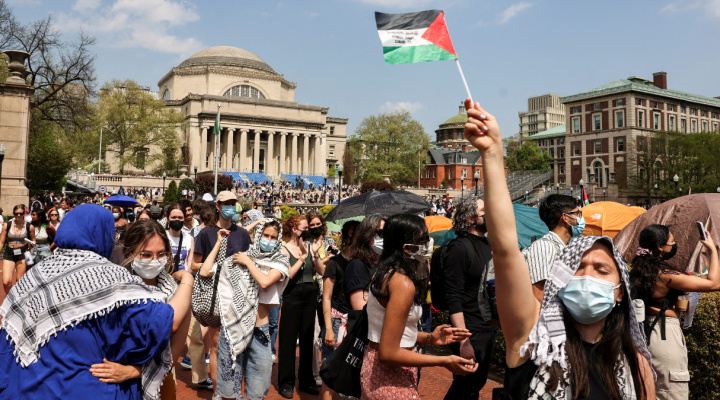
Pro-Hamas demonstrators at Columbia University in New York City, US, April 29, 2024. Photo: REUTERS/Caitlin Ochs
A recent report by the US House Committee on Education and the Workforce on antisemitism in higher education delivers a stark conclusion: In the wake of the Hamas-led Oct. 7, 2023, attack on Israel, many US campuses have shifted from being sites of debate to environments where hostility toward Jewish students is increasingly normalized. The report documents rising harassment, rhetoric that blurs into justification of violence, and a growing reluctance by university leaders to enforce their own rules when speech is framed as political activism.
That warning points to a broader institutional problem. Universities are not only struggling to respond to ideological extremism; they are also increasingly embedded in global networks of funding, influence, and political engagement. In this environment, they risk becoming more than passive hosts of debate, emerging as spaces where external conflicts are projected inward, including the strategic rivalry between Gulf states now playing out on Western campuses.
Earlier this year, the United Arab Emirates suspended government scholarships for students planning to attend British universities, citing concerns about Islamist radicalization on UK campuses. For decades, Western institutions were viewed across the Arab world as gateways to modernity — exporters of science and pluralism. Now an Arab state is signaling that those campuses may no longer be ideologically neutral.
Britain’s situation reflects long-standing policy choices. The United Kingdom does not formally designate the Muslim Brotherhood as a terrorist organization and has long served as a hub for Brotherhood-linked activism. British academia enrolls significant numbers of Qatari students and maintains financial and institutional ties with Doha, placing campuses within a broader ecosystem of Qatari engagement and soft power. That matters because Qatar and the UAE sit on opposing sides of a wider Gulf competition over political Islam.
Since the signing of the Abraham Accords in 2020, the UAE has positioned itself as a regional actor seeking stability, economic integration, and the containment of Islamist influence. Qatar, by contrast, continues to host Muslim Brotherhood figures and Hamas political leaders while expanding its global reach through media and partnerships with research institutions and universities.
The United Kingdom may have presented the most immediate concern for Emirati policymakers. But the broader question of ideological influence within Western institutions extends beyond Britain. Nowhere is that dynamic more consequential than in the United States.
Disclosures filed with the US Department of Education show that American universities have reported receiving more than $4 billion from Qatar over the past two decades, placing the Gulf state among the largest foreign funders of US higher education. Institutions such as Cornell University, Georgetown University, Northwestern University, and Texas A&M University have reported substantial Qatari funding supporting research programs, faculty, and academic centers.
Foreign partnerships and international funding are common in global higher education and do not automatically translate into political influence. The concern arises not from these relationships themselves, but from the political environment in which they operate — particularly when ideological movements tied to geopolitical actors become increasingly visible in campus activism.
Recent events on American campuses help explain why this matters. After the Oct. 7, 2023, attacks, universities including Harvard, Columbia, UCLA, and NYU witnessed demonstrations that in some cases moved beyond criticism of Israeli policy into justification of violence, calls for a “global intifada,” and rhetoric widely understood by Jewish students as eliminationist. Congressional hearings later exposed how difficult it had become for some university leaders to state clearly that calls for genocide violate campus rules when framed as political expression.

The issue is not protest itself, which is intrinsic to academic life, but ideological activism that normalizes movements rejecting liberal democratic principles. In such an environment, Gulf rivalry intersects with Western institutional hesitation, and campuses risk becoming arenas not merely of debate but of strategic signaling.
If Abu Dhabi concludes that British universities are incubating ideologies it considers destabilizing, the same logic could extend to the United States. American universities are even more globally influential than their British counterparts, educating future ministers, financiers, and opinion leaders from across the Middle East — making them higher-value terrain in any competition over ideas.
Whether the UAE would take similar measures regarding US institutions remains uncertain. The strategic partnership between Washington and Abu Dhabi is deeper than the UAE’s educational ties with Britain. And while the United States does not designate the entire Muslim Brotherhood as a Foreign Terrorist Organization, it does designate Hamas — which originated as a Palestinian branch of the Brotherhood — as a terrorist group.
The UAE’s decision regarding British scholarships should therefore be seen as part of a broader regional struggle over political Islam and the future direction of the Middle East. If that struggle is increasingly playing out on Western campuses, Americans should ask a sober question: Are their universities merely observers of this rivalry — or are they becoming its next front?
Nira Broner Worcman is a Brazilian journalist, CEO of Art Presse Communications, and author of A Sisyphean Task (translated from the Brazilian edition, Enxugando Gelo), on media coverage of the war between Israel and terrorist groups. She was a Knight Science Fellow at MIT and earned her master’s degree at NYU’s Science, Health, and Environmental Reporting Program.