
🔴 Website 👉 https://u-s-news.com/
Telegram 👉 https://t.me/usnewscom_channel
OAN Staff Brooke Mallory
2:06 PM – Monday, December 29, 2025
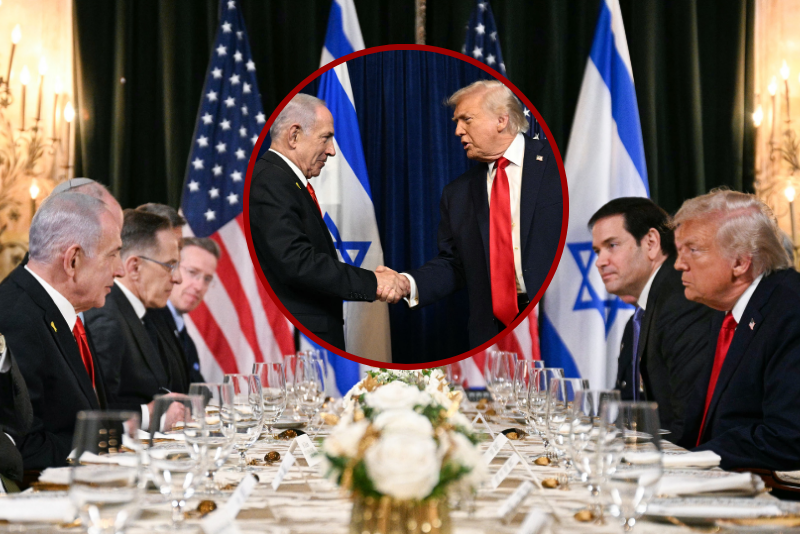
President Donald Trump welcomed Israeli Prime Minister Benjamin Netanyahu to his Mar-a-Lago resort on Monday for a closed-door meeting focused on addressing Israel’s concerns over Iran’s ballistic missile program, in addition to advancing the currently fragile Gaza ceasefire.
The meeting included a closed-door session and a working lunch, followed by a public press conference.
Netanyahu, who arrived in Florida the day before, was anticipated to push for a tougher U.S. stance on Hamas disarmament and present intelligence on Iran’s efforts to rebuild its ballistic missile capabilities, which were badly damaged in earlier strikes, but are now rumored by Israeli intelligence to be expanding.
The bilateral discussions come at a pivotal moment as the U.S.-brokered truce in Gaza — implemented in October after a devastating two-year war — still faces challenges in transitioning to its complex second phase. Ahead of the meeting, Trump told reporters that the leaders would address “five major subjects,” with Gaza prominent among them.
President Trump emphasized the need for Hamas to fully disarm before advancing further, as well as expressing optimism about Gaza’s reconstruction, which Trump noted would be beginning “pretty soon.” While the October ceasefire halted large-scale fighting, Hamas and other Islamist groups still retain weapons and capabilities, including rockets and small arms.
Ukraine
Before diving into matters pertaining to the Jewish State, a reporter asked Trump about the fresh developments happening in Ukraine, prompting Trump to disclose details of his earlier morning phone conversation with Russian President Vladimir Putin.
Trump noted that Putin had alerted him about an alleged Ukrainian drone attack on one of his presidential residences, which Putin claims occurred overnight after the U.S.-Ukraine talks with Zelensky.
“I don’t like it, it’s not good. I heard about it this morning. You know who told me about it? President Putin told me about it. Early in the morning he said he was attacked. That’s no good, it’s no good,” Trump said.
When pressed on whether U.S. intelligence had verified the attack, Trump responded that it was also “possible” the incident did not occur at all.
“Well, we’ll find out. You’re saying maybe the attack didn’t take place? That’s possible, I guess, but President Putin told me this morning.”
Russian Foreign Minister Sergei Lavrov later asserted that Moscow’s negotiating position to end its war in Ukraine was under review after the alleged attack, which he claims included 91 long-range drones. Lavrov added that all drones were destroyed by Russian air defenses, with no injuries or damage.
Trump described the call with Putin as productive, overall, but noted there remain “a few very thorny issues” to resolve in brokering a Ukraine-Russia peace deal.
According to reports, in response, Zelensky swiftly dismissed the Kremlin’s accusation as “a complete fabrication,” accusing Moscow of using the claim to undermine ongoing diplomatic efforts and justify more aggression against Ukraine.
Iran’s Ballistic Missile Production Facilities
During their meeting at Mar-a-Lago, Trump also issued a blunt warning to Tehran, stating that if Iran attempts to rebuild the nuclear facilities that were nearly destroyed in the U.S. and Israeli strikes back in June, the U.S. would “knock them down” once more.
While the June airstrikes effectively dismantled Iran’s nuclear hubs at Natanz and Fordow — a feat Trump described as “obliteration” — they left a critical gap — Iran’s ballistic missile manufacturing capabilities were not fully neutralized.
President Trump also clarified his stance on potential future military action, saying he would “absolutely” support Israeli strikes if Iran continues its ballistic missile program or tries to accelerate its nuclear path. The U.S. response would be “fast” and “immediate,” he asserted.
Despite the threats, the U.S. Commander-in-Chief added that he still believes Tehran wants to make a deal, though he noted that they likely “wish they made that deal” before the June strikes occurred.
In response to the remarks, an aide to Supreme Leader Ayatollah Ali Khamenei threatened a “harsh response beyond imagination” in the event of any new attack on Iran.
Gaza Ceasefire
The Gaza ceasefire, part of Trump’s broader peace plan, ended large-scale fighting following the Hamas-led October 7, 2023, terrorist attack on Israel. However, despite the first phase halting major hostilities, Israel still reports ongoing militant activities and delays in hostage remains returns.
The second phase envisions Israeli troop withdrawal, Hamas disarmament, establishment of interim international governance through a “Board of Peace,” and eventual reconstruction under UN oversight.
Nonetheless, differences persist. U.S. officials have expressed frustration with some “Israeli delays,” while Netanyahu insists on full completion of prior commitments, including the return of the last remaining hostage remains.
The primary delay stems from the unresolved return of the remains of the last Israeli hostage held in Gaza, identified as 24-year-old police officer Ran Gvili, who was killed and abducted during the 2023 attack. Netanyahu has insisted that Hamas must fully complete the first phase of the agreement — including handing over Gvili’s remains — before negotiations or implementation of the second phase can proceed.
This is a core commitment under the October 2025 ceasefire deal, and failure to comply represents a violation by Hamas, Israeli officials added.
On the other hand, U.S. officials have also reportedly expressed growing frustration with what they perceive as Israeli foot-dragging or tactics to stall progress, including Netanyahu’s linkage of the second phase to this single outstanding issue.
Prior to meeting Trump, Netanyahu held discussions with U.S. Secretary of State Marco Rubio and Secretary of War Pete Hegseth. The family of 24-year-old Gvili, whose remains are still in Gaza, accompanied Netanyahu and met with Trump administration officials as well.
Syria
President Trump also commented on Syria and its new leadership following the 2024 ousting of Bashar al-Assad. Trump expressed hope for improved relations between Israel and Syria’s new government.
Ahmed al-Sharaa, formerly known as Abu Mohammad al-Julani, is the President of Syria’s transitional government. He rose to power following the rapid collapse of Bashar al-Assad’s regime in December 2024, leading the military coalition that captured Damascus on December 8, 2024, ending 54 years of Assad family rule.
“I hope he’s [Netanyahu] going to get along with Syria, because the new president of Syria is working very hard to do a good job. He really is,” Trump said. “I know he’s a tough cookie, and you’re not going to get a choir boy to lead Syria. That’s the one thing I want to say.”
“I hope they’re going to get along. Because, you know, I dropped the sanctions on Syria, because otherwise they wouldn’t have had a chance. We want to see Syria survive, so we’re going to be talking about Syria too,” he added.


Netanyahu responded by emphasizing Israel’s desire for a “peaceful border” with Syria and protection against terrorism.
While the U.S. has recently embraced al-Sharaa as a stabilizing partner in the fight against ISIS, Israel has maintained a military presence in a 15-kilometer “buffer zone” inside Syria and has previously conducted airstrikes to prevent what it describes as “jihadist entrenchment” near its border.
The Israel Prize
Netanyahu also mentioned in post-meeting remarks to reporters that he formally announced Israel’s decision to award President Trump “the Israel Prize” for his “tremendous contributions to Israel and the Jewish people.”
Netanyahu noted that in the nearly 80-year history of the award, it has almost exclusively been given to Israeli citizens, emphasizing that the decision “reflects the overwhelming sentiment of Israelis across the spectrum” who view Trump as an ally.
Education Minister Yoav Kisch, whose ministry oversees the prize, also joined via a phone call during the meeting to confirm the nomination.
The 47th President will be awarded the prize for his “work in the fight against antisemitism, his contribution to promoting the return of the hostages to Israel, the recognition of Jerusalem as the capital of Israel, and his consistent support for the right of the State of Israel to defend itself,” according to a statement released by Kisch.
Stay informed! Receive breaking news alerts directly to your inbox for free. Subscribe here. https://www.oann.com/alerts
What do YOU think? Click here to jump to the comments!
Sponsored Content Below