
🔴 Website 👉 https://u-s-news.com/
Telegram 👉 https://t.me/usnewscom_channel
OAN Staff Katherine Mosack
8:45 PM – Thursday, February 5, 2026
The United States Supreme Court gave California the green light to use a new voter-approved congressional map that significantly favors Democrats, rejecting an appeal from state Republicans and the Trump administration.
The court also stated on Wednesday that the map, which will most likely give Democrats five additional seats in the House of Representatives, will go into effect before the 2026 midterm elections. California Republicans had requested to continue using the current map.
The order also follows the court’s decision to allow Texas to use a new map that would allow Republicans to pick up five additional House seats, which prompted the California measure.
In Abbott v. League of United Latin American Citizens, the lower court agreed with the plaintiffs that the “legislature’s motive was predominantly racial.” However, the majority put that ruling on hold in December, with Justice Alito stating in his opinion that “it is indisputable … that the impetus for the adoption of the Texas map (like the map subsequently adopted in California) was partisan advantage pure and simple.”
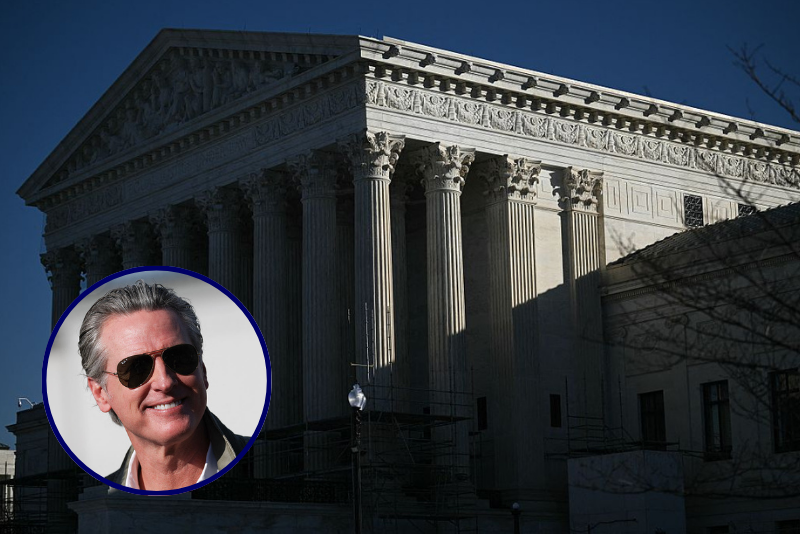
As Texas worked to approve its new map, California Governor Gavin Newsom announced the Proposition 50 ballot initiative, which was passed in a special election in November. This amended the state Constitution to allow a new map to be used from 2026 through 2030.
Shortly after, the challengers went to court to attempt to block the use of the map, arguing that it violated the Constitution by relying too heavily on race by drawing 16 congressional districts that favored Latino voters.
A divided three-judge court declined the request to continue with the old map. U.S. District Judge Josephine Staton concluded “that the evidence of any racial motivation driving redistricting is exceptionally weak, while the evidence of partisan motivations is overwhelming.”
In Tangipa v. Newsom in late January, challengers argued in the Supreme Court that the state’s goal had been “offsetting a perceived racial gerrymander in Texas.” They noted that Paul Mitchell, who drew the new map, “boasted publicly and on social media” that the new map “would maintain, if not expand, Latino voting power in California.”
“Under the guise of partisan line-drawing, California expressly used race as the ‘predominant factor’ in placing ‘a significant number of voters within or without’ Congressional District 13,” the Republicans wrote. “If left uncorrected, this pernicious and unconstitutional use of race will irreparably harm applicants and the public.”
The state countered that its challengers were “asking the Court to treat California’s map differently from how it treated Texas’s map, thereby allowing a Republican-led State to engage in partisan gerrymandering while forbidding a Democratic-led State from responding in kind.”
Justices ruled in favor of the state in a one- sentence order.
Stay informed! Receive breaking news alerts directly to your inbox for free. Subscribe here. https://www.oann.com/alerts


What do YOU think? Click here to jump to the comments!
Sponsored Content Below