

🔴 Website 👉 https://u-s-news.com/
Telegram 👉 https://t.me/usnewscom_channel
OAN Staff Brooke Mallory
12:13 PM – Monday, March 9, 2026
In a move that has since triggered a sharp rebuke from the White House, Iran’s “Assembly of Experts” officially named Mojtaba Khamenei as the country’s third Supreme Leader on Sunday.
The appointment follows the death of his father, Ayatollah Ali Khamenei, who was killed in a joint U.S.-Israeli airstrike, via Operation Epic Fury, on February 28th.
The appointment of 56-year-old Mojtaba Khamenei represents a profound and deeply controversial shift for the Islamic Republic, whose 1979 Revolution was explicitly founded on the rejection of hereditary monarchy and dynastic rule.
The revolution’s defining moments unfolded rapidly that February.
On February 1, 1979, Ayatollah Ruhollah Khomeini returned triumphantly from exile, greeted by several million jubilant supporters as he landed in Tehran. Just ten days later, on February 11th, the Pahlavi monarchy collapsed entirely. Khomeini assumed leadership as revolutionary forces and defecting troops overwhelmed loyalist units in street battles, ending centuries of imperial rule and ushering in the new Islamic order.
Mojtaba’s selection now stands in stark contrast to those founding principles, marking what many see as the emergence of a de facto family succession within the theocratic system.
Despite having never held an elected office or a senior clerical rank like “Grand Ayatollah,” Mojtaba has long been the “gray eminence” within his father’s office, analysts say, wielding immense influence over the Islamic Revolutionary Guard Corps (IRGC).
Reports indicate that the Assembly of Experts met virtually after their physical headquarters in Qom and Tehran were targeted by airstrikes. The IRGC had placed “heavy pressure” on the 88-member clerical body to ensure a swift transition, viewing Mojtaba as a symbol of “defiant consolidation” against Western intervention.
Speaking from Air Force One and later in an interview with ABC News, President Donald Trump wasted no time in dismissing the legitimacy of the new leader.
“He’s going to have to get approval from us,” President Trump said. “If he doesn’t get approval from us, he’s not going to last long. We want to make sure we don’t have to go back every 10 years.”
Despite his ongoing rhetoric regarding regime change, Trump also sought to clarify the scope of the current military campaign. Responding to concerns about a prolonged occupation, the president stated he is “nowhere near” close to ordering a large-scale ground invasion or placing “boots on the ground” — for the time being.
The transition of power to Mojtaba Khamenei is not merely a political succession. It is widely viewed by regional analysts as a moment of unprecedented existential trauma for the Islamic Republic.
The specific circumstances surrounding the death of his family — his father, sister, mother and other relatives — in the coordinated U.S.-Israeli strike, has since created a volatile psychological and political environment.
“Mojtaba didn’t just lose a leader; he lost his entire family,” noted one regional analyst. “He is now driven by a personal and existential desire for revenge, which likely eliminates any chance of the diplomatic ‘off-ramps’ the U.S. has previously offered.”
While the U.S. military has already destroyed much of Iran’s conventional air defense and naval capabilities, the IRGC remains a potent asymmetric threat, according to the White House.
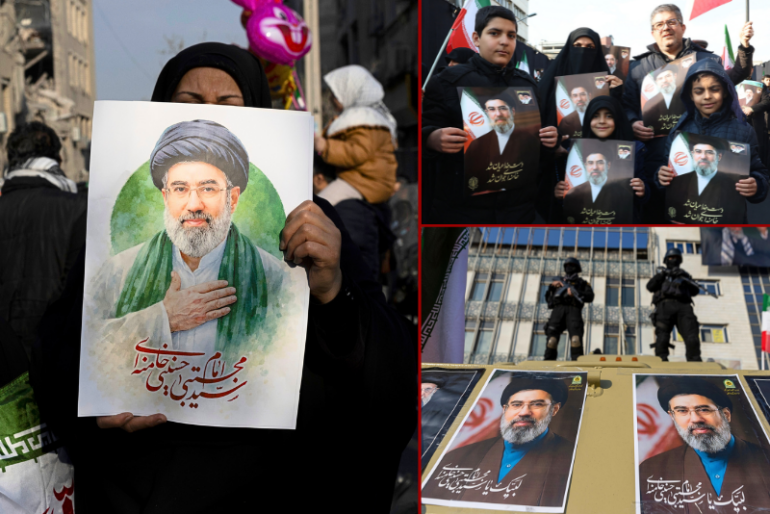
Iranian state media has already broadcast images of missiles labeled “At your command, Sayyid Mojtaba,” signaling that the new supreme leader intends to continue the fight. The successor’s full name is Sayyid Mojtaba Hosseini Khamenei, despite being commonly referred to as Mojtaba Khamenei.
Additionally, Iranian state TV reported that Mojtaba has already been wounded “by the enemy” in the “Ramadan War,” in their own words. The extent of his injuries is unknown, but Iranian sources suggest he will make a full recovery.
Mojtaba has long been the “gray eminence” within the Islamic Republic, operating as the silent power broker and primary gatekeeper to his late father’s office. Despite lacking the high-ranking religious credentials of a Grand Ayatollah, his deep-rooted ties to the Islamic Revolutionary Guard Corps (IRGC) — forged during his service in the Habib ibn Mazahir Battalion — allowed him to command immense influence over Iran’s security apparatus and vast financial networks.
His official ascension to Supreme Leader on March 8th followed a decade of grooming that culminated in a historic and tragic transition. The same February 28th airstrike that killed his father, Ayatollah Ali Khamenei, also reportedly claimed the lives of his mother, Mansoureh Khojasteh, his wife, Zahra Adel, and one of his sons.
While President Trump has dismissed his legitimacy as a “lightweight” leader, Mojtaba remains entrenched, backed by an IRGC that views his personal grief as a guarantee of his unwavering defiance against foreign intervention.
Although Trump has not ruled out the future use of ground forces specifically to secure nuclear sites in locations such as Isfahan, he has maintained that his primary goal, at this moment, is to reach a point where the Iranian leadership “cries uncle.” He reiterated that the U.S. is “nowhere near” close to sending troops on the ground.

In this context, the phrase “cries uncle” is an idiom that means to surrender, give up, or admit defeat under pressure. It stems from a traditional schoolyard game where one person holds another in a submissive position until the victim shouts “Uncle!” to signal they have had enough and concede the fight.
President Trump is describing a strategy of “Maximum Pressure” intended to achieve a specific psychological and political breaking point.
- Total submission: Trump is signaling that the American-Israeli air campaign, Operation Epic Fury, will continue until the Iranian leadership explicitly admits they can no longer resist and agrees to U.S. terms.
- Alternative to occupation: By aiming for the regime to “cry uncle,” Trump is suggesting that he believes he can force a surrender through bombardment and economic collapse alone, without the need for a long-term ground invasion or “boots on the ground.”
- The “Endgame”: In his recent statements, Trump defined his goal as reaching a point where the Islamic Republic either “cries uncle” or simply ceases to have a functioning command structure left to do so.
Ultimately, the Trump administration is seeking unconditional submission rather than a negotiated compromise.
Stay informed! Receive breaking news blasts directly to your inbox for free. Subscribe here. https://www.oann.com/alerts
What do YOU think? Click here to jump to the comments!
Sponsored Content Below