
🔴 Website 👉 https://u-s-news.com/
Telegram 👉 https://t.me/usnewscom_channel
OAN Staff Brooke Mallory
5:00 PM – Friday, March 13, 2026
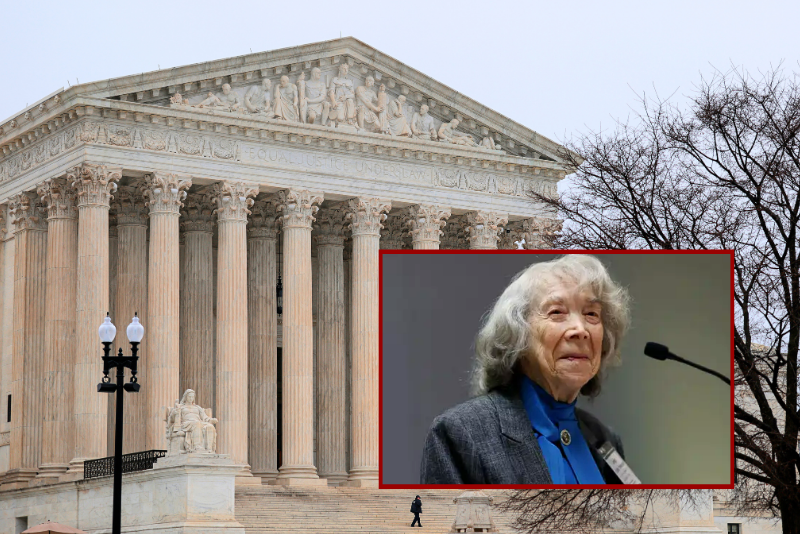
In a move that could redefine the boundaries of judicial independence and lifetime tenure, Judge Pauline Newman, the oldest active federal jurist in the United States, petitioned the U.S. Supreme Court on Thursday to overturn her years-long suspension from the bench.
Newman, 98, has been embroiled in an unprecedented legal battle with her colleagues on the U.S. Court of Appeals for the Federal Circuit since 2023.
Her petition for a writ of certiorari marks a climactic moment in a case that has pitted the 1980 Judicial Conduct and Disability Act against the constitutional protections of Article III judges.
The conflict began in March 2023 when Chief Judge Kimberly Moore initiated an investigation into Newman’s mental fitness, citing concerns about memory loss, confusion, and a backlog of cases.
Newman, a Ronald Reagan appointee who has served since 1984, refused to undergo court-mandated neuropsychological testing.
While the court viewed her refusal as “serious misconduct,” Newman and her legal team at the New Civil Liberties Alliance (NCLA) argue that the demands were unlawful. They highlighted that Newman has passed three independent psychiatric evaluations, which her lawyers argue proves she has the mental acuity of someone “decades younger.”
Her team also contends that the suspension — now in its third year — is a “constructive removal” that bypasses the constitutional requirement of congressional impeachment.
Newman’s appeal follows a string of defeats in lower courts. In August 2025, a D.C. Circuit panel ruled that it lacked the jurisdiction to review her claims, stating that the 1980 Act limits challenges to the Judicial Conference of the United States.
However, that panel also expressed “serious and important” concerns about the due process implications of her case, effectively inviting the Supreme Court of the United States (SCOTUS) to weigh in on whether the federal judiciary can shield itself from judicial review when disciplining its own.
Legal Questions for SCOTUS
| Issue | Newman’s argument |
| Jurisdiction | The 1980 Act cannot bar courts from reviewing “ultra vires” (beyond legal power) acts that violate the Constitution. |
| Separation of powers | Only Congress has the authority to remove an Article III judge. A judicial council cannot do so through indefinite suspensions. |
| Due process | It is a conflict of interest for a judge’s direct colleagues to act as the “complainant, witness, and judge” in the same case. |
Judge Newman’s absence has left the Federal Circuit — which handles all U.S. patent appeals — short-handed, according to reports. Nonetheless, beyond the specialized world of intellectual property, the case touches on a national debate regarding the “seasoned” age of high-ranking officials.
If SCOTUS takes the case, the ruling will likely establish a definitive precedent for how the judiciary handles aging judges who refuse to take “senior status,” a form of semi-retirement. For now, Newman remains a judge in name only, receiving her salary but barred from the chambers where she has spent the last 42 years.
It is a common point of confusion, but for an Article III judge, such as Newman, being “suspended” is not like a corporate suspension where pay can be docked. Under the U.S. Constitution, her salary is virtually untouchable.
Article III, Section 1 of the Constitution states that federal judges “shall, at stated Times, receive for their Services, a Compensation, which shall not be diminished during their Continuance in Office.” The Founding Fathers included this to ensure judicial independence. They feared that if Congress or the president could cut a judge’s pay, they could “starve” a judge into making specific rulings. Since Newman has not been removed from office, her salary cannot be lowered or stopped.


Stay informed! Receive breaking news alerts directly to your inbox for free. Subscribe here. https://www.oann.com/alerts
What do YOU think? Click here to jump to the comments!
Sponsored Content Below