

🔴 Website 👉 https://u-s-news.com/
Telegram 👉 https://t.me/usnewscom_channel
By STAN CHOE
Updated 7:24 AM PDT, March 23, 2026
NEW YORK (AP) — Relief is ripping through financial markets Monday after President Donald Trump said the United States has talked with Iran about a possible end to their war. Oil prices are easing, and stock prices are jumping on Wall Street following severe losses elsewhere in the world before Trump’s announcement.
The price for a barrel of Brent crude fell 10.5% to $100.37, down from nearly $120 last week, after Trump said on his social media network that the United States and Iran held productive talks the last two days “regarding a complete and total resolution of our hostilities in the Middle East.”
The S&P 500 leaped 1.9% toward its best day since well before the war began following the step down in tensions, even though Iran denied there were any negotiations.
Over the weekend, Trump had threatened to “obliterate” Iran’s power plants if it doesn’t open up the Strait of Hormuz within 48 hours. The strait has become a sore point for Trump because its near-closure by Iran has prevented oil tankers from leaving the Persian Gulf to supply customers around the world.
Trump said Monday that he is postponing attacks on Iranian power plants for five days to allow talks to continue. Still, caution remains, and the optimism in financial markets was measured. Shortly after Trump’s announcement — hours before his original deadline was set to expire — Iranian state television declared that the American leader had backed down “following Iran’s firm warning.” And a state-owned newspaper said Iran’s Foreign Ministry denied that any negotiations have taken place with the U.S.
The price of Brent crude fell as low as $96 immediately after Trump announced the postponement, but it quickly recovered a chunk of that loss. Benchmark U.S. crude had a similar reaction, immediately falling toward $84 per barrel before paring its loss and reaching $88.85.
Financial markets have had vicious swings, both up and down, since the war began because of uncertainty about how long it may last. The fear is that the war could keep so much oil and natural gas from the Persian Gulf off global markets that it sends a debilitating wave of inflation crashing through the global economy.
The frenetic swings of the past few weeks are similar, though not as dramatic, to those that hit last year when Trump shocked the global economy with his worldwide tariffs on “Liberation Day.” Many of those tariffs ended up being milder than originally threatened, and the back-and-forth in negotiations led to many jagged moves up and down.
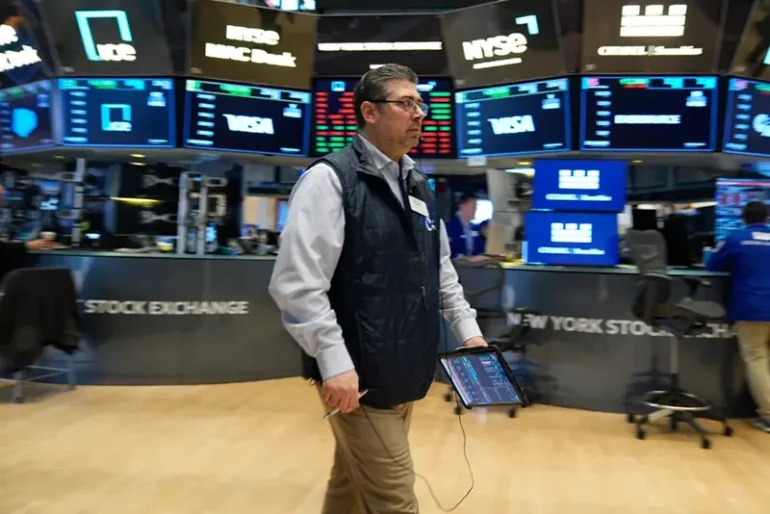
Still, Monday’s overriding reaction in financial markets was one of relief. The Dow Jones Industrial Average was up 910 points, or 2%, as of 10:15 a.m. Eastern time, and the Nasdaq composite was 2.2% higher.
In Europe, stock indexes immediately flipped from losses to gains following Trump’s announcement and then held onto them. France’s CAC 40 jumped 1.7%, and Germany’s DAX returned 2.2%.
That compares with sharp drops for Asian stock indexes, which finished trading before Trump made his announcement. South Korea’s Kospi careened 6.5% lower, Japan’s Nikkei 225 dropped 3.5% and Hong Kong’s Hang Seng fell 3.5%.
Treasury yields also eased in the bond market following Trump’s announcement. But like oil prices, they nevertheless remain well above where they were before the war began. The worry is that high oil prices could keep the Federal Reserve and other central banks from resuming their cuts to interest rates, which would give the global economy and prices for investments a boost.
The yield on the 10-year Treasury fell to 4.34% from 4.39% late Friday. But it remains solidly above its 3.97% level from just before the war.
On Wall Street, the rally was so widespread that nine out of every 10 stocks rose within the S&P 500.
At the head of the line were companies with big fuel bills that stand to benefit from any easing of oil prices. Norwegian Cruise Line Holdings surged 7.9%, while United Airlines climbed 4.5%, and American Airlines rose 4.9%. All, though, are still down for the year so far.

Stocks of smaller companies also led the market, and the Russell 2000 index of smaller stocks jumped a market-leading 3%. It had dropped last week to 10% below its record, a sharp enough drop that professional investors call it a “correction.”
AP Business Writers Yuri Kageyama, Matt Ott and Chan Ho-him contributed.
What do YOU think? Click here to jump to the comments!
Sponsored Content Below