

🔴 Website 👉 https://u-s-news.com/
Telegram 👉 https://t.me/usnewscom_channel
By Nora Eckert
December 16, 2025 – 8:34 AM PST
DETROIT (Reuters) – Ford CEO Jim Farley walked through Ford’s Michigan design studio Monday afternoon, reflecting on how he was about to wipe out thousands of work hours on electric vehicles that he and his team had hoped would revolutionize the American auto industry.
Shortly after, his company announced it would kill several of those battery-powered models and take a $19.5 billion writedown on EV-related assets. It marked the industry’s biggest electric-vehicle retreat since U.S. President Donald Trump’s sweeping auto-policy changes iced already cooling EV demand.
Farley had spent years telling staff and investors that catching up to Tesla and China’s leading EV makers amounted to an existential struggle. Now – after losing about $13 billion on EVs since 2023 – Farley says the path to survival lies in ditching these unprofitable models.
“We can’t allocate money for things that will not make money,” he told Reuters on Monday. “As much as I love those products, the customers in the U.S. were not going to pay for them. And that was the end of that.”
Farley’s angst reflects the broader conundrum facing auto executives in the wake of Trump-administration policies that stripped the industry of EV subsidies and eased restrictions on tailpipe pollution.
Most automakers now can’t sell EVs in the U.S. profitably or in volume – but must sell them in China, Europe and other markets to appease regulators and compete with Chinese automakers expanding globally.
That’s left Ford (F.N) and other automakers with the challenge of tailoring vastly different vehicle lineups for different regions.
The approach layers on extra expenses the industry thought it had left behind in recent decades through globalization – making essentially the same car, with common supply chains, to sell worldwide. Fifteen years ago, then-CEO Alan Mulally called the strategy ‘One Ford.’
Now Farley needs many Fords. His company and others have been turning to partnerships to absorb the extra costs of catering to different global markets. Renault (RENA.PA) and Ford earlier this month announced they would partner to build affordable EVs for Europe.
Following the partnership announcement, Ford said Monday it won’t build the electric commercial van it initially planned for that market. Ford has also been seeking a Chinese partner to provide EV platform technologies, Reuters has reported.
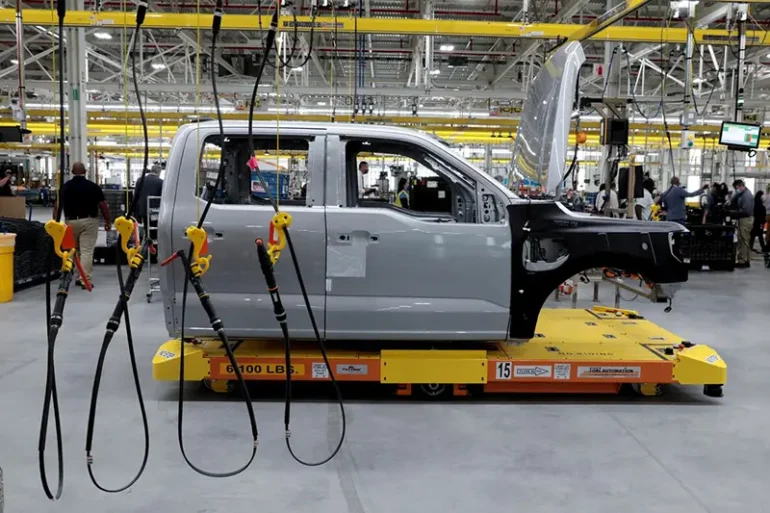
On EVs, Farley hopes to thread the needle by killing most EV models but preserving a $30,000 midsize electric truck due out in 2027, which a specialized skunkworks team in California has engineered to take on EV powerhouses Tesla (TSLA.O) and China’s BYD (002594.SZ).
“As a global company competing against the Chinese and others, we do not have time,” Farley said.
Michael Dunne, a consultant and former General Motors (GM.N) executive who spent years in China, said U.S. automakers have little choice but to balance raking in U.S. profits from gas-powered trucks while competing overseas with Chinese and other EV makers.
“EVs are not going to go away,” Dunne said. “So are we going to compete globally or are we just going to stay at home?”
GOVERNMENT SUPPORT DRIVES ELECTRIC CARS
U.S. electric-vehicle sales have dropped sharply since the Sept. 30 expiration of a $7,500-per-car consumer tax credit, killed in Trump-supported legislation.
That and other administration policies have cemented America’s status as an EV laggard relative to the world’s two other largest car markets. In China, EVs and plug-in hybrids account for roughly half of sales; in Europe, they comprise around 25%. U.S. sales sank to around 5% after Trump policies took effect.
Ford’s writedown reflects “a broader industry reckoning” that EV economics still don’t work without government support, said Stephanie Valdez Streaty, Cox Automotive’s director of industry insights.
Other automakers are grappling with those brutal economics.
GM in October recorded a $1.6 billion charge as it scaled back EV plans and warned more charges would follow. It is also retooling EV factories into gasoline-vehicle production hubs. Citigroup analysts said they expect GM’s charges ultimately to be less than Ford’s. GM has passed Ford in EV sales, although analysts estimate the company continues to lose billions on them.
GM had dismissed gas-electric hybrids as a waste of capital while it leaned into a lineup of about a dozen EVs for U.S. customers, which had started to gain sales traction just before Trump policies took hold. Now some of GM’s biggest U.S. competitors, Ford and Toyota, are leaning heavily into hybrids and seeing sales grow rapidly as consumers turn away from fully electric vehicles.
As Ford dropped most EV models, it nonetheless vowed that half its global sales volume by 2030 would consist of EVs, hybrids or so-called “extended-range” electric models, in which a small gasoline engine is used to recharge the large battery. Those models total 17% today. If current consumer trends hold, the vast majority of those vehicles will be hybrids with no charging plug, which vastly outsell plug-ins.
Hybrids already account for nearly half of all U.S. sales for Toyota, which in recent years took heavy criticism for sticking with hybrids over EVs. Elliot Johnson, chief investment officer at Evolve ETFs, which holds Ford shares, cheered the Detroit automaker’s move to follow Toyota’s lead.

“Hybrids are the future for legacy automakers,” Johnson said, offering automakers an easier path to transition existing customers to electrified models without charging hassles.
Stellantis (STLAM.MI) is battling to regain U.S. market share by focusing on hybrids and prioritizing sales of fleet vehicles. Volkswagen (VOWG.DE) carved out its standalone EV company Scout to tackle the electric market while leaning on partners Rivian (RIVN.O) and Chinese EV maker Xpeng to develop software.
Representatives for Stellantis and Volkswagen declined to comment. A GM spokesman pointed to its previously disclosed plans to offer plug-in hybrids. A White House spokesperson didn’t respond to requests for comment.
When asked what factors contributed most to the massive move, from waning consumer interest in EVs to Trump’s policy shifts, Farley said it was difficult to give specific weight to any of them. “It’s not one thing. It’s actually a combination of all of them.”
While the EV market has been tough for a while, Farley said pressure has increased recently to take action.
“Over the last several months,” he said, “it became really clear to the team. We’ve got to make a change.”
Reporting by Nora Eckert in Detroit, Additional reporting by Abhirup Roy in San Francisco and David Shepardson in Washington; Editing by Mike Colias, Brian Thevenot and Nick Zieminski
What do YOU think? Click here to jump to the comments!
Sponsored Content Below