
🔴 Website 👉 https://u-s-news.com/
Telegram 👉 https://t.me/usnewscom_channel
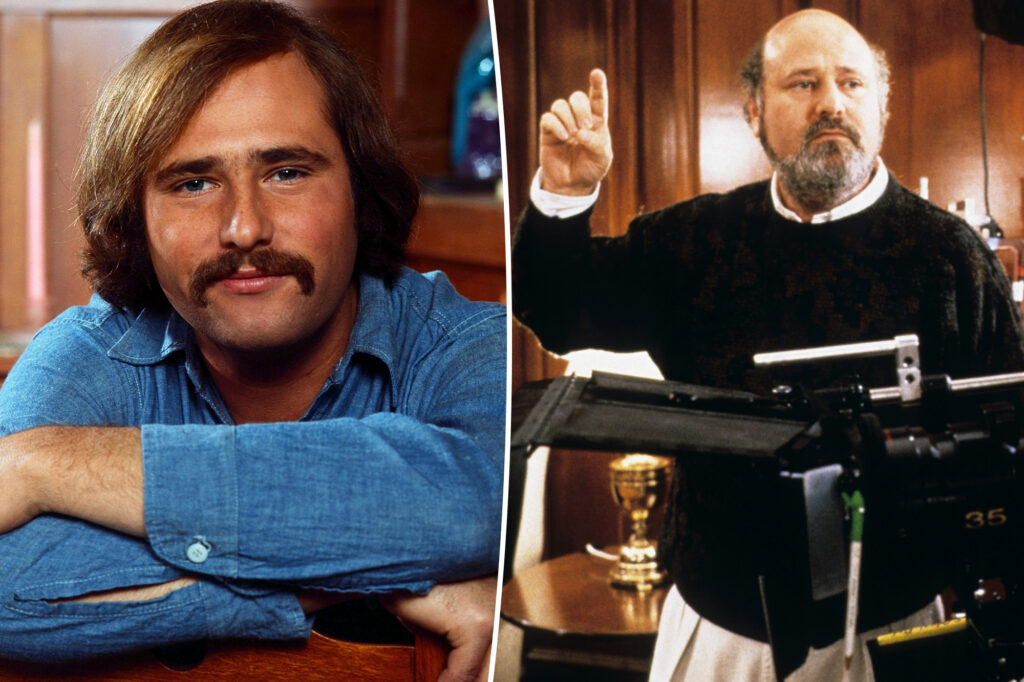
Rob Reiner, the director behind some of Hollywood’s most beloved and endlessly rewatchable movies, has died at 78.
Reiner’s death closes the book on a prolific career built on movies that stayed with audiences. His films didn’t rely on visual tricks or showy direction. Instead, he trusted scripts, actors and stories that let the work speak for itself.
“He addressed each movie on its own terms,” TV critic Alan Sepinwall told The Post. “There are a lot of celebrated directors whose work you look at and can always recognize as theirs. Reiner didn’t have a house style and bent his approach to what that film needed.”
“[People have expressed] disbelief that the same man had made films as varied as ‘Stand by Me’ and ‘A Few Good Men,’” he added.
That approach produced one of the most reliable runs in modern Hollywood.
But long before he was behind the camera, Reiner was in front of it.
He first rose to prominence playing Michael “Meathead” Stivic on “All in the Family” from 1971 to 1979, a role he landed after impressing creator Norman Lear with his comedic acting chops.
Starring opposite Carroll O’Connor, Jean Stapleton and Sally Struthers, the sitcom’s sharp writing and grounded performances gave Reiner early lessons in what would become his directorial touchstones.
“Rob Reiner would jump right in,” Struthers recently told The Post. “We started to call him ‘The Sultan of Slice’ because he knew immediately what line to cut without affecting a joke or the plot.”
“Rob said, ‘I know that we’re the same age, and I have no business instructing you. But, I see how disappointing it is for you when you lose a line or two, and nobody writes for you the delicious arguments like I get to do with Archie,’” she added.
Reiner’s first major success as a director was 1984’s “This Is Spinal Tap,” a mockumentary about a fictional British heavy-metal band that many viewers were convinced was real. Co-written with Christopher Guest, Michael McKean and Harry Shearer, the film plays like a real doc gone hilariously off the rails.
Without winking at the audience, it mined comedy from the band’s dedication to its own chaos, inspiring imitators across film and TV and helping define the mockumentary genre.
“I mean, it started out actually slow,” Reiner told Page Six in July. “People didn’t quite get it at first. They thought it was a real documentary about a real band.”
Guest and his wife, Jamie Lee Curtis, told The Post that they are “numb and sad and shocked” following the loss of their “great friend.”
In 1985, Reiner hit a very different tone with “The Sure Thing,” a breezy road-trip romantic comedy starring John Cusack and Daphne Zuniga. Cusack’s lovable slacker and Zuniga’s more grounded counterpart make for a pairing that helped set the stage for Reiner’s smarter-than-expected take on love and adventure.
In 1986, Reiner delivered one of his most enduring works with “Stand by Me.”
Based on a Stephen King novella, the film follows four boys — played by Wil Wheaton, River Phoenix, Corey Feldman and Jerry O’Connell — who hit the road in search of a missing teen’s body.
The movie isn’t just about the journey but about the vulnerability, humor and heartbreak of growing up. Reiner cited it as one of the most meaningful projects he ever worked on.
“I don’t know if it’s the best film or not, but it means the most to me,” he told Jewish Daily Forward in 2016. “It was the first time I did a film that was really reflective of my personality and sensibility. It has humor to it, but it also has this sad, melancholy aspect to it, and that’s kind of a mixture of what I am.”
O’Connell thanked Reiner for all that he provided the young co-stars nearly 40 years ago.
“Everything I have in my life is because of Rob Reiner,” he shared on Monday. “Everything I have, my children, my wife, my, just everything.”
King, who remembered Reiner as a “wonderful friend” and “brilliant filmmaker” in an X post, simply wrote: “You always stood by me.”
Reiner’s next project, 1987’s “The Princess Bride,” blended fairy-tale adventure with wit, romance and heart. With an ensemble including Cary Elwes, Robin Wright, Mandy Patinkin, André the Giant and Wallace Shawn, the film managed to be sincere and funny at the same time.
It wasn’t an instant blockbuster, but through home video and repeated viewings, it became one of those rare movies loved by both kids and adults that is still quoted and referenced decades later.
“I have a lot of things that I think about,” Reiner said of the film in 2014. “I love satire, I love romance, comedy, drama – I like all these things, and I try to find ways to make movies that I can use as many of these elements as possible and to put that all together.”
He added, “I think the best one that used all of them was ‘The Princess Bride.’”
Then came Nora Ephron’s “When Harry Met Sally” in 1989, starring Billy Crystal and Meg Ryan.
The romantic comedy asked a simple question — can men and women just be friends? — and answered it with sharp dialogue and performances that sparked endless discussion. Its influence on the rom-com genre can still be felt today.
Although Reiner was initially hesitant to cast Crystal in the lead role because they were such close friends, he never regretted the decision.
“Whenever you do something this personal and you’re best friends, if it doesn’t work, it’s like, ‘Oy!’” the late filmmaker told People in 2019. “Finally I said, ‘Aw, f–k it; he’s perfect!’”
Reiner also credited Crystal with coming up with one of the film’s most famous lines, which was ultimately spoken by the filmmaker’s mother Estelle — who happened to be on set that day.
“‘I’ll have what she’s having.’ My mother says that line,” Reiner quipped.
In 1990, Reiner took a much darker turn with “Misery,” based on another King novel.
James Caan stars as a novelist held captive by an obsessed fan, played by Kathy Bates, in a performance that won her an Oscar.
“I loved Rob,” Bates told The Post after Reiner’s death. “He was brilliant and kind, a man who made films of every genre to challenge himself as an artist. He changed the course of my life.”


Two years later, he directed “A Few Good Men,” a courtroom drama that became one of the most talked-about films of the early 1990s.
With a cast led by Tom Cruise, Jack Nicholson and Demi Moore, the movie leaned into moral conflict and rhetorical muscle, underscoring Reiner’s instinct for performance-driven storytelling.
Reiner praised Nicholson’s performance as Col. Nathan Jessep and shared an amusing anecdote from the film’s most famous scene, which comes when Nicholson shouts, “You want the truth? You can’t handle the truth!” at Cruise’s Lt. Daniel Kaffee.
“Every single time off camera, he gave the exact same performance as you’re seeing now,” Reiner told PeopleTV in 2018. “We did it five, six, seven times, and I kept saying, ‘Jack, why don’t you save a little bit for when we come around?’”
“He said, ‘You don’t understand Rob, I love to act. And I don’t get that much of a chance with great parts like this,’” the late director added in his best Nicholson impression. “It was exactly the same performance.”
But Reiner didn’t stop there.
In 1995, he directed “The American President,” a romantic drama starring Michael Douglas, Annette Bening and Michael J. Fox that blended political life with personal vulnerability.
The film struck a chord with audiences looking for a romantic take on public life.
He followed that with the thriller “Ghosts of Mississippi,” starring Alec Baldwin and Whoopi Goldberg, a historical drama focused on the long-delayed prosecution connected to the assassination of civil rights leader Medgar Evers.
Reiner showed again that he wasn’t afraid to take on weightier material.
“Rob Reiner had maybe the greatest opening stretch of movies a director has ever had,” Sepinwall told The Post. “His first seven films included all-time classics, all of which have a good argument for being the best example of their particular type of movie.”
“As a director, Reiner chose great collaborators, like Christopher Guest, William Goldman, and Nora Ephron. He had a great eye for casting, giving early major parts to people like Kathy Bates, John Cusack, and River Phoenix,” he added.
Reiner’s later films included “The Story of Us” (1999), a character study of marriage starring Bruce Willis and Michelle Pfeiffer; “Rumor Has It” (2005), with Jennifer Aniston, Kevin Costner and Shirley MacLaine; and, in 2007, “The Bucket List,” which paired Nicholson and Morgan Freeman as two older men chasing life’s last adventures.
The latter became a commercial hit and introduced Reiner’s work to a new generation.
In recent years, Reiner returned to his roots in comedy with “Spinal Tap II: The End Continues,” a sequel that revived the beloved fictional band decades later.
While there was never one style that defined Reiner as a director, there was a pattern: movies audiences didn’t just see once.