
🔴 Website 👉 https://u-s-news.com/
Telegram 👉 https://t.me/usnewscom_channel
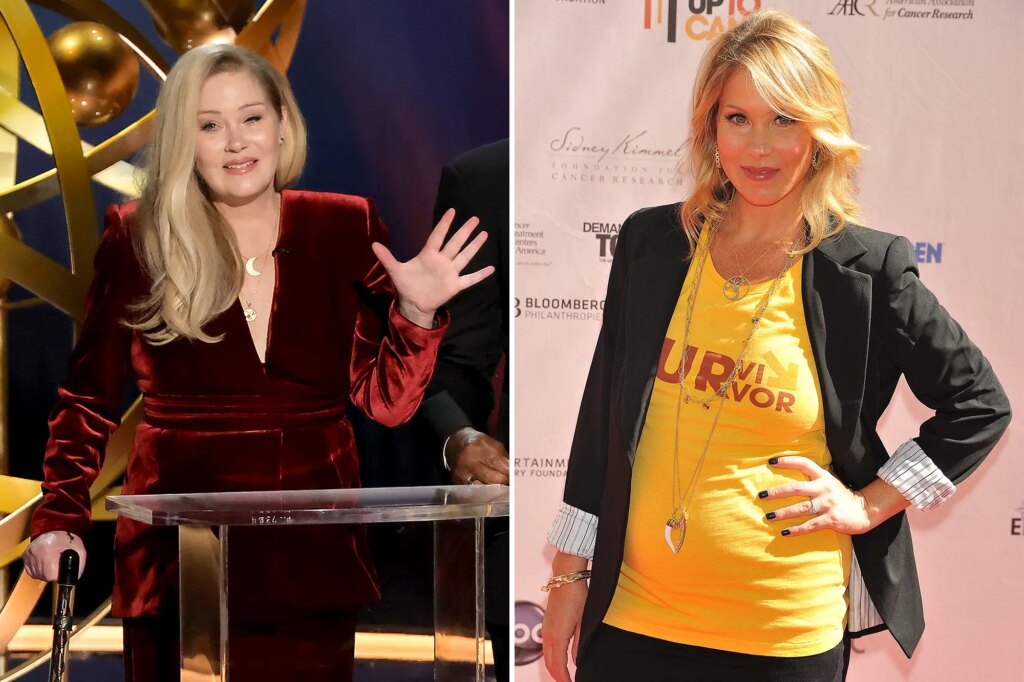
Christina Applegate’s unflinching honesty about life with multiple sclerosis (MS) has a backstory — and it’s rooted in regret.
Before she faced the autoimmune disease, the Emmy-winning actress battled breast cancer, and one choice she made during that fight would haunt her for years.
“Frankly, I was disgusted by what came out of my mouth,” Applegate, 54, wrote in her new memoir, “You With the Sad Eyes.”
The “Married … With Children” star was just 36 when a routine MRI in 2008 revealed early-stage breast cancer.
Finding out she carried a BRCA1 mutation — a genetic trait that drastically increases cancer risk — Applegate made the gut-wrenching decision to undergo a double mastectomy and was later declared cancer-free.
Determined to turn her pain into purpose, she went public with her story and even launched an organization to raise awareness about early detection and help high-risk women afford screenings.
“It was my way of coping with how brokenhearted I was to lose my breasts,” Applegate wrote.
“To this day, I feel emotionally and physically mangled by what I went through, but the organization mitigates the terrible loss I felt and feel,” she continued. “But there are other ways I know I hurt instead of helped, both others and myself.”
“I was acting like Little Ms. Warrior, but that’s not how I really felt.”
Christina Applegate
One glaring example? Her appearance on “The Oprah Winfrey Show” just a month after her surgery.
“It should have been a moment to share the truth,” Applegate writes. Instead, “I thought I should tell everyone that it was a blessing.”
That advice came from fellow breast cancer survivor Melissa Etheridge.
“Christina, this is a blessing that’s happened to you in your life,” the singer-songwriter told her. “Right now, you get to start over, to change everything.”
But looking back, Applegate isn’t buying it.
“Here’s how I feel about that interview now,” she writes bluntly. “It was bulls—t.”
While she was grateful to Oprah for the platform, the “Dead to Me” actress now says she squandered the moment.
“I had lied, thinking I was being uplifting,” she admitted. “I was acting like Little Ms. Warrior, but that’s not how I really felt.”
Instead of helping, she fears she hurt the very women she wanted to inspire.
“There I was, talking about f—king blessings when they were going through a living hell,” Applegate wrote. “I was setting up a paragon that no one going through cancer could ever rightly live up to.”
During the interview, she even highlighted how far plastic surgery had come since her mother’s own cancer battle, quipping, “They can make some very pretty boobies.”


Applegate struck a similar tone in other sit-downs, including one with Robin Roberts, another breast cancer survivor. But behind the brave face, she was facing another reality.
“The truth was, I was alone and sad and mourning something that is the most intimate and devastating of amputations, and no amount of plastic surgery can ever make up for it,” Applegate wrote.
That hard lesson stayed with her — and it would go on to shape how she faced her multiple sclerosis diagnosis in June 2021, at age 49.
MS is a chronic autoimmune disease that attacks myelin — the protective coating around nerve fibers — causing inflammation and scrambling signals between the brain and body.
Nearly 1 million Americans live with it, and women are about three times more likely than men to be diagnosed.
The condition can strike unpredictably and cause a wide range of symptoms, including extreme fatigue, chronic pain, muscle weakness, vision problems, mobility struggles and even incontinence.
“I’m not going to lie anymore. MS sucks,” Applegate wrote. “It’s not like you can get rid of the cancer, get breast reconstruction and move on, which was certainly how I described my journey to Oprah, Robin and others.”
Now, Applegate believes facing the truth head-on is the best way to support anyone battling a devastating diagnosis.
“We need to stop ramming blessings down the throats of people in distress. That’s not how we help people,” she wrote “We help people by radical, thoughtful honesty.”